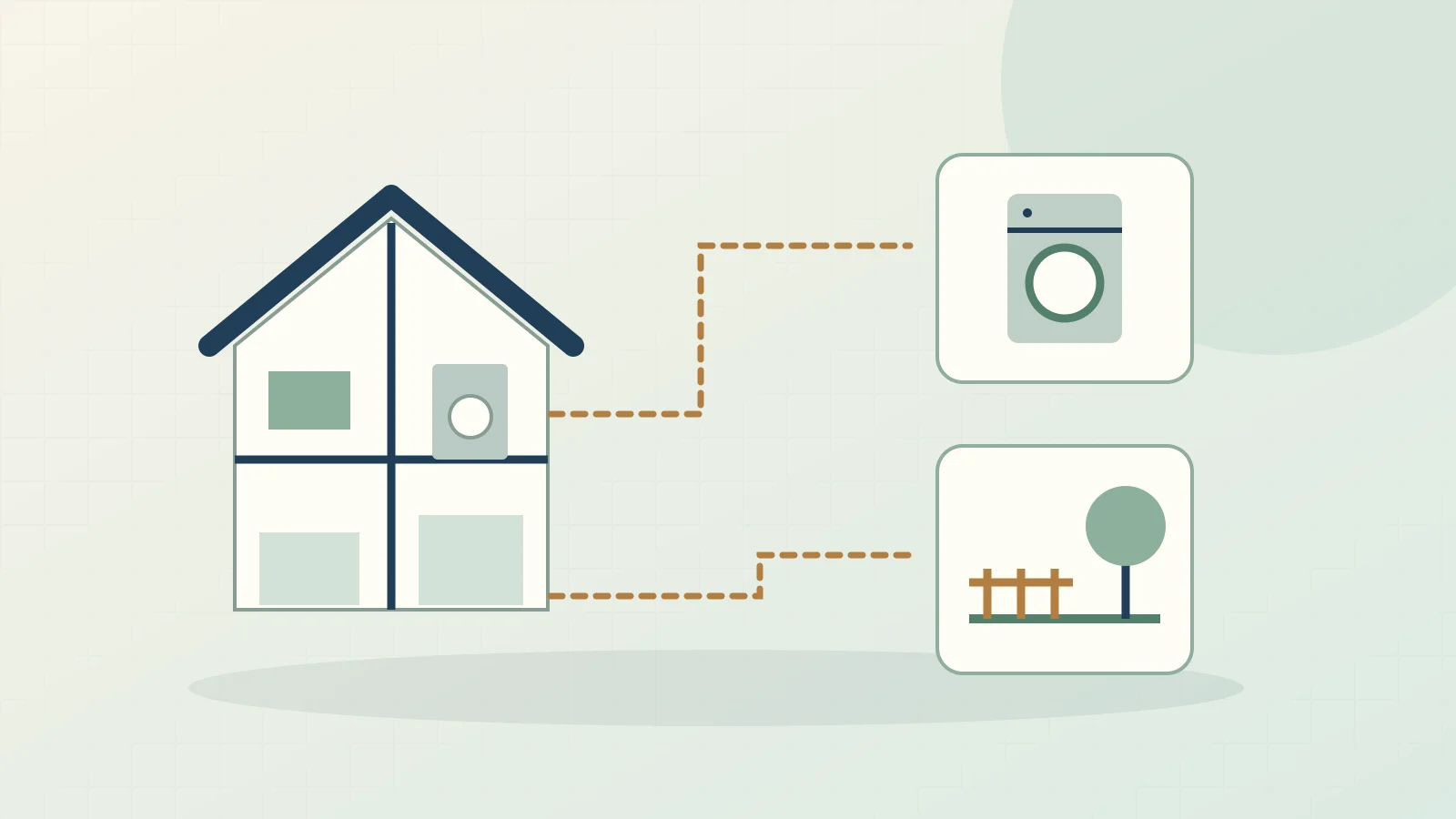
Cost segregation moves eligible rental components onto shorter depreciation schedules. It can bring deductions forward, but a large deduction is only useful if you can claim it. Check your usable tax benefit, study fee and eventual sale tax before ordering a report.
Regular depreciation and what a study changes
When you buy a rental, you cannot deduct the purchase price. You split it between land and building, and only the building is depreciable. Under the usual general depreciation system, a residential rental structure is depreciated straight line over 27.5 years and a nonresidential building over 39 years. Property required to use the alternative depreciation system needs a separate calculation. Land is never depreciable.
Example: you buy a single family rental for $400,000 and 20% of the value is land. That leaves a building basis of $320,000.
- $320,000 / 27.5 = $11,636 of depreciation per full year
The first and last years are prorated because of the mid-month convention, which only gives you credit from the middle of the month you placed the property in service. You can run your own numbers in the depreciation calculator. The wider picture is in the real estate tax strategy guide.
What a study reclassifies
A building is more than a structure. Some of what you bought is equipment and finishes that wear out fast, and some of it is site work outside the walls. The tax code gives those pieces shorter lives, and a cost segregation study is the documentation that supports treating them separately.
| Class | Typical items in a rental | How it is depreciated |
|---|---|---|
| 5 year property | Appliances, carpet and removable flooring, window coverings, some cabinetry and dedicated electrical or plumbing serving equipment | Accelerated over 5 years, bonus eligible |
| 7 year property | Certain furniture and equipment, more common in commercial buildings than in houses | Accelerated over 7 years, bonus eligible |
| 15 year property | Driveways, parking areas, sidewalks, fencing, landscaping, site drainage, exterior lighting | Accelerated over 15 years, bonus eligible |
| 27.5 year property | Foundation, framing, roof, walls, windows, general plumbing, electrical and HVAC | Straight line over 27.5 years, no bonus |
| Land | The lot itself | Not depreciable |
There is no allocation percentage you can safely apply to every rental. A report must identify the actual components and support their costs and classifications. Our example below reclassifies $80,000; that is an illustrative assumption, not an industry benchmark.
Used property can qualify, too. Buying an older duplex does not rule out a study. Bonus eligibility has separate acquisition requirements, including restrictions on prior use by the taxpayer and related-party purchases; the IRS depreciation guidance explains them.
How it works · illustrated
In the article’s hypothetical $400,000 purchase, the study separates $80,000 of short-life assets from the $320,000 building basis.
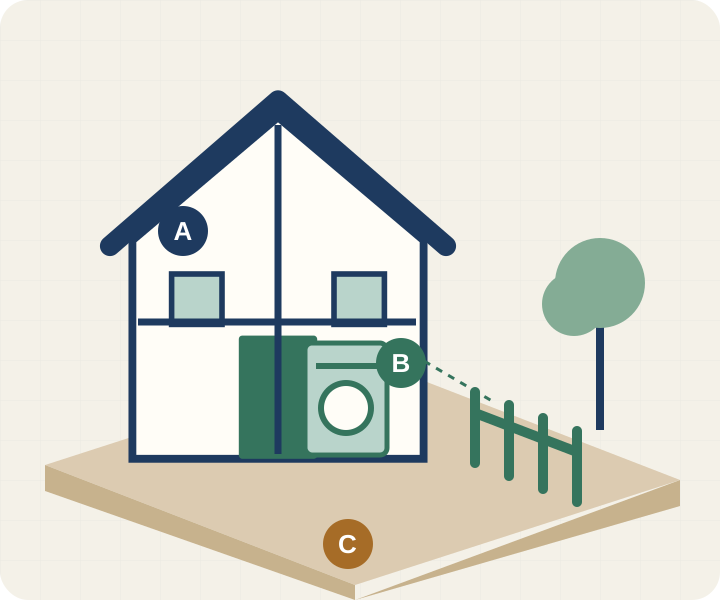
- A · Remaining structure
- $240,000
Depreciated over 27.5 years under the assumed method.
- B · Short-life assets
- $80,000
The example assumes these documented assets qualify for 100% bonus.
- C · Land
- $80,000
Excluded from depreciation. It stays outside the study’s deduction.
The purchase still totals $400,000. Reclassification changes the timing of deductions; it does not create additional cost basis. This allocation is hypothetical, not a typical study result.
Original RentalCalcs illustration · Conceptual artwork, not to scale · Hypothetical example, USD · Reviewed October 16, 2026. Rules: IRS Publication 527. The article’s worked example supplies the assumptions and arithmetic.
Can you use cost segregation on a long-term rental?
Yes. A single-family house or duplex rented on annual leases can have qualifying shorter-life components. Short-term rental status and real estate professional status are not requirements for commissioning a study or identifying those assets. The separate question is whether the resulting deduction can reduce your tax this year.
Establish building basis, document the components, calculate depreciation using the acquisition and service dates, then apply the owner's loss limitations.
A W-2 salary does not make the rental ineligible. It can mean the additional passive losses cannot offset that salary. IRS Publication 925 explains passive activity and at-risk limits; basis and other applicable limits also need review.
Why bonus depreciation makes it bigger
On its own, reclassification speeds things up modestly. The large first year number comes from bonus depreciation, which lets you deduct a set percentage of 5, 7 and 15 year property in the year it is placed in service.
The percentage depends on acquisition and service dates. The earlier phase-down remains relevant to property acquired before the new cutoff; the IRS describes that distinction in its 2026 depreciation guidance:
| Property acquired and placed in service | Bonus percentage |
|---|---|
| Placed in service in 2023 | 80% |
| Placed in service in 2024 | 60% |
| Acquired on or before January 19, 2025, placed in service in 2025 | 40% |
| Acquired on or before January 19, 2025, placed in service in 2026 | Generally 20% for ordinary eligible short-life property |
| Acquired and placed in service after January 19, 2025 | 100% for qualified property, unless an applicable election changes treatment |
The July 2025 law restored 100% bonus depreciation without the previous phase-down for qualified property acquired and placed in service after January 19, 2025. IRS Notice 2026-11 supplies interim guidance. Special property and elections can differ from the ordinary short-life assets in this table.
Check the contract date, not just closing. A binding acquisition contract signed in early January 2025 can put a March 2025 closing under the older 40% rule. Have your preparer establish the acquisition date before estimating the deduction.
Use the bonus depreciation calculator for a year-based estimate and the 2026 bonus depreciation guide for the acquisition-date distinctions.
Also check your state. Many states do not follow federal bonus depreciation, so the state return may spread the same deduction over several years.
Worked example: a $400,000 rental
This hypothetical rental is acquired in 2026 and ready and available for rent in September. Assume all $80,000 of the documented short-life assets qualifies for 100% bonus, no election out, and the usual 27.5 year method for the structure. State taxes and other basis adjustments are excluded.
- Purchase price: $400,000
- Land at 20%: $80,000
- Building basis: $320,000
- Study result: $80,000 reclassified ($56,000 of 5 year property and $24,000 of 15 year property)
- Remaining 27.5 year basis: $240,000
For a calendar-year owner, a September service date gives the structure 3.5 months of first-year depreciation under the mid-month convention. The date the property becomes ready and available for rental use matters, not just the closing date or first rent payment. See IRS Publication 527.
| Item | No study | With study |
|---|---|---|
| First-year bonus depreciation | $0 | $80,000 |
| First-year structure depreciation | $3,394 | $2,545 |
| Total first-year depreciation | $3,394 | $82,545 |
| Structure depreciation in a later full year | $11,636 | $8,727 |
Before rounding, the structure calculations are $320,000 / 27.5 x 3.5 / 12 and $240,000 / 27.5 x 3.5 / 12. The additional first-year deduction is approximately $79,152. Calculate with unrounded figures, then round the result; subtracting the displayed rounded totals differs by $1.
Later full-year structure deductions are about $2,909 lower with the study because $80,000 of basis was deducted earlier. The study accelerates deductions; it does not add $80,000 to total lifetime basis. Use the cost segregation calculator to explore the scale, then reconcile its assumptions with your actual service date and tax schedule.
A deduction is not the same as cash saved
Suppose the marginal federal rate is 32% and the study costs a hypothetical $4,500. Compare three possible amounts of the additional deduction that your preparer determines are usable this year:
| Extra deduction usable this year | Illustrative federal tax reduction | Reduction minus $4,500 study fee |
|---|---|---|
| All: about $79,152 | $25,328 | $20,828 |
| Half: about $39,576 | $12,664 | $8,164 |
| None this year | $0 | -$4,500 |
The same study ranges from $20,828 ahead to $4,500 out of pocket this year. The difference is how much of the additional deduction the owner can use.
These figures exclude state tax, additional preparation, fee deductibility, reduced later depreciation and sale tax. They are current-year comparisons, not forecasts of a refund or lifetime profit. Check ordinary operating cash flow in the single-family rental calculator before relying on tax savings to make a purchase work.
Worked illustration
Original RentalCalcs illustration · Reviewed October 16, 2026 · Hypothetical figures, not an observed transaction.
The September example produces about $79,152 of additional first-year depreciation. At an assumed 32% marginal federal rate, the usable share determines the current tax reduction.
All usable this year$25,328 tax reduction
After the $4,500 study fee $20,828
Half usable this year$12,664 tax reduction
After the $4,500 study fee $8,164
None usable this year$0 tax reduction
After the $4,500 study fee -$4,500
A suspended loss does not pay this year’s study fee. This comparison excludes state tax, fee deductibility, extra preparation costs, reduced later deductions and tax at sale. It is a current-year cash comparison, not lifetime return on the study.
Rules: IRS Publication 527 and Publication 925. Amounts use the article’s September service date and are rounded only for display. The full numbers appear in the adjacent table.
Open printable deduction and fee worksheetFree worksheet with example values, space for your records and source links. No account required.
Engineered study vs software or desktop study
Compare the work product before comparing the price. A provider's label does not establish whether its allocation is defensible. The IRS Cost Segregation Audit Techniques Guide describes methods, documentation and the elements examiners look for in a quality study.
An engineering approach may use a site inspection, construction records and component cost estimates. A desktop report may rely on your plans, photos, invoices and remote review. Ask how either approach handles missing records and property-specific features.
Before accepting a written quote, request:
- The method: how costs will be estimated and reconciled to your depreciable basis.
- The evidence: the asset list, recovery periods, legal classifications and supporting records you will receive.
- The responsible reviewer: who prepares and signs the report, their relevant experience and what examination support is included.
- The complete fee: study price, any site visit, amendments and your preparer's separate implementation work.
Send the proposed scope to the person who will prepare the return. The hypothetical $4,500 fee in this article is a modeling input, not a quoted market price.
When cost segregation does not pay
The fee consumes the current benefit
At a 32% marginal rate, a $4,500 fee needs about $14,063 of additional usable deduction just to match the fee in current federal tax reduction: $4,500 / 0.32.
That is an initial screen. It excludes reduced later deductions, sale tax, fee deductibility, preparation costs and the value of money over time. There is no universal purchase-price cutoff.
You expect to sell soon
A short hold leaves fewer years to benefit from earlier tax savings before a sale can trigger recapture. Compare the fee with the timing benefit and asset-specific sale tax. The sale illustration below shows why a first-year deduction alone cannot settle the decision.
The loss is suspended
Rental losses are generally passive. A high earner with W-2 income and no offsetting passive income may get no current benefit from the extra rental loss.
A qualifying owner who actively participates may use a special allowance of up to $25,000. It generally phases out as modified adjusted gross income rises from $100,000 to $150,000; married-filing-separately rules differ.
Unused passive losses generally carry forward. They may offset future passive income or be released on a qualifying fully taxable disposition of the entire activity to an unrelated person. A future deduction does not reimburse this year's study fee. See the conditions in Publication 925.
Real estate professional status alone does not make a rental loss nonpassive; material participation also matters. An activity with average customer use of seven days or less generally falls outside the passive rules' rental-activity definition, but material participation still determines whether its loss is nonpassive.
Neither is a label to choose on a tax return without meeting the tests. If this affects your operating plan, compare the business demands in the short-term versus long-term rental guide.
Your tax rate may be higher at sale
Taking an accelerated deduction in a low-rate year can be less attractive if later recapture is taxed at a higher rate. Model both rates and the timing of the cash; do not assume all depreciation is recaptured at one flat rate.
Already own the property? The look-back study
You did not miss your chance if you bought years ago. A study on a property you already own can identify missed acceleration. Depending on the depreciation method already adopted and your filing history, a method change may allow a current catch-up adjustment rather than amendments to earlier returns.
The mechanism is Form 3115, Application for Change in Accounting Method. Many eligible depreciation changes use automatic consent procedures, but eligibility, timing and filing requirements must be checked. Your CPA determines the Section 481(a) adjustment and whether it can be deducted currently after applicable loss limits. Commissioning a report does not itself authorize a catch-up deduction.
A look-back uses the property's original acquisition and service dates, not today's study date. Eligible property placed in service in 2023 generally had an 80% bonus rate, subject to its original eligibility and elections. The remaining basis follows the applicable depreciation schedule.
What happens at sale: recapture
All depreciation lowers your basis, which raises your gain when you sell. How that gain is taxed depends on what kind of property the depreciation was taken on.
- Straight-line depreciation on the structure can produce unrecaptured Section 1250 gain, subject to a maximum 25% rate.
- Section 1245 assets, such as qualifying appliances, can produce ordinary-income recapture up to depreciation and the gain allocated to that asset. The 25% ceiling does not apply to that recapture.
- Section 1250 land improvements with accelerated depreciation can produce ordinary-income recapture on the amount above straight line. Classification depends on the asset, not just its recovery period.
- Recapture applies to depreciation allowed or allowable, so skipping depreciation does not avoid it.
The detailed rules and asset classifications are in IRS Publication 544.
For a separate sale illustration, use five full years of structure depreciation, rather than the September first-year schedule above. Assume sufficient gain on every asset, a 32% ordinary rate, a 25% rate on building depreciation and no other gains or losses.
This deliberately high recapture case treats all $80,000 of short-life depreciation as ordinary income at sale. Actual asset classification and sale allocations control; part of the 15 year piece may instead fall in the 25% category.
| Item | No study | With study |
|---|---|---|
| Depreciation taken over 5 full years | $58,182 | $123,636 |
| Structure depreciation taxed at assumed 25% | $14,545 | $10,909 |
| Short-life depreciation taxed at assumed 32% | $0 | $25,600 |
| Depreciation-related tax at sale | $14,545 | $36,509 |
The study adds about $21,964 of depreciation-related sale tax. Its extra $65,455 of deductions over these five full years is worth about $20,945 at 32%, if fully usable.
That leaves the study roughly $1,018 behind before its fee, ignoring the timing value of earlier deductions. Amounts are calculated before rounding. These are depreciation-related amounts, not the entire sale tax bill.
Three inputs can change the comparison:
- Asset values at sale. A supported allocation with less gain on depreciated personal property can reduce ordinary-income recapture. Original cost is not a substitute for sale-date values.
- Holding period. More time between the deduction and sale can increase the value of deferral. Include the lower annual deductions during ownership.
- Exchange eligibility. A 1031 exchange can defer qualifying real-property gain. Personal property is ineligible, and some Section 1245 recapture can remain taxable even without cash boot.
Use the 1031 exchange calculator for the broad funding comparison and the depreciation recapture guide to assemble the asset-level sale questions for your preparer.
Common mistakes
- Buying a study before checking whether the passive loss rules let you use the deduction.
- Assuming 100% bonus applies when the property was acquired on or before January 19, 2025.
- Forgetting that land is excluded. A study reclassifies building basis, so an aggressive land allocation does not get fixed by a study.
- Ignoring state tax rules that do not follow federal bonus depreciation.
- Treating the first year deduction as savings instead of deferral, and being surprised by recapture at sale.
- Choosing a provider on price alone and ending up with a report that does not explain its method.
- Skipping the look-back option on a property bought years ago.
Bottom line
Before commissioning a study, collect the closing statement, land allocation, improvement records and existing depreciation schedule. Ask your preparer for two projections: continue the current schedule, or implement the proposed study with its full fee and expected sale treatment.
The investor tax tools help organize the estimates. The rental property tax deductions guide covers the broader expense picture. The decision is whether earlier usable deductions justify the cost over your holding period.
This article is general information, not tax or legal advice. Confirm your situation with a CPA.
Get new articles and market updates
Investing guides and market data, straight to your inbox. Unsubscribe anytime.