Depreciation lowers your rental's tax basis, so it can increase the gain when you sell. The resulting tax depends on the assets sold and your return. Estimate it before budgeting how much sale cash you can put into the next property.
This post explains the two kinds of recapture, works through a sale with and without cost segregation, and covers the legal ways to defer or reduce the bill. Rates and rules are federal and current for 2026. State treatment varies by state.
How depreciation creates a tax bill at sale
Every year you own a rental, you deduct part of the building's cost. Residential rental structures are depreciated over 27.5 years on a straight line, nonresidential buildings over 39 years, and land is never depreciated. You can see the annual figure for your property in the depreciation calculator.
Each deduction lowers adjusted basis. Subtract that basis from the net sale price to calculate gain. Depreciation therefore increases gain, or reduces a loss, compared with an otherwise identical property that had no depreciation.
Some gain attributable to depreciation receives different tax treatment from appreciation. Owners often call all of that treatment "recapture," although the building and personal-property rules differ.
Earlier usable deductions can provide a timing benefit. Whether accelerated depreciation adds value depends on your tax rates, fees, loss limits and holding period. Basis also reflects depreciation you were entitled to claim but missed, so skipping the deduction does not avoid the sale calculation.
How it works · illustrated
The worked example assumes ten full years of building depreciation and no other basis adjustments. Land is included in original cost but is not depreciated.
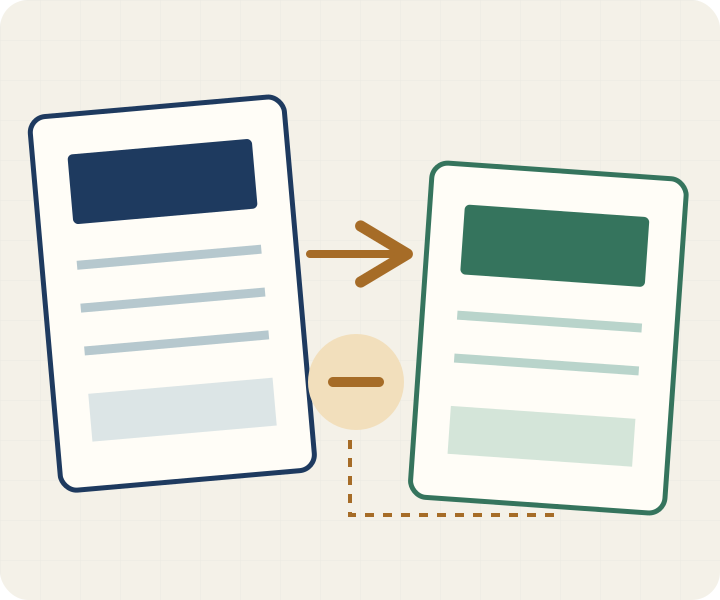
- Original property cost
- $500,000
Building and land together, before depreciation.
- Depreciation adjustment
- −$150,000
Ten modeled full years at $15,000 per year.
- Adjusted basis
- $350,000
Subtract this amount from the $700,000 net sale price.
That produces $350,000 of gain. The $250,000 mortgage payoff affects cash proceeds separately; it does not reduce this gain calculation. The later figure reconciles both views of the sale.
Original RentalCalcs illustration · Conceptual artwork, not to scale · Hypothetical example, USD · Reviewed October 16, 2026. Rules: IRS Publication 551. The article’s worked example supplies the assumptions and arithmetic.
Two kinds of recapture: Section 1250 and Section 1245
A rental property is really two kinds of property for tax purposes, and they are recaptured differently.
The building: a maximum 25% category
Section 1250 property includes the building structure. Gain attributable to straight-line depreciation can be unrecaptured Section 1250 gain, subject to a maximum federal rate of 25%.
That is a ceiling, not an automatic flat charge. Taxable income and other gains and losses affect the result; use the Schedule D instructions and tax worksheet. Ordinary-income Section 1250 recapture is a separate rule that can apply to depreciation above straight line.
Personal property: ordinary-income recapture
Section 1245 property includes qualifying appliances, carpet and furniture. A cost segregation study identifies and documents shorter-life components separately from the structure.
For each Section 1245 asset, ordinary-income recapture is limited to the smaller of depreciation subject to recapture or gain on the asset. There is no 25% cap on that ordinary-income amount.
A cost segregation study also identifies 15-year land improvements such as paving, fencing and landscaping. The classification of those is more technical, but the practical result is similar. When bonus or accelerated depreciation was claimed on them, the amount above what straight line would have allowed is generally taxed at ordinary rates too. Your CPA will sort each asset into the right bucket.
| Piece of the gain | Where it comes from | Federal rate |
|---|---|---|
| Section 1245 recapture | Depreciation on 5 and 7 year components | Ordinary rates, up to 37% |
| Unrecaptured Section 1250 gain | Gain attributable to straight line depreciation on the structure | Maximum 25%; actual rate depends on the return |
| Remaining long-term gain | Appreciation above your original cost | 0%, 15% or 20% |
| Net investment income tax | Applies on top, above income thresholds | 3.8% |
These are federal categories. Calculate state tax separately using the rules where you file and where the property is located.
Allowed or allowable: you cannot skip it
Some landlords think they can avoid recapture by never claiming depreciation. It does not work. The tax code reduces your basis by the depreciation "allowed or allowable", meaning the amount you were entitled to take, whether or not it ever appeared on your return. If you skip depreciation, you give up the deduction and still pay the recapture tax.
If you have missed depreciation in past years, it can usually be fixed. Depending on your filing history and the error, the correction may require an amended return or a method change using Form 3115. A qualifying method change can produce a catch-up adjustment. Have your preparer review it before the sale rather than assuming every missed deduction uses the same fix.
Worked example: a sale without cost segregation
This hypothetical illustration uses ten full years of depreciation to isolate the sale math. It excludes first-year and sale-year conventions, state tax and the 3.8% net investment income tax.
Assume deductions were usable at 32%, all building depreciation gain is taxed at 25%, and remaining long-term gain at 15%. There are no other gains, losses or Section 1231 lookback adjustments.
You buy a rental for $500,000. The land is worth $87,500, so the depreciable building is $412,500. You model ten full years of deductions and a sale for $700,000 after selling costs. Assume the price allocation gives the building enough gain to absorb its $150,000 of depreciation.
- Annual depreciation: $412,500 divided by 27.5 = $15,000
- Depreciation over 10 years: $150,000
- Adjusted basis: $500,000 minus $150,000 = $350,000
- Total gain: $700,000 minus $350,000 = $350,000
The tax at sale:
- Unrecaptured Section 1250 gain: $150,000 at 25% = $37,500
- Remaining gain: $350,000 minus $150,000 = $200,000, at 15% = $30,000
- Federal total: $67,500
Over the 10 years, those $150,000 of deductions saved $48,000 in tax at a 32% rate ($150,000 times 32%). You pay back $37,500 of it at sale. You came out $10,500 ahead on the rate difference, and you had the use of the money for years.
Does a mortgage payoff reduce depreciation recapture?
No. Paying off the loan reduces the cash you receive, not the gain on the sale. Keep two calculations separate:
- Tax gain: sale price minus qualifying selling costs minus adjusted tax basis.
- Cash after sale: sale price minus selling costs minus loan payoff minus taxes and other amounts paid at closing.
Adjusted basis generally starts with purchase cost and capitalized acquisition costs, adds qualifying capital improvements, and subtracts depreciation allowed or allowable and other basis adjustments. A refinance changes your borrowing; it does not reset that basis. IRS Publication 551 explains the basis records to keep.
Using the same $700,000 net sale and $67,500 illustrative federal tax bill above:
| Loan paid off at sale | Taxable gain | Cash after payoff and illustrated tax |
|---|---|---|
| $0 | $350,000 | $632,500 |
| $250,000 | $350,000 | $382,500 |
| $400,000 | $350,000 | $232,500 |
The tax calculation is unchanged across the rows. Budgeting from equity alone can therefore leave you short of cash for the next purchase. Model the next rental's down payment, closing costs and operating reserves in the single-family rental calculator, using the cash left after the sale.
Worked illustration
Original RentalCalcs illustration · Reviewed October 16, 2026 · Hypothetical figures, not an observed transaction.
Both bars total $700,000 after selling costs. Changing the mortgage payoff changes the second bar, while the tax-basis calculation remains the same.
Tax calculation: net sale less adjusted basis
- Adjusted basis$350,000
- Taxable gain$350,000
Cash distribution: loan and illustrated tax paid
- Loan payoff$250,000
- Federal tax$67,500
- Cash remaining$382,500
Here, $350,000 of taxable gain produces $382,500 of cash after the $250,000 loan payoff and $67,500 modeled federal tax. The tax assumption is 25% on $150,000 and 15% on the remaining $200,000; state tax, NIIT and other return-level adjustments are excluded.
Rules: IRS Publication 551 and Publication 544. Bar lengths show dollars on an equal $700,000 scale; labels provide the complete underlying values.
Open printable rental sale basis and cash worksheetFree worksheet with example values, space for your records and source links. No account required.
Can you owe tax if you sell below the original purchase price?
Yes, if the net proceeds allocated to an asset exceed its depreciated basis. Start with the $412,500 structure above and subtract $150,000 of depreciation: its adjusted basis is $262,500.
An allocated net sale amount of $362,500 produces $100,000 of gain, even though it is below original cost. In this simplified building-only case, potential unrecaptured Section 1250 gain is $100,000, not the full $150,000 of depreciation.
If the building's allocated net proceeds instead fall below $262,500, it has a loss rather than depreciation-related gain. Land and any separately depreciated components still need their own allocations and gain or loss calculations. Selling the overall property below its original price does not answer the tax question by itself.
The same sale with cost segregation
Now assume a cost segregation study at purchase reclassified $82,500 of the building as 5-year personal property, leaving $330,000 as 27.5-year structure. Assume the components meet all requirements for 100% bonus depreciation, including acquisition and placement in service after January 19, 2025. This is a forward-looking illustration that holds the stated tax rates constant through the hypothetical sale.
- Depreciation on components: $82,500 (all in year one)
- Depreciation on structure: $330,000 divided by 27.5 = $12,000 a year, or $120,000 over 10 years
- Total depreciation: $82,500 plus $120,000 = $202,500
- Adjusted basis: $500,000 minus $202,500 = $297,500
- Total gain: $700,000 minus $297,500 = $402,500
How that gain is taxed depends on how much of the $700,000 sale price is allocated to the components.
Version A: components allocated at their full original cost. This illustrates full recapture of the components at the assumed rate, not a prediction of their resale value.
- Section 1245 recapture: $82,500 at 32% = $26,400
- Unrecaptured Section 1250 gain: $120,000 at 25% = $30,000
- Remaining gain: $402,500 minus $82,500 minus $120,000 = $200,000, at 15% = $30,000
- Federal total: $86,400
That is $18,900 more than the $67,500 owed without cost segregation.
Version B: components allocated a lower sale value. Suppose the evidence supports allocating $12,500 to the components. This is an assumption, not a resale-value benchmark. Their basis is zero, so the gain is $12,500 and Section 1245 recapture is limited to that gain.
- Section 1245 recapture: $12,500 at 32% = $4,000
- Unrecaptured Section 1250 gain: $120,000 at 25% = $30,000
- Remaining gain: $402,500 minus $12,500 minus $120,000 = $270,000, at 15% = $40,500
- Federal total: $74,500
That is $7,000 more than without cost segregation. The allocation has to be reasonable and defensible, and it should be consistent with what the purchase contract says if the contract addresses it. The allocation should reflect the assets and evidence at sale, not whichever version gives the preferred tax result.
Why cost segregation can raise the recapture bill
The example shows the mechanics. Cost segregation does two things to your eventual sale.
First, it increases total depreciation during the hold. In the example you took $202,500 instead of $150,000, so your gain at sale is $52,500 larger.
Second, it moves depreciation out of the 25% capped category and into the ordinary rate category. Without the study, that $82,500 of cost would have produced $30,000 of straight line depreciation over 10 years ($3,000 a year), recaptured at no more than 25%. With the study, up to $82,500 is recaptured at 32% in the example.
Now compare that to what the study saved you while you owned the property. Total deductions were $52,500 higher, worth $16,800 at a 32% rate ($52,500 times 32%). In Version A, the extra tax at sale is $18,900, so on paper you are $2,100 behind. In Version B, the extra tax is $7,000 and you are $9,800 ahead.
The totals miss timing. Under this full-year simplification, first-year depreciation is $94,500 with the study and $15,000 without it. At 32%, the corresponding tax reductions are $30,240 and $4,800: $25,440 more cash retained initially.
Later annual deductions are smaller. The timing benefit depends on when deductions are usable, your holding period and what the retained cash earns. Subtract the study fee and additional sale tax before deciding whether the strategy helped.
A deduction that creates an unusable passive loss cannot deliver that immediate cash benefit. The rental property tax deductions guide explains the loss-limit distinction.
A taxable sale can reverse much of the earlier benefit. A longer hold may increase the value of the deferral; an eligible 1031 exchange can extend deferral on qualifying real property. Neither makes every cost-segregated component tax free. You can size the first-year benefit in the cost segregation calculator and what an exchange would defer in the 1031 exchange calculator.
Ways to defer or reduce recapture
Consider a 1031 exchange. An eligible exchange can defer qualifying real-property gain through the replacement property's basis. Read the exchange rules before using the 1031 calculator to compare funding.
An exchange does not make all cost-segregation recapture disappear. Personal property is ineligible, and Section 1245 recapture can be triggered even without cash boot. Give the study to your preparer before arranging the exchange.
Hold until death. Under current law, heirs generally receive a basis stepped up to fair market value at the date of death. That basis adjustment can eliminate deferred gain on qualifying inherited property, but ownership and estate rules matter. Treat this as an estate-planning question, not a guaranteed result for every ownership structure.
Review suspended passive losses. Unused losses generally carry forward. A fully taxable disposition of your entire interest in the activity to an unrelated person can release them. Have your preparer reconcile those losses with the sale under Publication 925.
Be careful with installment sales. Seller financing spreads ordinary capital gain over the years you collect payments. Section 1245 recapture does not get spread. It is all taxed in the year of sale, even if you received only a small down payment. Unrecaptured Section 1250 gain can be spread, but it is generally counted first as payments arrive, before the lower rate gain.
Do not count on the home sale exclusion. If you move into a former rental and later sell it as your primary residence, the exclusion of up to $250,000 (or $500,000 for a married couple) does not cover depreciation claimed after May 6, 1997. That depreciation is still taxed at up to 25%.
What to gather before estimating tax on a rental sale
Give your preparer the original closing statement, improvement invoices, complete depreciation schedules, any cost segregation report, and the proposed sale closing statement. Include suspended passive losses and previous exchanges. These records establish basis and separate the structure, land and shorter-life assets.
Ask for three outputs: taxable gain by asset, estimated tax by category, and cash remaining after the loan payoff. The depreciation calculator can help with a planning estimate, but a full-year projection should not replace the depreciation actually allowed or allowable on your returns.
Common mistakes
- Not taking depreciation. You pay recapture on what was allowable regardless, so skipping the deduction is a pure loss.
- Assuming everything is taxed at 15%. A long-held rental often has more gain from depreciation than from appreciation, and that part is taxed at up to 25% or at ordinary rates.
- Forgetting the cost segregation study at sale. The components are separate assets on your depreciation schedule. Your preparer needs the study to report the sale correctly.
- Never discussing allocation. The difference between Version A and Version B above was $11,900. Raise it with your CPA before closing, not at tax time.
- Selling with seller financing after heavy bonus depreciation. You can owe tax on all the Section 1245 recapture in year one while your cash arrives over many years.
- Ignoring state tax and the 3.8% tax. Both are left out of the example above for simplicity, and both can apply to the whole gain.
- Deciding on an exchange after closing. A 1031 requires a qualified intermediary to be in place before the sale closes.
IRS Publication 544 covers sales of business property, including both recapture sections, in detail.
Bottom line
Before listing, reconcile the depreciation schedule and sale allocation. Compare a taxable sale, an eligible exchange and a longer hold using cash after debt and tax, rather than equity alone.
Start the estimates with the investor tax tools. The real estate tax strategy guide connects this sale decision to the deductions taken during ownership.
This article is general information, not tax or legal advice. Confirm your situation with a CPA.
Get new articles and market updates
Investing guides and market data, straight to your inbox. Unsubscribe anytime.