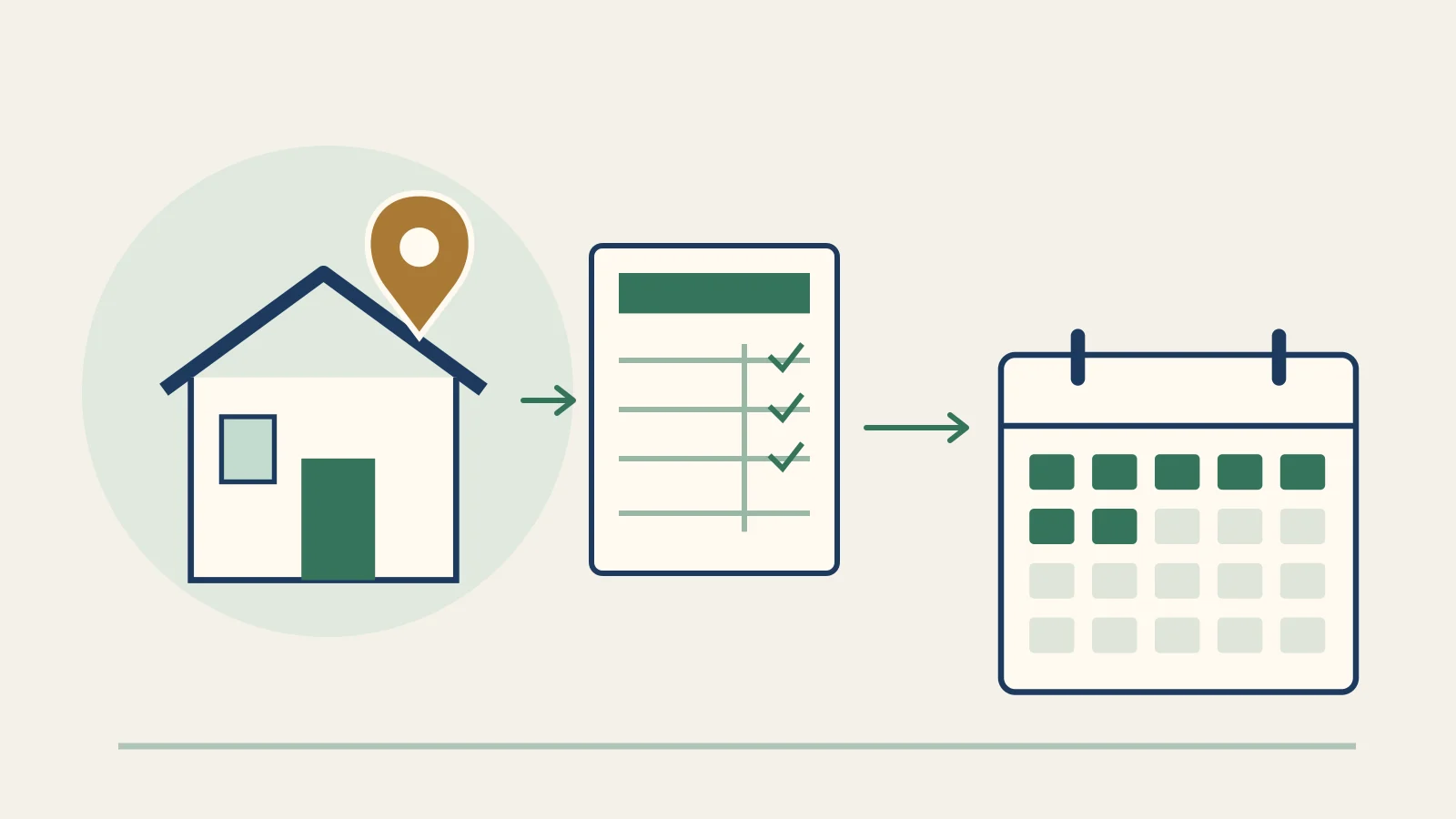
Airbnb legality depends on the address, rental space, owner occupancy and stay length. Permission for registered home sharing may exclude a whole-home investment. An active listing or seller's booking history does not establish that you can operate the same way after buying.
This guide connects the rule check to the investment decision: identify the permitted use, document the required approvals, and put any night cap or occupancy condition into the revenue forecast. The city examples were checked against official sources on October 14, 2026. They illustrate important differences; they are not an address-specific legal determination.
Why there is no single answer
"Short-term rental" does not have one nationwide duration threshold. The local definition, zoning district, legal dwelling status and hosting arrangement determine which rules apply. A mailing address can use a nearby city's name while lying in a different municipality or an unincorporated county. Start with the parcel and governing jurisdiction, not a platform's destination label.
Our Airbnb laws directory can help you start the search, but follow through to the current administering agency and adopted rules. Confirm whether a page describes an adopted requirement, a proposal or a change that has not taken effect. Save the effective date with your underwriting notes.
Where is Airbnb illegal in the US?
A national list of "illegal cities" is too coarse for a purchase decision. Some places restrict whole-home stays while allowing eligible residents to host guests; others regulate particular zones, housing types or numbers of nights. The useful question is whether your proposed use at your specific unit is allowed.
| Jurisdiction and official source | Important restriction, checked October 14, 2026 | What it changes in a buyer's model |
|---|---|---|
| New York City OSE | Entire homes/apartments cannot be rented for fewer than 30 days under the residential hosting rules. Eligible registered hosts must share the unit with guests; the limit is two guests, excluding children under four. Rent-regulated and NYCHA units are ineligible. | Do not project a residential investment apartment as a year-round, unhosted nightly rental. Registration is not an exemption from the underlying restrictions. |
| San Francisco Planning | The host must live in the specific unit at least 275 nights per calendar year. Unhosted stays are limited to 90 nights; city business and short-term rental registration requirements also apply. | Owning the building or living in another unit does not make a separate investment unit eligible. The 90-night limit concerns unhosted stays, not all hosted stays. |
| City of Los Angeles Planning | Regular home sharing is limited to a qualifying primary residence and 120 days per calendar year. The host must reside there more than six months of the year. Extended registration has additional eligibility requirements. | Do not assume an investment-only home qualifies or that an extension will be granted. These are City of Los Angeles rules, not a summary of every city in Los Angeles County. |
The table omits many property exclusions and operating requirements. In NYC, also check the prohibited-buildings list and legal sleeping areas. In San Francisco, the official FAQ identifies ineligible property types and a conditional pending-application pathway; simply submitting an application is not blanket permission. For NYC-specific research, use the New York City hosting guide alongside OSE's current requirements.
The six layers that decide whether you can host
Treat these as six checks with evidence, rather than six boxes a platform can approve for you. Public permission, private contractual permission and insurance coverage answer different questions, and all can affect whether your plan works.
- State and local use rules. Identify the applicable stay definition, jurisdiction, zoning and permitted hosting model. Check the adopted code and the agency that administers it.
- The legal unit and sleeping space. Confirm the dwelling/unit configuration, occupancy documents and relevant building or fire requirements. An attractive converted basement may not be approved for sleeping or as a separate rental.
- Host and registration eligibility. Check residency requirements, permit availability, applications, inspections, renewals and transfer rules. Record the exact unit and operator attached to any existing approval.
- Operating and tax duties. Record guest or night limits, reporting, tax registration, collection/remittance and any local contact requirements. Ask the administering agencies which obligations the platform handles and which remain yours.
- Private restrictions. Read the lease, condominium or HOA documents and recorded restrictions. Obtain any required consent through the process those documents specify.
- Financing and insurance. Disclose the intended rental use to the lender and insurer and review the actual loan and policy terms. Government permission alone does not amend a contract or create insurance coverage.
How it works · illustrated
The sequence connects a property to evidence and then to a usable calendar. Each step can change the investment decision.
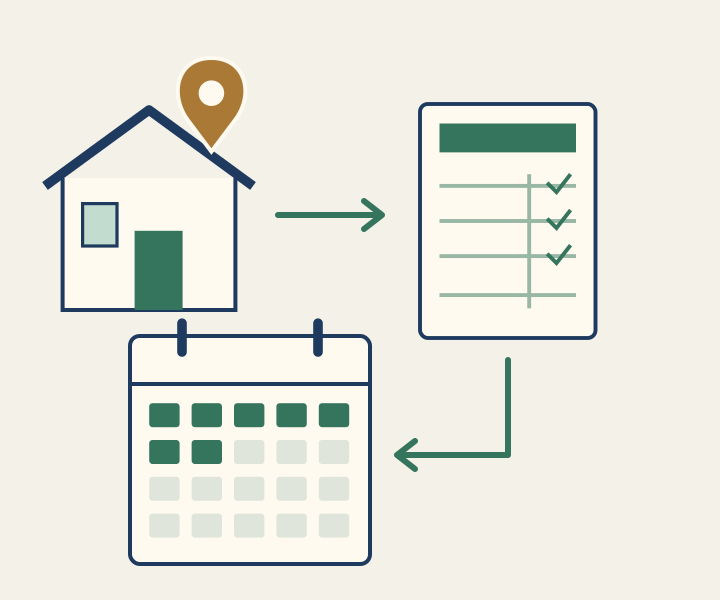
- Identify the property
- Address
Confirm the jurisdiction, legal unit and proposed hosting use.
- Resolve the conditions
- Evidence
Record eligibility, required approvals, contracts and coverage.
- Build the revenue case
- Calendar
Apply verified night limits, opening dates and realistic demand.
A listing, a tax payment or an informal email does not replace a required approval. The diagram describes due diligence; it does not certify a property.
Original RentalCalcs illustration · Reviewed October 14, 2026. Conceptual artwork, not a monetary scale. Sources and hypothetical assumptions appear in the surrounding article.
The unpermitted additions guide helps distinguish marketed space from a documented legal unit. A written city response is useful evidence, but an informal email is not a substitute for a required permit, inspection or legal interpretation of a disputed restriction.
The common regulatory models
Rules can affect both whether you may start and how much income you can earn. A residency condition can rule out an absentee investment model. A permit cap can delay or prevent entry. A night limit constrains the inventory available to sell. Renewal and reporting duties create recurring work after launch.
Do not model a permit as transferable merely because the seller has one. Ask the agency whether the approval survives a change in owner, operator, primary resident or unit configuration. If approval is still uncertain, keep the unapproved STR case separate from the income you are willing to rely on at closing.
A night cap is a revenue ceiling, not an occupancy forecast
Suppose a hypothetical eligible operation has at most 90 legally usable nights. This is an arithmetic example, not a claim that a 90-night allowance establishes eligibility in any city.
At an average nightly accommodation rate of $200 and 80% booking of those 90 nights, it sells 72 nights and earns $14,400 in accommodation revenue. Taxes collected for remittance are excluded; cleaning charges and cleaning costs are assumed to offset exactly.
Assume incremental costs are 25% of accommodation revenue: 15% management, 3% platform charges and 7% supplies/variable utilities. These are chosen scenario inputs, not prevailing platform or manager fees. A booked night then contributes $150 toward fixed annual cash costs. Assume those fixed costs are $18,000, including the financing, fixed operating bills, permit/compliance allowance and reserve contribution allocated to this rental plan.
Booked nights needed to cover the budget = $18,000 / $150 = 120 nights.
Even selling all 90 permitted nights cannot cover that budget. More demand does not solve an inventory limit. At the same cost assumptions, the rate needed at 90 sold nights is $266.67; at 72 sold nights it is $333.33. A higher rate is only a possible solution if local demand supports it.
The worked decision · Hypothetical annual scenario
At $200 per night and 25% incremental costs, each booking contributes $150 toward the $18,000 fixed annual cash budget.
80% of permitted nights booked72 nights
-$7,200 annual cash after the fixed budget
Maximum permitted in this illustration90 nights
-$4,500 annual cash after the fixed budget
Nights needed to cover the budget120 nights
30 nights beyond the hypothetical cap
All bars start at zero on the same 0–120 booked-night scale. The final bar is a requirement, not a permitted booking forecast. This invented 90-night scenario does not establish eligibility in any city.
Original RentalCalcs calculations · Reviewed October 14, 2026. All values and assumptions are available as text and in the adjacent table. No color interpretation is needed.
Open the address and revenue worksheetPreview: 3 of 6 rows
| Hypothetical annual outcome | 80% of permitted nights booked | Every permitted night booked |
|---|---|---|
| Booked nights | 72 | 90 |
| Accommodation revenue | $14,400 | $18,000 |
| Incremental costs at 25% | $3,600 | $4,500 |
| Contribution toward fixed budget | $10,800 | $13,500 |
| Fixed cash budget, including allocated debt and reserve | $18,000 | $18,000 |
| Cash after the modeled budget | -$7,200 | -$4,500 |
For a home you also occupy, decide which costs belong to the rental comparison and which are household costs you would pay anyway. The table is a test of the stated $18,000 rental budget, not the total return on an owner-occupied home. Replace every allowance with the property's actual amounts, including fees charged on cleaning revenue where relevant. The STR versus long-term rental guide helps compare the operating models.
How to verify an address before you buy
Build a compact evidence file while you still have time to resolve the purchase decision. Use the address and revenue worksheet to keep sources, answers and unresolved conditions together.
Preview: 3 of 7 rows
| Evidence to obtain | Specific question | Budget or decision affected |
|---|---|---|
| Parcel map and jurisdiction record | Which government regulates this address and unit? | Correct code and application path |
| Adopted rules and official program guidance | Does this hosting model qualify today, and are changes pending? | Eligible revenue model and effective date |
| Legal occupancy and building records | Is the proposed space approved for this residential/sleeping use? | Usable rooms, work and inspection costs |
| Permit record and agency response | What must a new buyer/operator obtain, and may operation begin while pending? | Opening date, carrying cash and closing conditions |
| Lease, HOA/condo and recorded restrictions | Is the proposed use permitted under the actual documents? | Feasibility and required consent |
| Lender and insurer documents | Is this use accepted and covered on these terms? | Financing, exclusions and annual costs |
| Tax, reporting and renewal instructions | What remains the operator's responsibility? | Recurring costs and compliance calendar |
When contacting the agency, describe the exact address and unit, proposed operator, residency arrangement, whole-unit or shared use, typical stay length and expected nights. Ask which approvals apply and what evidence supports the answer. Save the source URL, document date, staff response and open conditions. Conflicting records or a consequential ambiguity deserve qualified local advice before you rely on the income.
A seller's revenue report is evidence of past bookings, not proof of lawful or transferable future use. Likewise, a search result or a neighboring listing cannot resolve your parcel's eligibility.
Loans and insurance are part of "legal"
These are contract and coverage checks, separate from public-law permission. Review occupancy and rental-use conditions in the actual loan documents. A DSCR label alone does not tell you which stay lengths or income documentation a lender accepts; see the DSCR explanation and obtain the terms for the proposed use.
The NAIC's home-sharing insurance guidance warns that standard homeowners or dwelling coverage may not cover short-term rental exposures. Describe paying guests and hosting frequency to the insurer, and ask about liability, property damage, exclusions and business interruption. Platform protection and your own policy need to be reviewed together, rather than assumed interchangeable.
Use a written quote and policy review in the budget. The rental insurance cost guide provides a comparison checklist; a generic percentage of purchase price cannot establish coverage for a specific hosting plan.
The rules can change after you buy
Recheck the official program at renewal and before changing operator, unit configuration or hosting pattern. Save upcoming effective dates separately from rules already in force. Do not build a cash plan that needs a proposed exception or an unapproved extension to succeed.
Does the long-term fallback actually cover the loan?
For a separate investment property where a conventional lease is independently permitted, suppose the price is $320,000 with 25% down. At a hypothetical fixed 7% over 30 years, the $240,000 loan requires $19,160.71 annual principal and interest. The original acquisition budget is $80,000 down, $6,000 closing costs and $22,000 furnishing, or $108,000 deployed before any retained cash reserve.
If verified long-term rent is $2,400 per month, 5% vacancy/credit loss leaves $27,360 a year. Subtract management at 10% of collections ($2,736), tax ($3,800), insurance ($1,600) and routine repairs ($1,800). NOI is $17,424, before the mortgage and a separate $1,800 capital contribution. Cash after both is -$3,536.71 per year.
That fallback does not cover the modeled obligations. Conversion can also require vacancy, moving/storage, leasing costs and a different insurance quote; those transition costs are not included above. Previously purchased furniture does not automatically return $22,000 in spendable cash. Nor does a calculated cash deficit establish the property's market value.
Longer stays are not an automatic legal workaround. San Francisco's official guidance, for example, identifies a separate intermediate-length occupancy permit regime and possible tenant protections. Check the proposed fallback use itself, including zoning, tenancy rules and private restrictions, before counting its revenue.
Common mistakes
- Annualizing a peak nightly rate across dates that cannot legally or practically be booked.
- Dividing booked nights by available nights in one comparison and by 365 in another without labeling the difference.
- Assuming an existing registration belongs to the property forever or permits a new operator automatically.
- Treating tax collection by a platform as proof that the rental use is authorized.
- Calling a unit "hosted" because the owner lives elsewhere in the building.
- Counting an extension, insurance claim payment or fallback rent before verifying its conditions.
Put restrictions into the model as actual inputs: permitted use, usable calendar, approval date, nightly rates, costs and fallback assumptions. A footnote saying "subject to local law" does not repair a forecast built on an ineligible use.
Bottom line
Before relying on short-term rental income, establish the address's permitted operating model and the evidence needed to use it. Then test whether the permitted nights and credible rates cover the costs, and whether the separately verified fallback is affordable.
Use the rental pro forma guide for a nights-to-cash budget and the single-family calculator for the conventional rental fallback. The calculator does not determine STR eligibility. Finally, test approval delay, lower bookings and conversion costs with the sensitivity analysis guide, recording each unresolved condition before committing to the purchase.
Get new articles and market updates
Investing guides and market data, straight to your inbox. Unsubscribe anytime.
