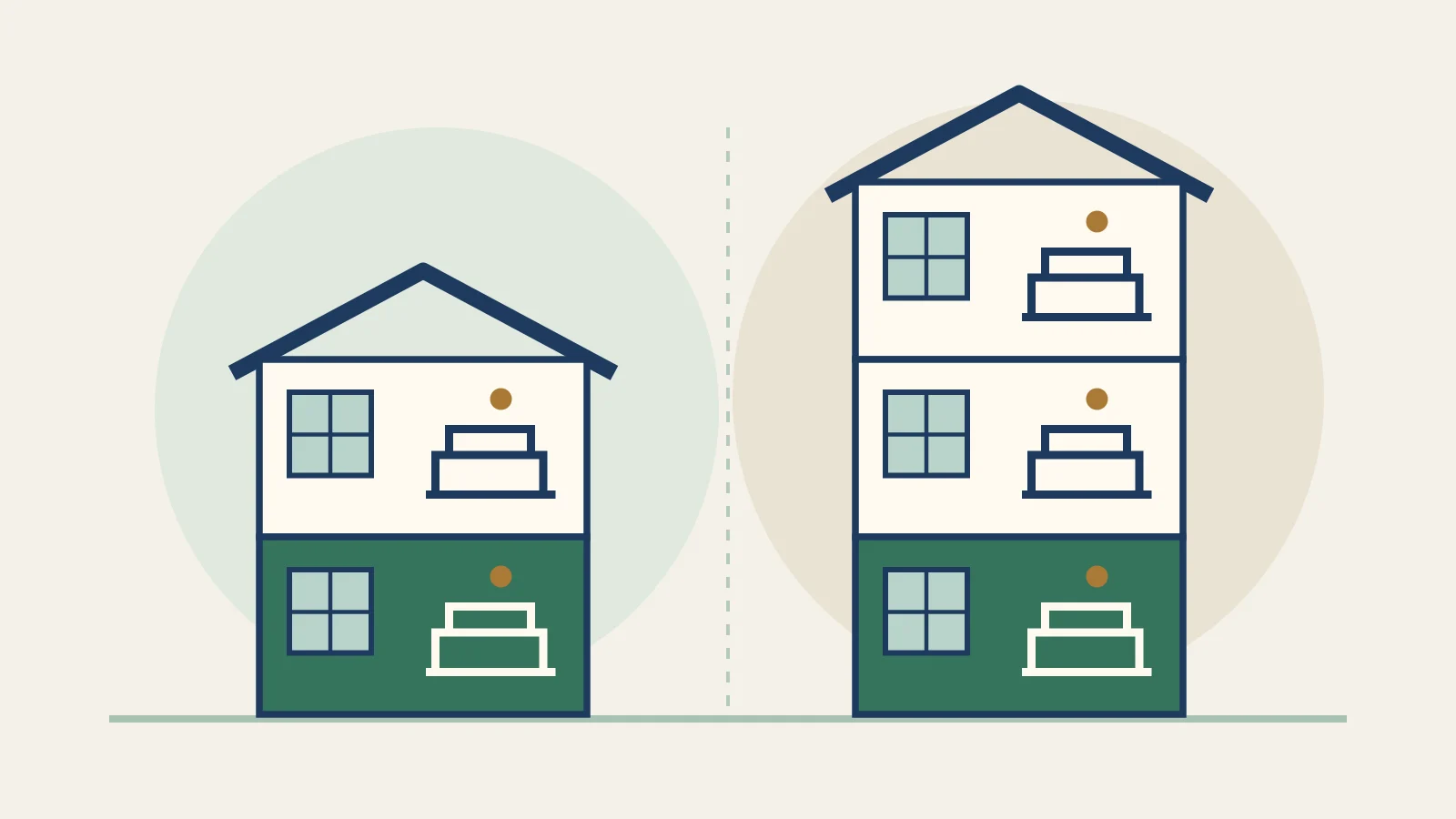
A triplex earns its extra cost only when additional rent outweighs the larger loan, expenses and cash commitment. In our first hypothetical comparison, it saves about $155 a month; in the second, it costs $68 more. Unit count alone cannot choose the purchase.
Both examples include mortgage insurance, a reserve for future replacements and the cost of maintaining the whole building. These are educational scenarios, not current listings, financing quotes or a promise that you qualify. Start with the house hacking guide if living alongside your tenants is a new idea.
The Core Tradeoff
A duplex contains two separate homes. When you occupy one, the other is the sole rental unit. A triplex contains three homes, leaving two rentals while you live there. The extra lease can cushion a vacancy, but it brings another kitchen, bathroom and set of appliances to inspect and eventually replace.
Compare the actual units, not just the door count. A duplex with a larger, renovated rental can collect more than two small triplex units. Separate meters, parking, legal occupancy, lease restrictions and the condition of shared systems can change both income and work. Confirm the legal unit count with local records before relying on three rents or a particular loan program.
How it works · illustrated
The owner unit is green; rental units are cream. A second rental adds income, but it also adds costs and a larger cash commitment.
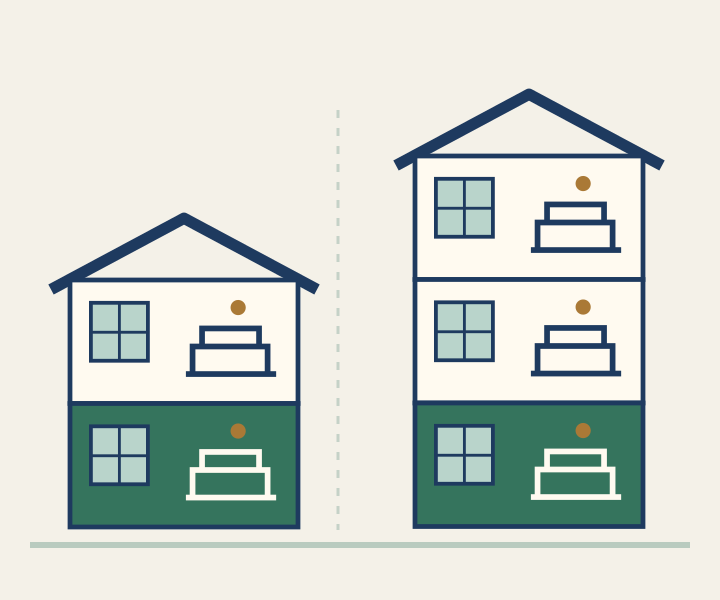
- Duplex · one tenant unit
- $1,140/mo
Effective rent after the example 5% vacancy and credit-loss allowance.
- Triplex · two tenant units
- $2,185/mo
Combined effective rent from two $1,150 leases, after the same allowance.
- Triplex · extra cash earmarked
- $13,200
Additional closing cash, initial repairs and retained property reserves.
The owner’s appraised rent can matter to a lender, but it is not collected income while the owner lives there. All values are hypothetical USD.
Original RentalCalcs illustration · Reviewed October 14, 2026. Conceptual artwork, not a monetary scale. Values follow the hypothetical worked examples in this article.
Down Payment Reality Check
These examples use a hypothetical 5% down conventional loan, with 360 monthly payments at 6.75%. The Fannie Mae eligibility matrix, dated August 5, 2026, permits up to 95% loan-to-value for certain two-to-four-unit principal-residence purchases through Desktop Underwriter. That ceiling is not an approval: underwriting method, borrower qualifications, reserves, loan limits and property eligibility still matter. See the 5% down conventional house-hack guide for the broader process.
The closing-cost allowance is an illustrative 3% of price, including assumed fees and prepaids. Replace it with an itemized estimate. The CFPB Loan Estimate comparison guide explains how to compare cash to close, mortgage insurance, lender costs and the full monthly payment.
Preview: 3 of 7 rows
| Initial cash, USD | Duplex | Triplex |
|---|---|---|
| Purchase price | $285,000 | $375,000 |
| Down payment, 5% | $14,250 | $18,750 |
| Closing allowance, 3% | $8,550 | $11,250 |
| Cash to close | $22,800 | $30,000 |
| Immediate repairs | $5,000 | $7,000 |
| Property reserve retained | $12,000 | $16,000 |
| Total cash earmarked | $39,800 | $53,000 |
The triplex requires $7,200 more at closing and $13,200 more cash earmarked overall. A retained reserve is still your cash; it is not a transaction expense or equity in the building. Keep the household emergency fund separate from these property amounts. The reserve figures are assumptions, not lender minimums or proof that every repair is covered.
The FHA Test That Only Applies to the Triplex
Among these two property types, FHA's additional self-sufficiency test applies to the triplex. It also applies to four-unit properties. HUD Handbook 4000.1, printed page 171, requires the payment-to-net-self-sufficiency-rent ratio to be no more than 100% for three-to-four-unit properties.
Net rent uses the appraiser's estimate for every unit, including the owner's, less the greater of the appraiser's vacancy/maintenance estimate or 25% of rent. Simply multiplying by 75% can overstate the allowable rent if the appraiser's allowance is higher.
For an isolated illustration, three units appraised at $1,150 each produce $3,450 gross. A 25% allowance leaves $2,587.50. Against a hypothetical lender-calculated qualifying payment of $3,000, the ratio is 116% and fails. At a 30% allowance it leaves only $2,415.
This is a separate FHA screening example, not the conventional payment in our comparison. Have the lender calculate the required payment, insurance treatment, reserves and eligibility from the actual file.
Passing this test would not replace borrower qualification, and the owner's appraised rent is not cash the owner collects. The triplex FHA walkthrough explains why that distinction matters.
Monthly Cash Flow Breakdown
The first pair assumes self-management, tenant-paid in-unit utilities and no association fee. Owner-paid common utilities are shown separately. Each triplex rental asks $1,150; the duplex rental asks $1,200. Vacancy and credit loss are modeled at 5% of scheduled rent. The mortgage-insurance allowance is 0.50% of the original loan balance annually, held flat for this comparison; it is not a PMI quote or cancellation schedule.
Routine repairs and future capital replacements cover the entire building, including the owner's home. They are deliberately separate. Use the capital-reserve guide to replace generic allowances with an inventory of the actual roof, heating, cooling and other systems.
Preview: 3 of 12 rows
| Monthly line, USD | Duplex | Triplex |
|---|---|---|
| Principal and interest | $1,756.08 | $2,310.63 |
| Mortgage-insurance allowance | $112.81 | $148.44 |
| Property tax | $285.00 | $375.00 |
| Property insurance | $165.00 | $210.00 |
| Routine repairs | $150.00 | $225.00 |
| Capital reserve | $125.00 | $175.00 |
| Common utilities | $60.00 | $100.00 |
| Total modeled outflow | $2,653.89 | $3,544.07 |
| Scheduled tenant rent | $1,200.00 | $2,300.00 |
| Vacancy and credit loss, 5% | -$60.00 | -$115.00 |
| Effective tenant rent | $1,140.00 | $2,185.00 |
| Owner's net housing cost | $1,513.89 | $1,359.07 |
The triplex lowers housing cost by $154.82 a month, about $1,858 a year. Neither property provides free housing. The owner's net cost is outflow less tenant rent, not investment cash flow or a tax deduction. It includes principal repayment and a reserve transfer, so it is also different from an economic cost-of-housing calculation.
All loan calculations use unrounded payments internally. Numbers display to cents; final comparisons use unrounded values. Neither model includes income taxes, appreciation, tenant deposits as income, the value of your labor or sale proceeds.
The Break-Even Analysis
Dividing the extra $7,200 cash to close by $154.82 monthly savings gives about 47 months. Including the extra $2,000 of immediate repairs gives about 59 months. These are simple cash-recovery calculations, not an investment return: the down payment remains equity, reserves remain liquid, and a sale would involve debt payoff and selling costs.
The extra $4,000 reserve earmark increases the liquidity commitment even though it is not spent on day one. If $53,000 would leave your household unable to absorb a job interruption or repair, the triplex's monthly advantage does not settle the decision.
The worked decision · Hypothetical USD
Monthly owner cost after tenant rent. Both cases retain the modeled loan, insurance, taxes, repairs, capital reserve and utilities.
Duplex
Base case$1,514/mo
One rental empty for the month$2,654/mo
Triplex
Base case$1,359/mo
One rental empty for the month$2,452/mo
All bars start at zero and use the same $0–$3,000/month scale. The vacant unit contributes zero; the remaining triplex rental retains a 5% loss allowance. Additional turnover bills are excluded. Values rounded to dollars.
Original RentalCalcs calculations · Reviewed October 14, 2026. Educational scenarios, not observed returns or lender commitments. Detailed inputs and primary financing sources appear in the surrounding article.
Open the property comparison worksheetThe graphic's vacant-month case replaces the annualized vacancy assumption for one rental with a full month of zero collections. In the duplex, the only rental produces nothing, so owner cost reaches $2,653.89.
In the triplex, one unit is empty and the other still contributes $1,092.50 after its 5% allowance, giving a $2,451.57 owner cost. Additional turnover repairs, leasing fees and empty-unit utilities are excluded; add them before relying on a reserve balance.
If the general vacancy/loss allowance rises from 5% to 10% on both buildings, net costs become $1,573.89 and $1,474.07. The triplex advantage shrinks to $99.82. Use vacancy evidence by market type as a research starting point, then test the leases and local turnover history.
A Worked Example: Same Neighborhood, Illustrative Numbers
Here is a second fictional pair in the same assumed neighborhood, with comparable condition and owner living space. No address, actual listing or verified market rent is claimed. Financing and the PMI assumption stay the same, while prices, rents, taxes and insurance change.
Preview: 3 of 8 rows
| Monthly comparison, USD unless noted | Duplex | Triplex |
|---|---|---|
| Purchase price | $259,000 | $349,000 |
| Total tenant asking rent | $1,050 | $1,900 |
| Principal and interest | $1,595.88 | $2,150.43 |
| Mortgage insurance | $102.52 | $138.15 |
| Taxes and insurance | $375.00 | $495.00 |
| Repairs, capital reserve and utilities | $335.00 | $500.00 |
| Effective rent after 5% loss | $997.50 | $1,805.00 |
| Owner's net housing cost | $1,410.90 | $1,478.57 |
Here the triplex costs $67.68 more each month, as well as $7,200 more at closing under the same 8% down-payment-plus-closing assumption. There is no positive monthly saving to recover that extra closing cash. A better owner unit could still have personal value, but that is a housing preference to price explicitly, not a cash-flow advantage.
When the Duplex Wins
A duplex is the stronger candidate when it preserves necessary liquidity, has better verified rent relative to all costs, or offers a more manageable first tenancy. It can also avoid the three-to-four-unit FHA property test when FHA is the viable financing path. None of those reasons substitutes for inspecting the property and checking the loan.
An occupied rental deserves special attention: confirm actual collections, deposits, lease expiration, concessions, repairs owed and any lawful limits on changing terms. The one-unit-rented duplex analysis helps distinguish in-place income from hoped-for market rent.
When the Triplex Wins
A triplex is stronger when the second rental produces enough incremental income to cover the extra debt, operating costs, reserve needs and work, while leaving the owner able to carry a vacancy. A lower average housing cost and partial rent during one vacancy are separate benefits; evaluate both.
The unit you choose to occupy changes the comparison. Living in the higher-rent unit gives up more income. The owner-unit selection guide addresses that tradeoff, but livability, accessibility and the occupancy terms of your financing still constrain the choice.
The Fourplex Question
Repeat the same analysis for four units rather than assuming another door must improve the result. Add the actual rent, property condition, shared utilities and management costs. Check four-unit loan limits and program requirements; the FHA self-sufficiency test still applies. The same Fannie Mae matrix treats eligible two-to-four-unit principal residences together, but that does not make every fourplex eligible for the same terms.
What About Appreciation?
Keep appreciation out of the monthly affordability test. An increase in value cannot pay this month's mortgage unless you sell or borrow, each with costs and constraints. If you model a future sale, show the holding period, remaining balance, selling expenses and price assumptions separately. Do not choose the triplex because of an unsupported claim that one unit count appreciates faster.
Also run the move-out case. With all units rented, 5% vacancy and management at 9% of effective rent, the first duplex produces about -$579 a month and the first triplex about -$562 under otherwise unchanged assumptions.
This assumes the owner's duplex unit rents for $1,200 and the owner's triplex unit for $1,150. Actual operating expenses may change when you leave. Lower housing cost while you occupy a unit is not proof of a viable future rental.
Mistakes First-Time House Hackers Can Avoid
Counting the owner's unit as collected rent. Its estimated rent may enter a lender's test, but it does not arrive in your bank account while you occupy it.
Treating vacancy as a cash reserve. Reducing forecast income is not the same as keeping money available. Test a concentrated vacant month and a separate repair bill.
Leaving out PMI, shared bills or replacement reserves. Those omissions can erase a narrow apparent advantage. Build a property-specific pro forma with each assumption and its evidence.
Assuming a refinance rescues the exit. A later appraisal, rate and loan approval are uncertain. Model staying with the existing debt before relying on a new loan.
Running Your Own Numbers
Use the duplex-versus-triplex worksheet to record two actual candidates, the lender's terms, verified rents, owner-paid bills, capital needs and cash remaining after closing. Each assumption should have a source and date. Mark unknowns rather than quietly replacing them with optimistic defaults.
Then enter the owner-occupied scenarios in the house hack calculator. For a separate rental benchmark, use the single-family analyzer and reconcile its expense/reserve convention with this article before comparing totals. Review the base case, vacancy case and all-units-rented case together. The better first purchase is the one whose evidence and carrying costs fit your household, not the one with the highest door count.
Get new articles and market updates
Investing guides and market data, straight to your inbox. Unsubscribe anytime.
