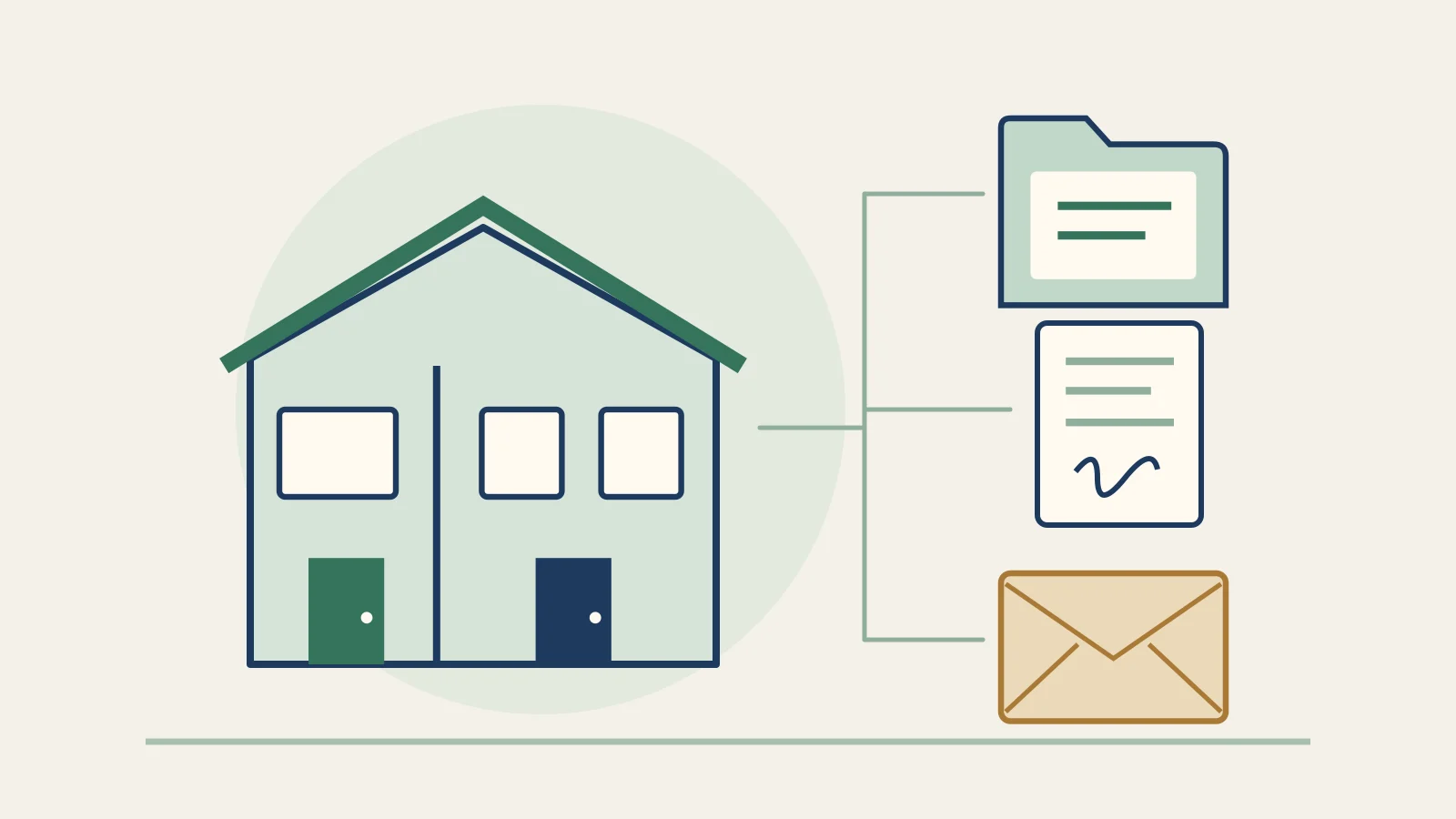
House hacking means living in a home you own while renting out another part. In our duplex example, occupying the smaller unit reduces the owner's monthly budget by $380. Neither arrangement beats renting a comparable home after the building's full costs.
Start with three checks: can you legally rent the space, can you finance this particular arrangement, and can your household fund the property when rent stops? A listing's advertised rental potential answers none of those questions by itself.
The three ways to house hack
Choose a living arrangement you would accept even during a difficult tenancy. More projected rent is not enough if the layout, commute or shared space makes the home unsuitable.
| Arrangement | What you share | Evidence to collect before relying on rent |
|---|---|---|
| Live in one unit of a duplex, triplex or fourplex | Building, grounds and possibly utilities | Recognized unit count, lawful occupancy, leases and the lender's property classification |
| Rent bedrooms in your single-family home | Kitchen, living areas and household routines | Local room-rental rules, insurance coverage, a workable household agreement and lender treatment of boarder income |
| Live in the main home or an accessory dwelling unit | Lot, access and sometimes meters | ADU permits, occupancy approval, rental restrictions, utility responsibility and financing eligibility |
A separate entrance or a second kitchen does not establish that a basement is a legal second unit. Confirm the address with the local planning or building department and obtain the applicable records. Then have the lender and insurer evaluate the same layout. Their classifications serve different purposes.
For bedrooms, agree on guests, shared bills, parking, cleaning and privacy before advertising. For an ADU, distinguish a finished, rentable dwelling from a construction plan: unfinished space has no current tenant income, while permits, construction costs and timing still need funding. Compare separate-unit options in the duplex versus triplex guide.
How it works · illustrated
The building, the lender and the household each answer a different question. Passing one check does not establish the other two.
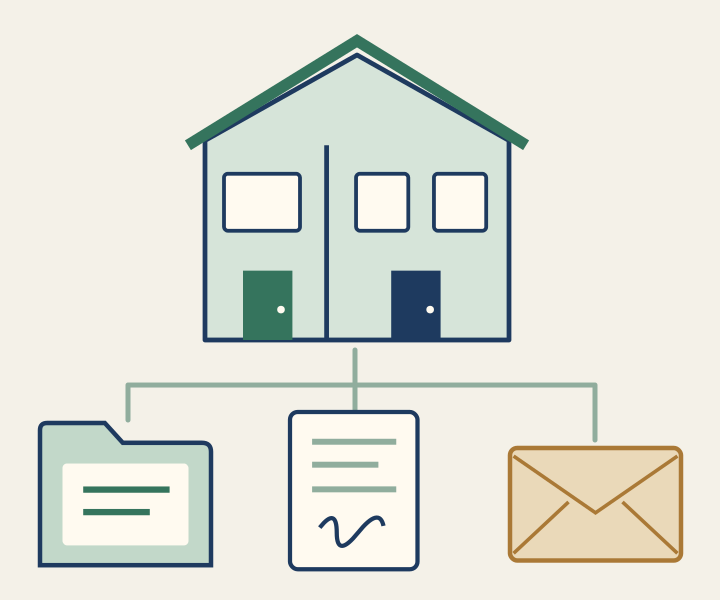
- Property records
- Can the space be rented?
Confirm recognized units, permits and rental restrictions for this address.
- Financing evidence
- Will this rent qualify?
Give the lender the same layout, leases and occupancy plan.
- Household funding
- Can you carry the building?
Include the tenant unit’s repair needs and a period without rent.
Conceptual artwork, not a monetary scale. Original decision framework; the documents shown are illustrations, not government or lender approvals.
RentalCalcs editorial framework · Reviewed October 15, 2026. Program sources and the complete hypothetical budget follow.
Financing a house hack
Owner-occupant financing can require less initial equity than an investment-property loan. Eligibility depends on the borrower, property, loan size and program; a low published down payment is not a complete approval or funding budget.
| Financing path | Potential starting point | Qualification question |
|---|---|---|
| FHA | 3.5% minimum investment for eligible maximum financing; mortgage insurance applies | Does the borrower qualify, does the property meet requirements, and does a three- or four-unit building pass self-sufficiency? |
| Eligible standard Fannie Mae DU purchase, two to four units | Up to 95% loan-to-value, potentially 5% down | Is this the standard eligible case? High-balance and other underwriting paths have different limits. |
| VA purchase for an eligible borrower | Potentially no down payment; no monthly mortgage insurance | Confirm eligibility, entitlement, lender approval, appraisal and occupancy; a funding fee may apply. |
Sources reviewed October 15, 2026: HUD Handbook 4000.1, Fannie Mae's August 5 eligibility matrix and VA purchase-loan requirements. DU means Desktop Underwriter. The Fannie matrix's high-balance limits are 85% for two units and 75% for three to four; its standard 95% row does not describe every conventional loan. VA supports eligible purchases of up to four units, but zero down does not mean zero closing costs.
Can you count the planned rent to qualify?
Do not assume every rental dollar in your household budget becomes qualifying income. Give the lender the actual unit layout, existing leases, rent evidence and your income records. Ask what income can be counted, what documentation is missing and how it affects the full payment you must qualify for.
This matters especially for roommates. Fannie Mae's boarder-income rules generally exclude boarder income, with specific exceptions including HomeReady and qualifying live-in assistance arrangements. Planning to find a new roommate is not proof that the lender will accept that rent. Ask for a program-specific answer before making it necessary to your financing.
For FHA three- and four-unit properties, self-sufficiency is a separate property test. HUD uses appraiser-estimated rent for all units, including the owner's, less the greater of the appraiser's vacancy/maintenance allowance or 25% of rent. PITI cannot exceed that result. The owner's hypothetical rent in this test is not cash received while living there.
FHA generally requires at least one borrower to occupy within 60 days of signing the security instrument and intend to remain at least a year; rehabilitation products can differ. Confirm your loan's requirements. Passing a year is not blanket permission to repeat owner-occupant financing indefinitely or disregard other loan conditions.
A worked example: a duplex with FHA financing
Consider a hypothetical $400,000 duplex with two legal units: a 600-square-foot one-bedroom renting for $1,600 and a 900-square-foot two-bedroom renting for $2,000. Both rents are assumptions, not a market estimate. The owner will occupy one unit and self-manage the other.
Build the cash requirement first
With 3.5% down, the base loan is $386,000. Financing the illustrative 1.75% upfront FHA premium adds $6,755, producing a $392,755 mortgage. That premium is included in the loan here, so it is not added again to cash needed at closing.
| Cash allocation | Hypothetical amount |
|---|---|
| Down payment | $14,000 |
| Closing costs and prepaids, with no credits assumed | $12,000 |
| Initial work | $3,000 |
| Opening property buffer | $12,000 |
| Total capital committed | $41,000 |
The $12,000 buffer is an assumption, not a lender reserve requirement or a claim of sufficiency. Inspection findings, existing deposits, bill dates and the household's separate emergency needs can change it. Reconcile deposits and credits against the lender's Loan Estimate cash-to-close calculation; do not add an earnest-money deposit twice. The first-rental funding guide develops the complete acquisition budget.
Hold the building costs constant
At an illustrative 6.5% fixed rate over 30 years, principal and interest calculate to $2,482.48 a month. The budget rounds that up to $2,483. The rate is a selected assumption, not a current quote.
Preview: 3 of 8 rows
| Whole-building monthly item | Budget |
|---|---|
| Principal and interest | $2,483 |
| Mortgage insurance, planning placeholder | $177 |
| Property taxes | $400 |
| Property insurance | $150 |
| Housing payment subtotal | $3,210 |
| Routine repair allowance | $200 |
| Capital replacement allowance | $200 |
| Total before tenant rent | $3,610 |
Replace the $177 mortgage-insurance placeholder with the lender's actual schedule. Verify taxes after purchase and obtain an insurance quote covering the intended rental use. The two $200 allowances are separate planning set-asides, not actual monthly bills or evidence that the roof is funded. Count a later repair against the relevant reserve without treating the transfer and the same bill as two expenses.
There is no HOA, owner-paid utility difference or paid live-in management in this example. Tenant and owner utilities are separately paid and assumed comparable to the alternative rentals. Add any differences for a real property. The owner's management labor is not priced; excluding it does not make that labor free.
Apply a 5% vacancy and collection-loss allowance to the tenant unit's rent. Do not count rent from the unit occupied by the owner. Keep the full $400 building allowance whichever unit the owner chooses.
Same building · Different living space
Both owner budgets include the same $3,210 payment and $400 whole-building allowance, less effective tenant rent. Each alternative rental matches the owner’s unit.
Live in the two-bedroom
Owning costs $90 more per month in this arrangement.
Live in the one-bedroom
Owning costs $110 more per month in this arrangement.
Every bar starts at $0 and uses the same $0–$2,500 monthly scale. The darker bar is the owner budget; the green bar is comparable rent. Values and the full calculation also appear in the table below.
Original RentalCalcs hypothetical example · USD/month · Reviewed October 15, 2026. Tenant rent: $1,600 or $2,000, less 5% vacancy/collection loss. Self-managed while occupied. No HOA or utility difference; no tax benefit, appreciation, sale, alternative investment return or price for owner labor. Payment and mortgage-insurance assumptions are detailed above. This is a monthly budget comparison, not a wealth forecast.
Open the house-hack decision worksheetThe complete monthly comparison
Preview: 3 of 7 rows
| Monthly comparison | Owner in two-bedroom | Owner in one-bedroom |
|---|---|---|
| Tenant unit's scheduled rent | $1,600 | $2,000 |
| Less 5% vacancy/collection allowance | $80 | $100 |
| Effective tenant rent | $1,520 | $1,900 |
| Whole-building budget before tenant rent | $3,610 | $3,610 |
| Owner's housing budget after rent | $2,090 | $1,710 |
| Rent for a comparable home the owner would occupy | $2,000 | $1,600 |
| Additional monthly cost of owning in this example | $90 | $110 |
Choosing the smaller unit lowers the owner's outlay by $380. But renting a comparable smaller home also costs $400 less. Comparing $1,710 with a two-bedroom rental would mix a property decision with a reduction in living space.
These are monthly cash-budget comparisons. They do not establish which choice builds more wealth: the purchase also commits $41,000 and introduces equity, sale costs, taxes and investment alternatives. Principal paydown is equity, not money available to pay this month's bills. Appreciation or refinancing is not assumed.
Test a month without a tenant and a future move-out
If the tenant unit produces no rent for one month, the owner must fund $3,610, before any additional turnover work. That is $1,520 more than the larger-unit owner's average budget or $1,900 more than the smaller-unit owner's. Actual zero rent replaces the 5% allowance for that month; do not deduct both. The first-timer house-hack math guide goes deeper into funding and vacancy scenarios.
If both units later become rentals, scheduled rent totals $3,600. After 5% loss, $3,420 is collected. Management at an assumed 8% of collections costs $273.60. Subtract the same $3,210 payment and $400 building allowance: property cash flow is -$463.60 a month. Self-managing instead gives -$190 before valuing the owner's work. Moving out does not rescue this example's property budget.
This holds the rate, payment and costs constant to isolate the change in occupancy; it is not a forecast of a future year. Verify occupancy obligations, insurance, licensing, unit turnover costs and financing before converting. The next home's cost is additional. Build a separate full-property forecast using the rental pro forma guide, or the single-family rental calculator for an appropriate one-home rental scenario.
How to find and analyze a property
Work in an order that prevents an appealing rent estimate from hiding a missing approval or a large bill.
- Before an offer: choose an acceptable owner unit; check recognized units and rental restrictions; ask the lender about the specific property and rent treatment. Get preliminary insurance terms.
- During due diligence: inspect the whole building, obtain repair estimates, review leases and deposits, and verify the owner's unit can actually be occupied on the required timeline. Have local counsel review possession and lease obligations; a sale does not promise a vacant unit.
- Before closing: reconcile the Loan Estimate and final closing figures, known work, cash left over and first rent date. Identify who pays each utility and when insurance and any required licenses take effect.
- Before leasing: prepare a compliant lease and consistent screening process, document condition and deposits, and establish repairs and emergency communication procedures.
For rent evidence, match bedrooms, condition, location, parking, utilities and lease term. Asking listings show competition, not confirmed collections. Existing leases and documented comparable rentals help test what a tenant will actually pay. Use the rent-pricing guide before replacing the illustrative rents above.
Reconcile the calculator with the whole-building budget
Use the house-hack calculator to enter the unit sizes, owner unit, rents, loan and costs. Its owner housing subtotal allocates maintenance to the owner's square-foot share. This article reserves for the entire building, including the rented unit: add that remaining share when reconciling the two views.
In the example, the two-bedroom owner occupies 60% of the 1,500 square feet: $240 of the $400 allowance. Add the remaining $160 to an owner-share subtotal. The one-bedroom owner occupies 40%: $160, leaving $240 to add. Enter repairs and capital allowances totaling $400 monthly, and reconcile the actual payment and mortgage-insurance assumptions separately. Do not assume a default calculator result reproduces this rounded budget.
Use the house-hack decision worksheet to record evidence, outstanding questions, the comparable rental and the funding gap. It fills locally for printing; entries are not submitted or automatically saved.
Living next to your tenants
Plan how the arrangement will work on an ordinary Tuesday and during an emergency. A separate entrance does not prevent noise, parking disputes or a midnight leak. Establish a maintenance channel, emergency contact, lawful access procedure and written responsibility for shared spaces and utilities.
Apply consistent, lawful screening and advertising practices. Confirm the fair-housing, landlord-tenant, deposit and licensing rules that apply to your location and arrangement; owner occupancy is not a reason to assume every exemption applies. Budget for qualified local help when an issue exceeds your experience. Keep deposits and rental records organized rather than treating deposits as spending money.
If privacy is essential, price that preference into the choice of unit or property. The highest rent on a spreadsheet does not compensate automatically for an arrangement you cannot sustain.
Common mistakes
- Calling all projected rent qualifying income. Get the lender's documented treatment of units, ADUs or boarders before depending on it.
- Comparing unlike homes. Match the owner's actual unit to a comparable rental, including utilities and parking.
- Reserving only for the owner's portion. The tenant's plumbing and the shared roof still belong in the building budget.
- Confusing a low down payment with affordable ownership. Include fees, work, opening cash and a month with no rent.
- Treating the move-out as automatically profitable. Recalculate all-unit rent, management, turnover, continuing costs and the next home separately.
Bottom line
A workable house hack needs a home you can live in, a lawful rental arrangement, confirmed financing and enough cash to carry the entire building. In this example, the smaller unit lowers monthly outlay but does not make ownership cheaper than a comparable rental. Complete those checks before deciding whether the longer-term tradeoffs justify buying.
Get new articles and market updates
Investing guides and market data, straight to your inbox. Unsubscribe anytime.
