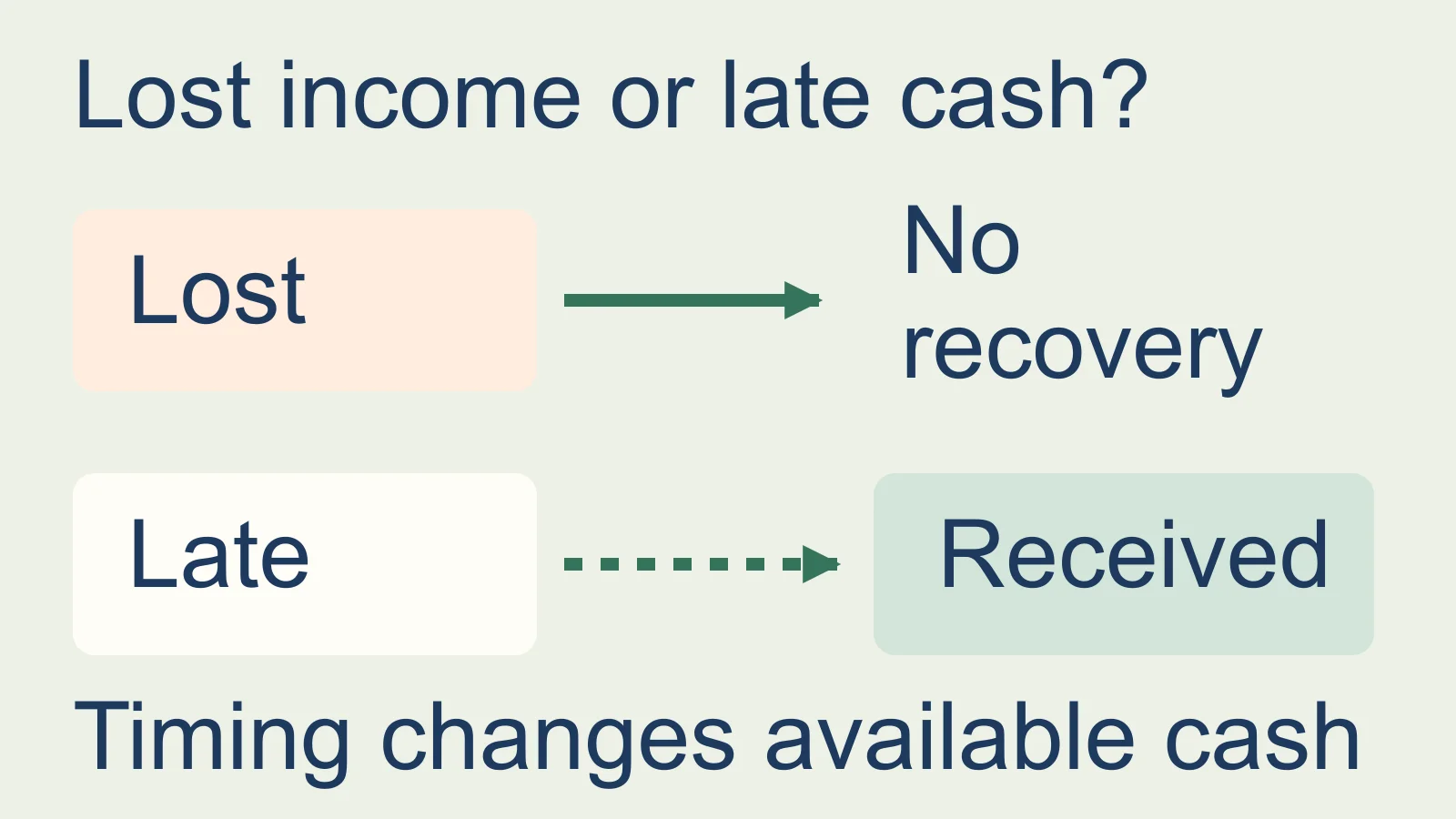
Underwrite a voucher rental with separate lines for vacancy, tenant collection loss, HAP loss and payment timing. Combining them into one optimistic percentage can hide a cash shortage. In the hypothetical house below, a normalized year leaves about $1,645 after reserves and debt; a two-month vacancy plus one month of lost HAP turns that into a $1,661 deficit.
The rent split used here is $1,360 of monthly housing assistance and $290 of tenant rent. It is an assumption for an ordinary tenant-based Housing Choice Voucher, not a Memphis payment schedule or a prediction of a household's behavior. Obtain the actual approved figures using the payment-standard guide.
The decision
Separate profitability from the lowest cash balance
Apply losses only to rent due during occupied periods.
Keep replacement funding below the stated NOI convention.
Model delayed receipts separately from amounts permanently lost.
Which rent can be lost, delayed or never earned?
Vacancy removes rent from both payers. Tenant nonpayment affects tenant rent due. An abatement can remove assistance that will not be paid later. A payment delay can leave an enforceable receivable but still empty the bank account. Each event needs its own amount, time period and evidence.
| Event | Annual income treatment | Cash-calendar treatment |
|---|---|---|
| Unit empty before lease starts | Remove both rent portions for those days | Fund operating bills and debt without rent |
| Tenant rent due but not collected | Apply a documented loss assumption to tenant rent due | Record receipts when received |
| HAP formally abated | Remove the abated amount; do not assume repayment | Fund the missing payment and any repairs |
| HAP due but paid late | Keep income only if it remains collectible | Move the receipt to its expected payment month |
If columns extend beyond the screen, scroll inside the table. Focus the table to scroll with arrow keys.
This is a planning framework, not a finding that any one event will occur. The HUD HAP contract defines the owner's agreement; the payment notice and governing rules determine the status of a particular amount.
How should vacancy and lease-up be modeled?
Use a dated timeline for the first lease and a separate normalized allowance for later years. Do not deduct a full annual vacancy percentage on top of the same explicitly empty months. One market may process a complete tenancy packet quickly while another file waits for missing documents or repairs; neither establishes a universal extra month for voucher rentals.
The example's normalized allowance is $825 a year. That is an assumed 2.5 months of lost rent at $1,650, spread across five years: $4,125 divided by five. It is not a claim that voucher tenants stay five years or that every turn takes 2.5 months. Compare the assumption with actual vacancy dates, completed packets and local operating records.
For the first-year stress case, replace that allowance with two actual empty months: $3,300. Count any overlap between marketing, repairs and agency processing only once. The vacancy-rate guide and market-versus-voucher comparison provide related budgeting context, not evidence for an automatic voucher discount.
How do you calculate tenant collection loss?
Apply tenant collection loss to the tenant rent actually due during occupied months. In the normalized case, the $825 vacancy allowance removes half a month of rent from each payer. Tenant rent due is therefore $290 × 11.5, or $3,335. An assumed 10% loss is $334 when rounded, not 10% of the entire contract rent.
The percentage is deliberately illustrative. It is not a statement about voucher households. The PHA can change the payment split during the lease, so update the payer-specific base when the notice changes. Reconcile charges, receipts, credits and open balances rather than inferring performance from tenant income or assistance status.
The household does not owe the PHA's covered portion under 24 CFR 982.451. A missing HAP receipt belongs in a separate investigation. Do not shift it into tenant arrears merely to make the ledger balance.
How are abatement and a payment delay different?
An abatement is not just a late deposit. HUD's owner-maintenance and PHA-remedies rule distinguishes withholding and abatement; the actual notice determines what is recoverable and what must be corrected. Avoid a blanket assumption that every interruption will be repaid after a repair.
The HCV NSPIRE compliance date has been extended to February 1, 2027; the HUD notice index distinguishes that transition from other portfolios. Ask which authorized protocol applies now and retain the inspection findings and deadlines. This guide does not assume a well-maintained property can never lose assistance.
For normalized planning, the example sets a separate $198 allowance for permanent HAP loss. In the stress case, one occupied month's $1,360 HAP is lost instead. It does not sit on top of the same $198 allowance. A different two-month delay, if the money remains owed, would require a $2,720 bridge but would not by itself reduce eventual annual income.
Start with $5,000 available after closing. In this illustrative first year, cash falls to -$664 in month 5, before delayed HAP arrives in month 6.
Same $1,650 rent and annual stress budget as below. Tenant cash is $261 per occupied month ($290 due less $29 permanently lost). Other operating bills are spread evenly at $5,500 ÷ 12, plus management at 8% of actual receipts. Each month also funds $125 replacements and $693.58 debt service. Real due dates, closing costs and one-time repairs can require more cash.
- Month 1Vacant
No rent is earned; the bills continue.
- Cash received
- $0
- Cash paid / set aside
- $1,277
- HAP still collectible
- $0
- Closing available cash
- $3,723
- Month 2Vacant
The second empty month replaces the normalized vacancy allowance.
- Cash received
- $0
- Cash paid / set aside
- $1,277
- HAP still collectible
- $0
- Closing available cash
- $2,446
- Month 3HAP permanently lost
$1,360 HAP is removed from income; no receivable remains for it.
- Cash received
- $261
- Cash paid / set aside
- $1,298
- HAP still collectible
- $0
- Closing available cash
- $1,409
- Month 4HAP delayed
$1,360 HAP is earned and collectible, but not yet received.
- Cash received
- $261
- Cash paid / set aside
- $1,298
- HAP still collectible
- $1,360
- Closing available cash
- $373
- Month 5HAP delayed
Another $1,360 is delayed. Two months now await payment.
- Cash received
- $261
- Cash paid / set aside
- $1,298
- HAP still collectible
- $2,720
- Funding shortfall
- -$664
- Month 6HAP catches up
$4,080 HAP arrives: $2,720 catch-up plus $1,360 for this month.
- Cash received
- $4,341
- Cash paid / set aside
- $1,624
- HAP still collectible
- $0
- Closing available cash
- $2,053
Months 7–12: each brings $1,621 of receipts and about $214 of cash after bills, reserve funding and debt. Year-end available cash is $3,339: the $5,000 opening balance less the annual $1,661 stress deficit.
Read the two balances separately. The $2,720 receivable in month 5 is money still owed, not cash to pay bills and not another income loss. With 8% management paid on receipts, the delay reduces available cash by $2,502.40 versus timely payment; the other $217.60 of fees is deferred too.
Under these month-end assumptions, opening funding would need to be at least $5,665 (rounded up) to avoid the shortfall. This is not a reserve recommendation or an intramonth cash minimum.
| Month / event | Tenant cash | PHA cash | Cash paid / set aside | Collectible HAP at end | Closing available cash |
|---|---|---|---|---|---|
| 1 · Vacant | $0 | $0 | $1,277 | $0 | $3,723 |
| 2 · Vacant | $0 | $0 | $1,277 | $0 | $2,446 |
| 3 · HAP permanently lost | $261 | $0 | $1,298 | $0 | $1,409 |
View all 12 rowsCollapse 12-row table
| Month / event | Tenant cash | PHA cash | Cash paid / set aside | Collectible HAP at end | Closing available cash |
|---|---|---|---|---|---|
| 1 · Vacant | $0 | $0 | $1,277 | $0 | $3,723 |
| 2 · Vacant | $0 | $0 | $1,277 | $0 | $2,446 |
| 3 · HAP permanently lost | $261 | $0 | $1,298 | $0 | $1,409 |
| 4 · HAP delayed | $261 | $0 | $1,298 | $1,360 | $373 |
| 5 · HAP delayed | $261 | $0 | $1,298 | $2,720 | -$664 |
| 6 · HAP catches up | $261 | $4,080 | $1,624 | $0 | $2,053 |
| 7 · Regular receipts | $261 | $1,360 | $1,407 | $0 | $2,267 |
| 8 · Regular receipts | $261 | $1,360 | $1,407 | $0 | $2,481 |
| 9 · Regular receipts | $261 | $1,360 | $1,407 | $0 | $2,696 |
| 10 · Regular receipts | $261 | $1,360 | $1,407 | $0 | $2,910 |
| 11 · Regular receipts | $261 | $1,360 | $1,407 | $0 | $3,125 |
| 12 · Regular receipts | $261 | $1,360 | $1,407 | $0 | $3,339 |
If columns extend beyond the screen, scroll inside the table. Focus the table to scroll with arrow keys.
Download the monthly cash ledger CSV
Original hypothetical timing, not a PHA payment schedule. A negative balance means additional funding is needed; no overdraft, interest or funding injection is modeled. Keep a permanent loss only once and a collectible delay only in receipt timing. The notice controls collectibility: 24 CFR 982.404. Reviewed October 17, 2026.
What does the complete rental budget show?
The normalized case is profitable by about $137 a month after reserves and debt, but that margin does not fund a bad first year. The loan, repairs and replacement funding must appear below or alongside the operating calculation before the result can support a purchase decision.
Hypothetical $139,000 house; 25% down; $104,250 loan at 7% for 30 years. Rent is $1,650 a month, split $1,360 HAP/$290 tenant. Management is 8% of collections. Taxes, insurance, routine repairs and compliance spending total $5,500 a year. Replacement funding is a separate $1,500. These are model inputs, not local quotes or recommended loss rates.
| Annual line | Normalized year | First-year stress |
|---|---|---|
| Gross scheduled rent | $19,800 | $19,800 |
| Vacancy | −$825 | −$3,300 |
| Tenant collection loss | −$334 | −$290 |
View all 11 rowsCollapse 11-row table
| Annual line | Normalized year | First-year stress |
|---|---|---|
| Gross scheduled rent | $19,800 | $19,800 |
| Vacancy | −$825 | −$3,300 |
| Tenant collection loss | −$334 | −$290 |
| HAP loss | −$198 | −$1,360 |
| Effective income | $18,444 | $14,850 |
| Management | −$1,475 | −$1,188 |
| Other operating expenses | −$5,500 | −$5,500 |
| NOI before replacement reserves | $11,468 | $8,162 |
| Replacement reserve | −$1,500 | −$1,500 |
| Principal and interest | −$8,323 | −$8,323 |
| Cash after reserve and debt | $1,645 | −$1,661 |
If columns extend beyond the screen, scroll inside the table. Focus the table to scroll with arrow keys.
The normalized collection-loss amount is $333.50 and effective income is $18,443.50 before rounding. NOI is $11,468.02; the annual mortgage payment is $8,322.93. Rounded line items may not sum exactly. The stress case uses ten occupied months for tenant rent due, a 10% tenant-loss assumption and one separate lost HAP month during occupancy. No vacancy or abatement dollars are counted twice.
The definition matters: the $1,500 replacement allocation reduces spendable cash, but this guide excludes it from NOI. A lender or commercial reporting standard may deduct a reserve in its own underwritten cash flow. Reconcile that convention before comparing ratios. The NOI guide and CapEx reserve guide explain the distinction.
Translate annual profit into opening cash
The stress case loses $1,661 across the year before acquisition expenses and one-time work. That is not the maximum funding need. If the empty months and repairs come first, the lowest monthly bank balance can be worse even when later receipts offset part of the loss.
Start the cash calendar with cash actually reserved after closing. Enter debt, taxes, insurance, utilities and repairs in their due months; enter tenant and PHA receipts separately. Security deposits are liabilities, not rental income available to improve the modeled yield. For an occupied acquisition, use the in-place tenant checklist to reconcile the seller's receivables and deposits.
Use the worked calendar above to reconcile the opening and closing balances, then enter your actual payment dates in the worksheet. Keep cash set aside for replacements separate from available cash; do not count both a reserve transfer and a repair paid from that same reserve as two new cash requirements.
How should the market-rate alternative be compared?
Hold the house, expense scope, financing and holding period constant. Change only inputs supported by the alternative lease: achievable rent, utility responsibilities, fees, actual lease-up and evidenced loss assumptions. A larger amount paid by an individual tenant does not establish a higher default rate; a PHA payer does not eliminate administrative or compliance interruptions.
If the alternative rent is unknown, leave it unresolved rather than claiming a voucher premium from a county index. The FMR explanation distinguishes a rent reference from approved owner rent. A controlled comparison should show both annual cash and the money required before receipts begin.
Which assumptions need evidence before an offer?
The most consequential inputs are the ones that change the sign of cash flow or require funding you do not have. Replace them first rather than adding precision to a minor expense.
- Reconcile approved rent and both payment portions to the current notices and lease.
- Obtain actual vacancy and collection records for the property when authorized; do not substitute a claim about typical voucher tenants.
- Review inspection notices and unresolved items, with repair scope and written quotes where needed.
- Confirm which management fees apply to billed rent, collected rent, leasing and repairs.
- Compare the monthly low-cash point with available reserves, separately from the annual yield.
Run the scenarios with your verified inputs
Use the Section 8 investment analyzer for the property comparison and the single-family calculator for the complete purchase budget. Keep this worksheet beside the model: a single vacancy input may need a reconciled combined loss amount, while the receipt calendar remains separate.
Carry supported NOI into the voucher valuation guide. A positive normalized yield is useful only if the owner can fund the actual timing and the price does not require unsupported future rent.
Keep the assumptions with the evidence
Open the free loss assumptions and monthly cash worksheet. It includes the worked inputs, source links and blank spaces for your own records. Print or download the CSV; no account is required and this worksheet does not save your data.
Open printable worksheetDownload example CSVGet new articles and market updates
Investing guides and market data, straight to your inbox. Unsubscribe anytime.