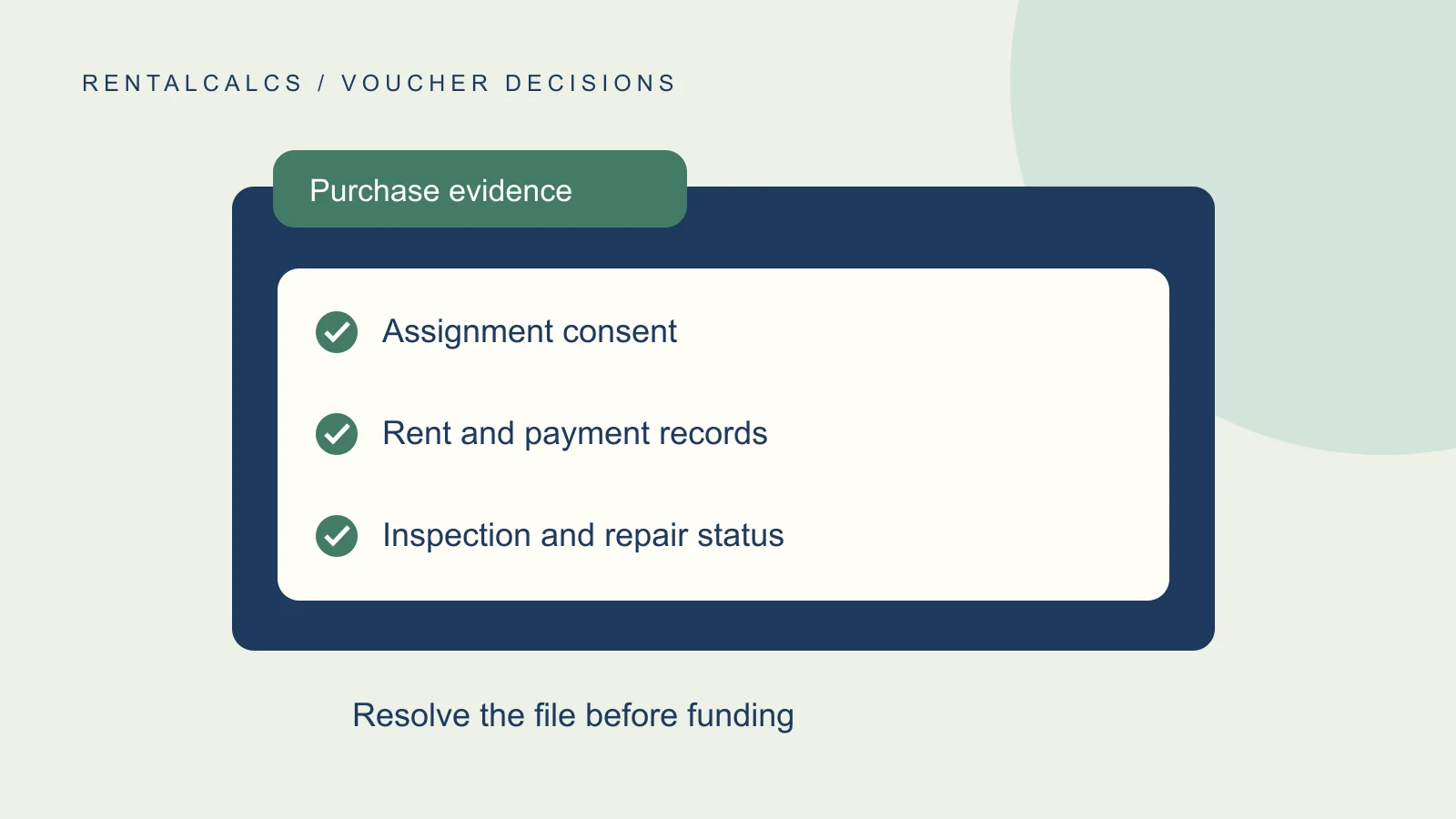
An occupied voucher rental gives a buyer records to inspect, not an automatic income guarantee. The purchase works only if the approved rent is collectible, the assistance arrangement can continue with the new owner and the building's costs leave enough cash.
For an ordinary sale involving tenant-based Housing Choice Vouchers, start with one fact: the owner cannot assign the HAP contract without the PHA's prior written consent. A signed purchase contract and new deed do not substitute for that consent. HUD-52641, Part B, section 14 sets out the assignment requirement.
This guide addresses that tenant-based arrangement. Project-based contracts and foreclosure protections require their own review. The duplex figures below are hypothetical; no seller, tenant or actual transaction is described.
How the HAP Contract Transfers
Before closing: ask the seller to initiate the PHA's ownership-change process and authorize appropriate record sharing. Confirm which entity will acquire the property, who may sign, what documents the agency requires and how written consent will be delivered. Resolve conditions with the closing team while contractual options remain available.
At closing: reconcile the lease assignment, deposits, rent proration, outstanding receivables and any seller credit for unfinished work. Record who receives or forwards payments that arrive around the ownership change. The settlement statement and PHA payment file must refer to the same parties and effective dates.
After closing: complete any permitted post-closing proof-of-ownership steps, confirm the approved payee and verify the first remittance. A new bank account entry is not proof that all prior obligations have transferred correctly. HUD's HAP contract guidebook, ownership-change chapter is the federal starting point; the agency supplies its actual packet.
Do not invent a national two-week transfer timetable. Ask which steps are prerequisites to consent, which require a recorded deed and which affect the payment cycle. Put unresolved items in the acquisition decision instead of assuming they will clear after funding.
Verifying the Actual Payment Structure
Reconcile each unit across four records: the executed HAP contract, the latest rent/payment notice, the tenant ledger and the PHA remittance history. Obtain documents through authorized channels and keep household information out of public worksheets.
| Record | Check against the rent roll |
|---|---|
| Lease and tenancy addendum | Unit, rent, term, utilities, deposits and amendments |
| Current PHA notice | Effective date, approved rent, HAP amount and tenant rent |
| PHA remittances | Period covered, payee, adjustments, reversals and missing payments |
| Tenant ledger and receipts | Amount due, amount received, arrears and credits |
Suppose Unit A's approved rent is $950: $750 HAP plus $200 tenant rent. Unit B is $925: $800 HAP plus $125 tenant rent. Together, owner rent is $1,875 monthly, including $1,550 HAP and $325 tenant rent. A deposit showing only $1,550 does not prove all rent was collected; a deposit above it may include a prior-period adjustment.
Use the latest effective notice rather than the original contract's split. The PHA amount can change, and the tenant is not responsible for the portion covered by HAP. 24 CFR 982.451 describes those boundaries. The broader seller rent-roll checklist helps reconcile accrued rent with cash receipts.
Confirming the Rent is at Market
Build the acquisition's base case from verified current rent. Put any proposed increase in a separate scenario with its intended effective date. A new owner does not gain an automatic right to reset every lease or collect the top payment-standard figure.
Compare similar unassisted units with the same condition, bedroom count and utility responsibility. The PHA must review rent reasonableness before an increase; its current reasonable-rent determination limits rent to owner. See 24 CFR 982.507. Read the existing lease, agency process and applicable notice rules before scheduling a change.
The FMR and approved-rent guide explains why a higher schedule does not establish immediate upside. For a purchase with old leases, the below-market lease analysis separates current income from future potential.
The Inspection Factor
Ask for the latest inspection report, open deficiency notices, correction deadlines, proof of completed repairs and written payment status. A passed program inspection six months ago is not a building-condition warranty. Commission your own property inspection and capital assessment; inspect common systems as well as occupied units with proper access arrangements.
HUD's mandatory NSPIRE compliance date for HCV is February 1, 2027, following an extension through January 31. An agency may already use the newer standards. Confirm the procedure actually in force for these units; the separate October 2026 Public Housing/Multifamily scoring date is not the HCV deadline. HUD's official notice index records the distinction.
Do not group all missing HAP into “late rent.” Current rules distinguish amounts withheld during a correction period from abatement after failure to cure. Under 24 CFR 982.404, qualifying timely correction requires payment of withheld amounts; abatement is a different loss. Obtain the written basis, dates and amount for this specific file. Unresolved payment eligibility belongs in the closing conditions and purchase price, not a hopeful receivable.
Running the Numbers on an In-Place Section 8 Property
Buy the fictional duplex for $165,000, using the $1,875 verified monthly rent above. Assume 3% vacancy/collection loss for planning, not because the tenants have vouchers. Budget $2,100 property tax, $1,400 insurance, $1,800 routine repairs including ordinary turn work and $1,200 annual capital reserve. Assume no other owner-paid utilities or operating costs; a real property must replace that assumption with its lease responsibilities and bills. Management is 8% of collected income, with routine leasing assumed included.
Preview: 2 of 9 rows
| Annual budget | Amount |
|---|---|
| Scheduled rent | $22,500 |
| Vacancy and collection loss, 3% | −$675 |
| Collected income | $21,825 |
| Management, 8% of collections | −$1,746 |
| Taxes, insurance and routine repairs | −$5,300 |
| NOI before capital reserve | $14,779 |
| Capital reserve | −$1,200 |
| Principal and interest | −$10,130 |
| Cash after reserve and debt | $3,449 |
Financing is a $123,750 loan, 75% of price, at an illustrative 7.25% fixed for 30 years. The monthly payment is about $844; annual debt service uses the unrounded payment, about $10,130. This is not a current financing quote. NOI divided by price is about 9.0%, before reserves and financing, using this article's stated convention.
Initial cash is $54,250: $41,250 down payment, $5,000 closing costs, $2,000 immediate work and $6,000 starting liquidity. The $3,449 annual cash result is a 6.4% modeled cash yield on that entire commitment, about $287 per month for the building. Using only the down payment would display 8.4% and omit $13,000 tied up in the purchase.
The starting buffer stays in the denominator; it is not automatically a recurring expense. The annual reserve is a planned allocation for future replacements. Use the cash-on-cash guide and capital-reserve guide to keep those uses of cash separate.
Stress Testing the Same Duplex
First test timing. If two months of the $1,550 HAP are administratively delayed but remain owed, $3,100 of receipts arrive later. Earmarking that amount from the $6,000 buffer leaves $2,900 before other unexpected costs. This is an incremental bridge requirement, not a complete monthly bank balance. Rent from the household, bill due dates and later catch-up payments still belong in a cash calendar. No catch-up payment is assumed unless the amount is confirmed payable.
Now test loss. If one month of Unit A's $750 HAP is actually abated and an extra $1,500 repair is needed, the annual budget changes permanently. Holding the ordinary 3% vacancy/collection allowance separate, and assuming an 8% management fee is avoided on the lost $750, cash falls by $690 + $1,500 to about $1,259. Model the lost assistance once; do not also treat it as a collectible delayed receipt. If the management contract charges on scheduled rent, the fee saving disappears.
Test the decision
Separate delayed receipts from lost income
Hypothetical example, reviewed October 9, 2026. Uses the worked duplex: $14,779 base NOI, $1,200 annual reserve, a $123,750 loan at 7.25% for 30 years and $54,250 committed cash. The delay test earmarks an incremental bridge; it is not a complete cash calendar. Lost assistance is separate from delayed money.
Buffer after earmarking delayed receipts
$2,900
6.4% modeled annual cash yield after additional loss and repair. A negative buffer is a funding gap.
Available bridge cash$6,000
Delayed receipts to bridge$3,100
Original RentalCalcs calculation. Bars show dollar magnitude; red and a minus sign mean negative cash. Values are rounded for display.
- Delayed receipts to bridge
- $3,100
- Buffer after earmarking the bridge
- $2,900
- Base annual cash after reserve and debt
- $3,449
- Annual cash after additional loss and repair
- $3,449
The additional loss test retains the base 3% ordinary loss allowance and reduces management fees by 8% of assistance actually lost. Do not count the same amount as both a delayed receivable and an abatement. Confirm payment eligibility in writing.
Download the purchase evidence worksheet (CSV)Free to use without an account. This illustration does not save a deal.
Checking the PHA's Process
Evaluate the process you will actually use. Request the owner-change checklist, accepted submission channel, payment calendar, remittance access and escalation contact. Ask whether this particular file is missing anything. An unanswered general inquiry is not proof that a contracted payment will fail; an unresolved notice in the file is concrete evidence to investigate.
If hiring management, ask who follows up on missing payments and who retains inspection documentation. A written scope is more useful than a vague promise that the manager “handles Section 8.”
What About the Existing Lease?
Review the lease, amendments and HUD tenancy addendum together. Identify remaining term, utility obligations, deposit handling, notices and promises the seller made. The tenancy addendum takes precedence over conflicting lease language under the HUD HAP contract, Part C.
An ownership change is not an excuse to collect unapproved extra rent or shift the PHA's portion to the tenant. Have the closing team resolve lease and local-law questions before buying. The Section 8 program overview is useful orientation, but it cannot determine the rights under this particular lease.
Three Mistakes in an Occupied Voucher Purchase
Treating bank deposits as the approved rent. Deposits may include arrears, adjustments or multiple units. Match the service period and unit before using them as recurring income.
Counting unapproved rent increases at closing. A larger payment standard, a seller's application or an agent's estimate is not an approved increase with an effective date.
Using one cash buffer for several obligations. If $3,100 is needed to bridge receipts, that money is temporarily unavailable for a roof deposit or insurance deductible. Test concurrent demands on the same dollars.
Due Diligence Checklist for Section 8 In-Place Properties
Before removing acquisition contingencies, the file should answer these questions:
- Has the PHA given the required written assignment consent, and are its conditions resolved?
- Do current rent notices, leases, tenant receipts and HAP remittances reconcile by unit and month?
- Are any payments withheld, abated, disputed or subject to recovery, and how are they allocated at closing?
- What repairs remain, who pays, and what written evidence closes the deficiency?
- Which owner and payee details must change, and who verifies the first remittance?
- Does committed cash include closing costs, immediate work and liquidity in addition to the down payment?
The downloadable worksheet in the stress test provides a blank evidence log. Keep names, bank information and household income documents in your secure transaction file, not in a shared planning sheet.
Running Your Own Analysis
Use the single-family calculator to rebuild the one-to-four-unit budget and the Section 8 analyzer to explore rent assumptions. Neither replaces PHA consent or a document review.
An occupied property earns a stronger base case through reconciled records and resolved conditions. If the deal depends on a rent increase that has not been approved, unpaid amounts whose status is unclear, or cash already assigned to another expense, price those uncertainties before closing.
Get new articles and market updates
Investing guides and market data, straight to your inbox. Unsubscribe anytime.
