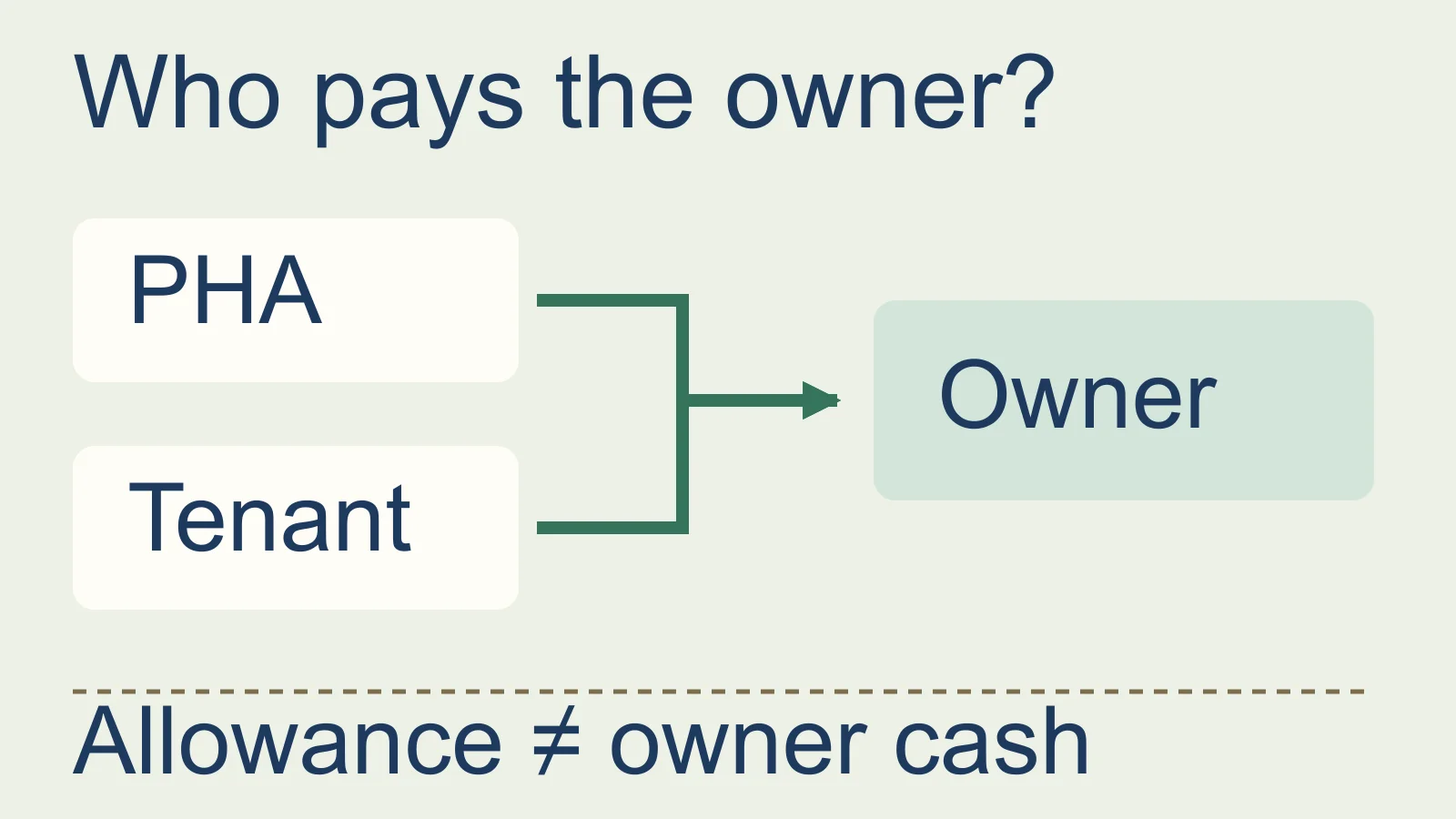
A Section 8 payment standard is an input to the household's assistance calculation, not the rent a landlord is entitled to collect. In the example below, a $1,750 standard supports $1,600 of owner rent: $1,300 from the housing authority and $300 from the tenant. The remaining $150 is a utility allowance, not another payment to the owner.
This guide covers ordinary tenant-based Housing Choice Vouchers (HCV). It follows the money from the published reference to an approved lease. Project-based assistance, special housing types and household-specific exceptions need their own rules. The broader Section 8 investing guide explains the operating tradeoffs.
The decision
Approve the rent before modeling the income
Match the address, bedroom size and effective schedule.
Keep owner rent, tenant rent and utility support separate.
Fund the gap between preparing the unit and receiving rent.
How does a payment standard become owner rent?
The housing authority calculates assistance using the applicable payment standard, gross rent and the household's total tenant payment. The result may fund owner rent, a utility reimbursement, or both. A landlord cannot work backward from a published standard and assume every household can lease at that amount.
- Rent to owner: the approved monthly contract rent, before subtracting either payer's share.
- Utility allowance: the PHA's allowance for the utilities the household must supply, not a forecast of its actual bill.
- Gross rent: rent to owner plus the applicable utility allowance.
- Total tenant payment (TTP): a household amount determined by the PHA. It is not necessarily the tenant's check to the landlord.
For an ordinary unprorated example, assistance is the lower of the applicable standard or gross rent, less TTP, with a floor of zero. Assistance above owner rent becomes a utility reimbursement. See HUD's rent and HAP calculation chapter for the household rules and exceptions. The FMR calculation guide explains those definitions in more detail.
Illustrative monthly dollars. Only the two payments in the owner lane add up to the approved $1,600 rent.
A comparison input, not a payment.
Plus $150 utility allowance = $1,750 gross rent.
Lower of standard ($1,750) or gross rent ($1,750), less $450 total tenant payment (TTP) = $1,300.
Payments to the owner
Owner HAP
$1,600 rent − $1,300 HAP
Owner receives $1,600, assuming both pay in full.
Change only TTP to $50: $1,750 − $50 = $1,700 total assistance.
- PHA → owner: $1,600; tenant → owner: $0.
- Remaining assistance → family or utility supplier: $100 utility reimbursement.
The $150 allowance still is not a second owner payment.
Ordinary unprorated tenant-based HCV example; assistance has a zero floor. The PHA determines inputs and any exceptions. Approval and the initial affordability test still apply. Method: HUD rent and HAP calculation chapter, sections 3.1–3.4. Reviewed October 17, 2026.
Which FMR or SAFMR applies to the property?
Use the authority's adopted schedule for the address, program, bedroom size and applicable date. HUD's metro or nonmetropolitan-county Fair Market Rent and ZIP-based Small Area FMR are reference layers. Neither establishes the rent approval for a particular unit.
The basic payment-standard range is generally 90% to 110% of the relevant FMR, but exception and reasonable-accommodation provisions mean that range is not universal. HUD's June 2025 payment-standard guide distinguishes mandatory SAFMR areas, voluntary adoption and exceptions. A ZIP boundary is not a housing authority's service boundary.
Use the ZIP rent lookup to identify the displayed HUD reference and fiscal year, then obtain the administering PHA's schedule. The SAFMR guide explains the ZIP layer. A FY2027 HUD value and an older locally effective schedule can both appear in a file; record their different dates instead of treating the newest upload as local adoption.
What changes when rent exceeds the standard?
In this ordinary example, assistance stops increasing once gross rent reaches the applicable payment standard. Additional approved owner rent therefore increases the household's share. At initial occupancy, a gross rent above the standard also triggers the 40% adjusted-monthly-income limit in 24 CFR 982.305.
Assume the PHA has supplied a $1,750 applicable standard, $150 utility allowance and $450 TTP. Adjusted monthly income is $1,500. Each proposed rent below still needs rent-reasonableness approval; these are hypothetical inputs, not a local schedule or eligibility determination.
| Monthly amount | Base rent | At the boundary | Above the boundary |
|---|---|---|---|
| Rent to owner | $1,600 | $1,750 | $1,775 |
| Utility allowance | $150 | $150 | $150 |
| Gross rent | $1,750 | $1,900 | $1,925 |
View all 7 rowsCollapse 7-row table
| Monthly amount | Base rent | At the boundary | Above the boundary |
|---|---|---|---|
| Rent to owner | $1,600 | $1,750 | $1,775 |
| Utility allowance | $150 | $150 | $150 |
| Gross rent | $1,750 | $1,900 | $1,925 |
| Assistance paid to owner | $1,300 | $1,300 | $1,300 |
| Tenant rent to owner | $300 | $450 | $475 |
| Family share including allowance | $450 | $600 | $625 |
| Share of adjusted monthly income | 30.0% | 40.0% | 41.7% |
If columns extend beyond the screen, scroll inside the table. Focus the table to scroll with arrow keys.
The $1,750 proposal reaches the initial 40% boundary; $1,775 exceeds it. A $25 rent increase can therefore change approvability even though it barely changes the owner's operating budget. Use the unrounded household calculation at a boundary. The PHA makes the actual determination under 24 CFR 982.505 and the initial-occupancy rule above.
Including utilities does not create free income
Suppose the owner instead includes those utilities, receives $1,750 of approved rent and actually spends $150 a month on them. Gross rent remains $1,750 with no tenant-paid allowance; the owner's receipts after that utility cost are $1,600. That equals the original rent before other costs. The PHA must approve the changed responsibility and allowance; actual bills could be higher or lower.
Compare the full utility cost and rent-reasonableness evidence before changing the lease. Moving an expense from one party to another is not itself an improvement in the building's economics.
How do you verify the PHA's adopted schedule?
Build a short source file that another person can reproduce. An undated screenshot with a large bedroom amount is not enough to establish which schedule governs a tenancy.
- Identify the PHA administering the voucher and confirm the property is within the relevant jurisdiction. Portability can make the office nearest the property the wrong starting assumption.
- Save the official payment schedule and administrative-plan reference. Record the program, geographic coverage, effective date and whether it applies to a new tenancy or a continuing one.
- Confirm the family unit size and rented unit size. The ordinary rule uses the lower applicable payment standard, with household and exception rules handled by the PHA.
- Obtain the utility responsibility, applicable allowance and written rent determination. Reconcile the final owner/tenant payment split to the lease and HAP documents.
Use the authority directory for agency discovery, then rely on the administering agency's own documents. HUD's payment calculation rule governs the ordinary unit-size comparison; it is not permission to select whichever nearby schedule pays most.
Which inspection rules apply in 2026?
As reviewed October 17, 2026, HUD extended the HCV, PBV and Moderate Rehabilitation NSPIRE compliance date to February 1, 2027. Confirm which authorized inspection protocol the PHA currently uses. Do not apply the separate October 2026 Public Housing/Multifamily scoring date to every voucher lease. The dates and program scopes are listed in HUD's NSPIRE notices.
The owner still needs a compliant unit and a way to resolve defects promptly. Save the inspection report, defect classification, repair deadline and proof of completion. Ask how reinspection and payment status are confirmed. The actual notice and applicable program rules control; an informal statement that the unit is ready does not establish approval.
- Find the applicable schedule
Record the PHA, program, geography, date and utility responsibilities.
- Submit the complete tenancy file
Proposed rent and the lease still need PHA review; a reference amount is not approval.
- Resolve approval and condition
Retain the rent determination, inspection result and required repair evidence.
- Reconcile the executed documents
Match the approved lease, HAP effective date, payer amounts and first receipt.
Sequence, not a promised timeline. Follow the administering PHA’s written process before committing to a start date.
Reviewed October 17, 2026. Context: PHA approval of assisted tenancy. The steps are an original RentalCalcs decision aid.
Why can reasonable rent be lower than the payment standard?
The PHA compares the proposed rent with comparable unassisted units, considering location, condition, size, type, age, amenities, services and utilities. A high standard does not override weak rental comparables. Rent reasonableness is a separate control under 24 CFR 982.507.
Assemble comparable units with a matching utility arrangement and meaningful differences explained. A renovated three-bedroom with parking cannot establish the same rent for an unrenovated two-bedroom without adjustments. The rent-pricing guide helps organize the market evidence; the PHA's determination still governs the assisted tenancy.
How much cash is needed before the first payment?
An approved monthly budget does not pay the bills during an empty or unpaid month. In an illustrative lease-up, two months without rent at $1,600 mean $3,200 of forgone gross rent. If the lease later becomes effective but two $1,300 HAP payments are still owed, another $2,600 may be temporarily unavailable. Those are different events: lost occupancy and a collectible receivable.
Do not combine those amounts into a claimed reserve requirement without a cash calendar. Add the actual mortgage, insurance, utilities, repair spending and tenant receipts in the months they occur. The vacancy and collection-loss guide works through annual profitability and first-year cash separately.
What obligations continue after approval?
The payment split can change during the contract. Reconcile every PHA notice to the rent ledger, retain inspection and repair records, and follow the applicable process before requesting a rent increase. Under the HAP contract rule, the household is not responsible for the PHA's covered rent portion; a late agency payment is not permission to collect that amount from the tenant.
An owner buying the property should also obtain the required assignment consent and reconcile the existing file. The occupied-property purchase guide covers that separate transaction. This is general program information; use the administering PHA's written process and appropriate local advice for a specific dispute.
Build the property budget from the approved figures
Enter owner rent, owner-paid utilities and real operating costs into the Section 8 investment analyzer. Compare the same property with a market tenancy using the cash-flow comparison guide. Neither a payment-standard range nor a HUD-to-market index ratio establishes an achievable rent premium.
For purchase pricing, carry the supported income into the HAP valuation guide. The sequence matters: confirm the rent and responsibilities first, fund the lease-up second, and only then decide what those cash flows are worth.
Keep the assumptions with the evidence
Open the free rent approval and utility worksheet. It includes the worked inputs, source links and blank spaces for your own records. Print or download the CSV; no account is required and this worksheet does not save your data.
Open printable worksheetDownload example CSVGet new articles and market updates
Investing guides and market data, straight to your inbox. Unsubscribe anytime.
