
Compare the pricing measure before choosing a yield
A cap divides annual net operating income by price before debt. The quoted denominator is useful only when the income and property scope match.
Dated pricing comparison
| Reference / observation period | Published cap | Income basis and limits |
|---|---|---|
| Newmark average cap series Q2 2026; report page 6 | 5.7% | Publisher average, reported down 10 bps quarterly and 20 bps annually within its series. Cap-reporting count, transaction threshold, weighting and trailing/forward NOI are not disclosed. This cannot be subtracted from the other broker's cohort as a market trend. |
| Marcus & Millichap publisher average Through Q1 2026; Q2 report | 6.50% | Publisher-reported average cap. Sales research generally covers $1m+ transactions; cap-reporting subset, weighting and NOI basis undisclosed. Explicit Maryland release binding; no fresh source request at build time. |
On narrow screens, focus or swipe the bounded table to read all columns. Complete methods and source text are available without signing in.
Which local facts change Baltimore's buyer income?
| Measure | Value / period | Limit |
|---|---|---|
| Newmark occupancy / effective-rent growth | 95.9% / +0.5% year-over-year Q2 2026 | RealPage inventory. Effective rent is not the subject's collected income; no automatic reconciliation to the earlier Marcus vacancy series. |
| Newmark absorption / deliveries | 2,049 / 439 units First half 2026 | Both are H1 totals. They do not establish which competitor is available during the subject's renewals. |
| Downtown / Towson–Hunt Valley effective-rent growth | −0.2% / +1.5% year-over-year Q2 2026, selected submarkets, p. 13 | Operating comparison, not neighborhood caps or a city-versus-county legal test. No full proprietary table is reproduced. |
Baltimore City: the seller's license does not simply transfer
Observed: Current City Code §5-12 prohibits transferring a rental license and requires a new-license application within 60 days after assuming record ownership or operation. Section 5-4 separately restricts renting and collecting rent without the required license.
An occupied building can appear to have steady contractual rent while the buyer's right to operate and collect depends on a separate licensing file. The application deadline alone does not establish an unconditional right to collect rent during the interval.
RentalCalcs interpretation: Treat licensing as a closing dependency, not a minor administrative line. Older official 2021/2022 PDFs still describe a 15-day transfer process; do not use that superseded wording to justify automatic continuity.
What would change this view, and what to request
A documented current procedure, timely complete buyer application and confirmation of the subject's lawful operating status can reduce the interruption risk. This report does not decide the legal status of a particular buyer or unit.
Next document or test: Obtain the current license, inspection and violation records, buyer application requirements and written agency or counsel confirmation of operating/collection treatment across closing. Resolve the timing before assigning full scheduled income to the first buyer year.
Evidence: Baltimore City Code §5-12 — transfer prohibited Baltimore City Code §5-4 — license required
Towson and the northern catchment: research geography does not choose the regulator
Observed: Newmark's Q2 table shows positive annual effective-rent growth in Towson/Hunt Valley while downtown is negative. Its 'Baltimore City North' transaction grouping includes Rodgers Forge, illustrating why a research label needs a parcel check.
Leasing momentum can support a renewal case without establishing a lower cap or a City of Baltimore license requirement. Baltimore County has its own rental-registration/licensing process, including a multifamily application rather than the city's transfer rule.
RentalCalcs interpretation: Compare competing buildings by unit mix, tenant calendar and net consideration, then identify the actual municipality/county from SDAT and the parcel. Do not turn a northern leasing advantage into an unsupported yield premium.
What would change this view, and what to request
A subject may compete primarily with a different catchment or require concessions despite the submarket's positive average. The publisher's classification cannot establish the legal situs of a specific address.
Next document or test: Request competing renewal offers, receipts and dated vacancies. Verify parcel jurisdiction, approved units and the correct agency's application/inspection requirements; the county form and city code are separate workflows.
Evidence: Newmark — Baltimore & Washington multifamily, Q2 2026 Baltimore County — multifamily rental housing application Maryland SDAT — property record glossary
City water reimbursements: a budget recovery needs both lease support and receipts
Observed: City Code §7-3(a-1) requires an express written-lease provision when tenants pay water or wastewater costs, including reimbursement to the owner, and specifies tenant access to account records.
An owner-paid bill and a forecast tenant reimbursement are different cash flows. Assuming full reimbursement without matching lease language, bills and collections can overstate the income supporting the quoted cap.
RentalCalcs interpretation: For a city master-metered building, start with the gross owner bill. Recognize recoveries only after the lease and payment ledger reconcile; do not both net the expense and add the same recovery as other income.
What would change this view, and what to request
Valid lease provisions and consistent receipts may support the budgeted recovery. Separate meters or a different jurisdiction can change the workflow; this city's lease rule is not applied across the whole metro.
Next document or test: Obtain twelve months of water/sewer bills, meter map, leases, reimbursement charges and actual receipts. Identify arrears and any owner share; check current legal treatment with the appropriate agency or counsel.
Evidence: Baltimore City Code §7-3(a-1) — water lease provisions
What the sources establish—and what they leave open
The 5.7% and 6.5% references have different periods and undisclosed cap-reporting samples. Newmark lists Real Capital Analytics and RealPage; Marcus & Millichap also uses RCA/RealPage/CoStar. They are partly overlapping evidence, not independent corroboration. More trading or stronger occupancy does not itself establish a buyer's collectible NOI. Current municipal law adds a separate operating perspective and exposes a consequential conflict with older official PDFs.
| Area / product | Available | Still required |
|---|---|---|
| Metro pricing | Two dated publisher averages with different cohorts/periods | Cap-reporting properties, standardized NOI and a reconciled common sale set |
| Baltimore City | Current license and lease requirements; selected downtown operations | Buyer's actual license/inspection status, legal unit count and collectible receipts |
| Baltimore County / Towson | Separate county process and selected operating comparison | Parcel jurisdiction, subject inspection path and matched suburban sale income |
| Columbia, Annapolis and other metro jurisdictions | Metro context only in this edition | Local licensing/expense evidence and product-matched caps; no city rule extrapolation |
Maryland apartment research — Earlier Baltimore evidence and the distinct Washington-area Maryland boundary.
Baltimore County cap-rate screen — Separate modeled county screening; it does not cover independent Baltimore City as a sale-cap cohort.
Maryland county directory — Geographic context; the unavailable Baltimore City cap child is not linked.
Which evidence would support a different exit yield?
Publisher outlook: Newmark expects reduced supply to help occupancy and rent; Marcus & Millichap's earlier outlook emphasizes differing class/suburban performance. Those forecasts do not resolve the cap-series gap or promise a subject's income growth. No cap target or probability is assigned here.
Compression
Matched sales support a higher price per dollar of lawful buyer NOI while leasing improves without repeated incentives.
Watch: Disclosed comparable income, license continuity and net renewals.
Invalidation: A lower broker average reflects a different cohort or unpriced owner costs.
Underwrite: Keep a lower exit yield as conditional upside.
Stabilization
A smaller delivery flow helps leasing, while modest rent gains and compliance costs limit NOI growth.
Watch: Subject collections, dated competitor availability and completed buyer operating file.
Invalidation: Downtown concessions or licensing delays materially reduce receipts.
Underwrite: Hold the exit cap unchanged and fund closing work separately.
Expansion
Buyer income misses and debt/refinance requirements demand a lower bid or more equity.
Watch: Uncollected recoveries, application delays and actual loan sizing.
Invalidation: Clean legal/operating evidence and comparable bids support the original income multiple.
Underwrite: Combine a recurring income shortfall with a wider exit; model temporary downtime separately.
Conditional editorial cases, with no probability or forecast cap target. A policy or Treasury rate does not equal a property's quoted borrowing rate.
What if one Baltimore unit misses four collected months?
One hypothetical $1,500 unit with four uncollected months removes $6,000 beyond baseline loss if those months were not already included. This tests timing risk, not a forecast of a four-month licensing delay. A temporary interruption reduces first-year cash; capitalize it at exit only if a comparable recurring normalized loss persists.
From the local evidence to the offer
- Locate the parcelSeparate independent city, county and publisher catchment before choosing a licensing workflow.
- Verify collectible incomeReconcile buyer operating status, leases, water bills and actual receipts across closing.
- Size cash and downsideFund work once, price annual expenses, and distinguish temporary downtime from recurring exit NOI loss.
How the income miss and exit yield change gross value
Baseline: $1,000,000
Income miss, unchanged cap: $914,286
Recurring miss and wider exit: $800,000
| Case | NOI | Exit cap | Gross value |
|---|---|---|---|
| Baseline | $70,000 | 7.00% | $1,000,000 |
| Income miss, unchanged cap | $64,000 | 7.00% | $914,286 |
| Recurring miss and wider exit | $64,000 | 8.00% | $800,000 |
The stress is counted once. A one-off loss or repair reduces current cash, while exit capitalization requires recurring normalized NOI. No interim cash flow is added to these gross values.
Hypothetical assumptions. NOI change is cumulative over your chosen holding period, not an annual growth rate. Results exclude debt, sale costs, taxes and interim cash flow.
Starting value $1,000,000
Exit value $875,000 (-12.5%)
$70,000 starting NOI at 7% → $70,000 exit NOI at 8%. NOI must change by 14.3% to preserve starting value at this exit cap rate.
| Cumulative NOI change | 6.50% exit | 7.00% exit | 7.50% exit | 8.00% exit |
|---|---|---|---|---|
| -10% | -3.1% | -10.0% | -16.0% | -21.3% |
| 0% | 7.7% | 0.0% | -6.7% | -12.5% |
| 10% | 18.5% | 10.0% | 2.7% | -3.7% |
| 20% | 29.2% | 20.0% | 12.0% | 5.0% |
Fixed table stays unchanged when the calculator is edited. Value = annual NOI ÷ (cap ÷ 100). Growth here is cumulative, not annual; +10% over five years is about 1.92% annually, not 10% per year. A 100-basis-point cap move is one percentage point.
What the buyer actually invests and earns
Every input is hypothetical. The same 8-unit acquisition uses $1,000,000 price, $132,480 effective annual income and $62,480 recurring expenses, leaving $70,000 NOI / 7.00% entry cap. Published market caps do not supply these assumptions.
- Annual cash after debt/reserve
- $23,484
- Invested cash
- $560,000
- DSCR before reserves
- 1.68×
Open the full income, cost, debt and return reconciliation
Illustrative 8-unit acquisition: $1,000,000 price and $1,500 monthly rent per unit. Every budget input is a hypothetical assumption, not a property quote or local average. One unit missing four $1,500 months removes $6,000 beyond the baseline 8% allowance only if not already included. This is a hypothetical collection/timing stress, not a legal conclusion or an expected licensing delay.
| Income or expense | Amount | Treatment |
|---|---|---|
| Scheduled income | $144,000 | 8 × $1,500 × 12 |
| Vacancy / collection loss | -$11,520 | 8% combined allowance; avoid double-counting concessions |
| Effective income | $132,480 | Before recurring expenses |
| Buyer property taxes | $18,000 | Hypothetical; verify phased assessment and district bill |
| Commercial insurance | $9,000 | Hypothetical; quote coverage and deductible |
| Management | $6,624 | 5% of effective income |
| Recurring repairs | $12,000 | Distinct from initial correction work |
| Owner utilities | $9,000 | Gross owner budget; no unsupported tenant recovery assumed |
| Administration and contracts | $7,856 | Itemize licensing, service and other recurring costs |
| Total recurring expenses | $62,480 | Sum of the recurring cost rows |
| Net operating income | $70,000 | Effective income minus recurring costs; before debt |
| Replacement reserve | $4,800 | Below NOI in this example |
| Annual debt service | $41,716 | $550,000 loan; assumed 6.5%; 30-year monthly amortization |
| Cash after debt and reserve | $23,484 | Before income tax and distributions |
Buyer cost checks: Use SDAT for jurisdiction, assessment year, phase-in and account identity, then reconcile the actual local tax bill and credits. Maryland's assessment process is not California's ownership-change rule; seller taxes are not automatically the buyer's expense.
Verify the subject's licensing and inspection file with the actual city or county authority. Quote insurance, price initial corrections and reconcile owner water bills to supported recoveries; the example assumes no separate recovery income.
The 55.0% loan-to-price assumption is not a lender offer. Down payment $450,000 + closing costs $30,000 + initial work $80,000 = $560,000 invested cash.
| Metric | Result |
|---|---|
| Going-in cap | 7.00% |
| DSCR before / after reserves | 1.68× / 1.56× |
| Debt yield before reserves | 12.73% |
| Cash-on-cash after debt and reserves | 4.19% |
Initial capital work is separate from recurring repairs. NOI divided by price plus initial work gives 6.48% yield on cost, excluding closing costs. It is a different denominator from going-in cap.
Original collected-income stress: An incremental loss of $6,000 collected annual income reduces NOI to $64,000, cash after debt/reserves to $17,484, and gross value by $85,714 at the same 7.00% cap. This is the same income miss tested above, not an additional cumulative loss.
Total acquisition cost is $1,110,000 including price, closing and initial work; annual NOI yield on that cost is 6.31%. No initial reserve deposit is assumed. Add any lender deposit to invested cash; annual reserves already sit below NOI.
Analyze the full property cash flow
Core research and calculations remain free. Inputs do not transfer to the linked calculator; enter and verify them there.
Take the document requests to the property
Is Baltimore's multifamily cap rate 5.7% or 6.5%?
Both are dated publisher averages in different series. The comparison preserves each basis; neither establishes a property quote or a like-for-like market move.
Does the seller's city license transfer to the buyer?
Current city §5-12 prohibits a transfer and requires a new application within 60 days after assuming ownership or operation. Separately confirm lawful operation and collection across closing; the deadline is not treated as an automatic collection grace period.
Can I apply the metro cap to a converted rowhouse?
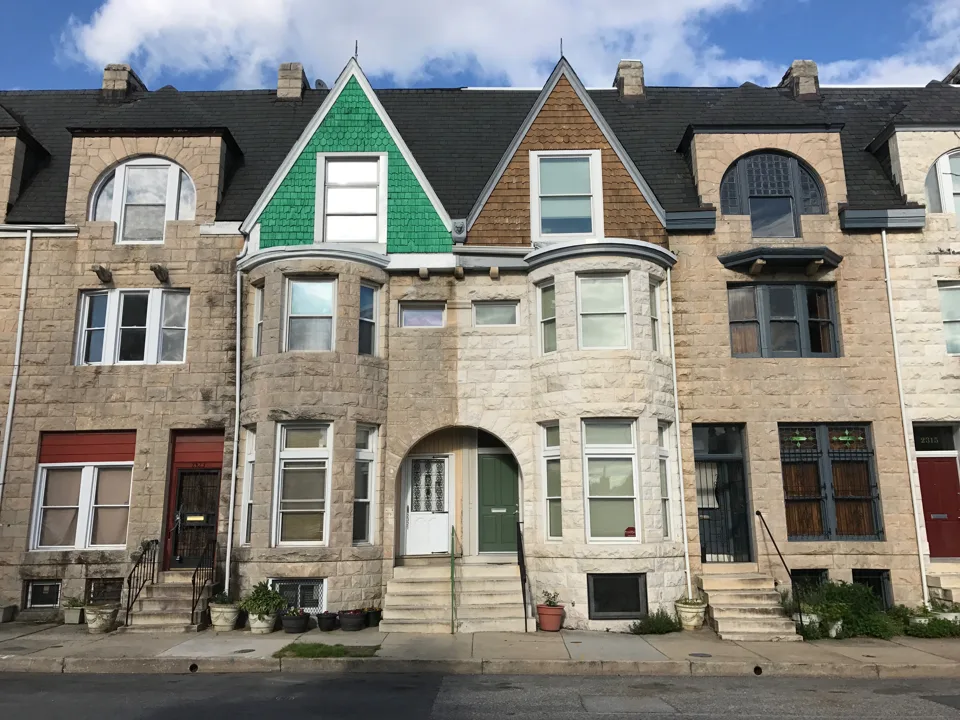
Verify approved units, licensing, leases, repair scope and comparable sale income. Exterior form does not establish legal apartment count, and a large-community average does not price a small conversion.
Open the free Baltimore metro worksheet
Manual fields, local document prompts and the same reconciled example. Entries do not calculate or automatically save; print or save a completed PDF before closing. No account is required.
Source ledger, ownership and refresh
Access and substantive review: October 22, 2026. Observation and publication dates below remain separate. Edition baltimore-2026-10-22-v1; evidence binding maryland-2026-10-19-v1 / maryland-2026-10-19-v1-cap-1. These are editorial snapshots, not live feeds.
- Newmark — Baltimore & Washington multifamily, Q2 2026
Geography / product: Baltimore section pp. 4–7 and 13; Washington statistics excluded. Observation period: Q2 / first half 2026 as labeled. Published: Day not stated in PDF; directory lists 2Q26.
Underlying provider: Newmark; RealPage operations, RCA/RealPage sales. Method / undisclosed fields: Full PDF read; pp. 6 and 13 visually checked. 5.7% average cap, unknown cap-reporting count, weighting, threshold and NOI convention. Proprietary database methodology notes possible historical revisions. Leasing catchments are not legal jurisdictions.
Refresh trigger: Next quarterly edition, sample/method revision or correction. Accessed and reviewed October 22, 2026.
- Baltimore City Code §5-12 — transfer prohibited
Geography / product: Baltimore City only. Observation period: Current code accessed October 22, 2026. Published: Current text cites ordinances 24-403 and 23-275.
Underlying provider: Official city law library. Method / undisclosed fields: New-license application within 60 days; older official transfer PDFs are superseded. Does not alone establish a collection grace period. Cap/NOI/sample/weighting not applicable.
Refresh trigger: Code amendment, agency procedure or ownership change. Accessed and reviewed October 22, 2026.
- Baltimore City Code §5-4 — license required
Geography / product: Baltimore City only. Observation period: Current code accessed October 22, 2026. Published: Page day not stated.
Underlying provider: Official city law library. Method / undisclosed fields: Operating and collection restriction with stated housing-authority exception; address-specific application requires verification. Cap/NOI/sample/weighting not applicable.
Refresh trigger: Code or subject status change. Accessed and reviewed October 22, 2026.
- Baltimore City Code §7-3(a-1) — water lease provisions
Geography / product: Baltimore City residential leases. Observation period: Current code accessed October 22, 2026. Published: Page day not stated.
Underlying provider: Official city law library. Method / undisclosed fields: Written lease and account-record access requirements, not proof of collections or metro-wide law. Cap/NOI/sample/weighting not applicable.
Refresh trigger: Code, lease or billing change. Accessed and reviewed October 22, 2026.
- Baltimore County — multifamily rental housing application
Geography / product: Baltimore County, seven-or-more-unit form. Observation period: Public form accessed October 22, 2026. Published: Revision day not stated.
Underlying provider: Official county department. Method / undisclosed fields: New/renewal/owner-information changes, lead certificates and inspection/self-certification fields. Search-indexed form text checked; direct PDF request blocked. No fee, deadline or inspection eligibility is adopted as a current property fact. Cap/NOI/sample/weighting not applicable.
Refresh trigger: Current application or subject ownership/inspection change. Accessed and reviewed October 22, 2026.
- Maryland SDAT — property record glossary
Geography / product: Maryland parcels; city account identity distinct. Observation period: Current guidance accessed October 22, 2026. Published: Not stated.
Underlying provider: Official state agency. Method / undisclosed fields: Assessment and account definitions, not a numerical tax quote. Cap/NOI/sample/weighting not applicable.
Refresh trigger: Assessment year, parcel or tax bill change. Accessed and reviewed October 22, 2026.
- Census — Maryland counties current/ACS25
Geography / product: Baltimore City 24510, Baltimore County 24005, CBSA 12580. Observation period: January 1, 2025. Published: Not stated.
Underlying provider: U.S. Census TIGERweb. Method / undisclosed fields: Entity identification, not publisher inventory crosswalk. Cap/NOI/sample/weighting not applicable.
Refresh trigger: Delineation or publisher boundary revision. Accessed and reviewed October 22, 2026.
- Marcus & Millichap — Baltimore Q2 report, pp. 1–2
Geography / product: Baltimore metro; named operating submarkets. Observation period: Operations March / sales through Q1 2026. Published: Q2 report; public file July 2026.
Underlying provider: Marcus & Millichap; CoStar, RealPage, RCA; BLS for employment. Method / undisclosed fields: Generally $1m+ sales. Cap subset, weighting and NOI basis undisclosed. Forecast panels are not observations. Actual two-page report rechecked October 22; forecast panels are distinct.
Refresh trigger: Next publisher edition, correction, changed listing or material rule change. Accessed and reviewed October 22, 2026.
Limited facts summarized; proprietary reports and graphics are not redistributed. Recheck the publisher directory on a new edition and review observations, narrative, tool defaults and worksheet together. A build or usability check alone does not advance the evidence date. Send a correction with the source and claim.