Sacramento rent & investment research · CA
Sacramento metro rent report
Buy Sacramento’s lawful in-place income; an improving apartment market does not make a rent reset immediate.
Zillow all-home metro asking-rent index · All bedroom counts · Seasonally adjusted
By RentalCalcs editorial · Reviewed
Live refresh status unavailable; showing the dated source snapshot shipped with this edition.

The investment view
For an occupied older building, prefer a purchase price supported by existing lawful collections and a funded capital plan. A market-rent comparison is useful only after the lease, regulatory coverage, timing and competing effective rents support it. Do not pay the seller today for a vacancy or increase that the business plan cannot lawfully deliver. A newer or already vacant property deserves a separate analysis rather than an assumed exemption.
Sacramento’s Q3 vacancy improved while apartment asking rents rose only 0.8% annually
The broad provider-metro index is $2,269 monthly, +2.0% over one year and +7.1% over three. It covers all rental-home types and bedroom counts in the provider market across Sacramento, Placer, El Dorado and Yolo counties. It is not a lawful increase for an occupied city apartment.
Monthly rent data
| Month | Typical rent |
|---|---|
| September 2021 | $1,981 |
| October 2021 | $1,996 |
| November 2021 | $2,014 |
| December 2021 | $2,029 |
| January 2022 | $2,041 |
| February 2022 | $2,049 |
| March 2022 | $2,058 |
| April 2022 | $2,072 |
| May 2022 | $2,079 |
| June 2022 | $2,088 |
| July 2022 | $2,092 |
| August 2022 | $2,098 |
| September 2022 | $2,096 |
| October 2022 | $2,097 |
| November 2022 | $2,091 |
| December 2022 | $2,090 |
| January 2023 | $2,091 |
| February 2023 | $2,096 |
| March 2023 | $2,105 |
| April 2023 | $2,107 |
| May 2023 | $2,110 |
| June 2023 | $2,110 |
| July 2023 | $2,112 |
| August 2023 | $2,112 |
| September 2023 | $2,119 |
| October 2023 | $2,122 |
| November 2023 | $2,128 |
| December 2023 | $2,134 |
| January 2024 | $2,141 |
| February 2024 | $2,150 |
| March 2024 | $2,155 |
| April 2024 | $2,162 |
| May 2024 | $2,167 |
| June 2024 | $2,170 |
| July 2024 | $2,175 |
| August 2024 | $2,180 |
| September 2024 | $2,184 |
| October 2024 | $2,189 |
| November 2024 | $2,195 |
| December 2024 | $2,196 |
| January 2025 | $2,199 |
| February 2025 | $2,201 |
| March 2025 | $2,207 |
| April 2025 | $2,209 |
| May 2025 | $2,211 |
| June 2025 | $2,213 |
| July 2025 | $2,219 |
| August 2025 | $2,222 |
| September 2025 | $2,225 |
| October 2025 | $2,229 |
| November 2025 | $2,231 |
| December 2025 | $2,237 |
| January 2026 | $2,240 |
| February 2026 | $2,242 |
| March 2026 | $2,243 |
| April 2026 | $2,247 |
| May 2026 | $2,251 |
| June 2026 | $2,258 |
| July 2026 | $2,260 |
| August 2026 | $2,264 |
| September 2026 | $2,269 |
Kidder Mathews’ CoStar-attributed Q3 2026 apartment reading shows 6.1% vacancy, down from 6.5% a year earlier, with $1,807 asking rent and 0.8% annual growth. Quarterly net absorption was 1,023 units against 248 deliveries. That is a more constructive leasing balance for the surveyed apartments; it does not tell an owner how much an existing resident can or will pay.
Distinguish three rents before making an offer: the lawful in-place amount, the effective amount a comparable new lease would collect, and the seller’s proposed stabilized rent. The first supports current debt service. The second tests a future leasing opportunity. The third remains a hypothesis until its legal path, costs and timing are supported.
A hypothetical $300 monthly gap can add $180,480 of unsupported income value
Assumed four-unit rent gap · recurring annual income
This is why a below-market rent roll can be an expensive acquisition even when the asking price looks reasonable per door. Paying for the higher rent upfront transfers realization risk to the buyer. Required repairs and financing begin before the hypothetical additional income arrives.
A genuine, lawful opportunity can still have value. Model the actual permitted increases or supported vacant-unit leasing dates, deduct work and carrying costs, and discount delayed cash flows. Do not use an immediate capitalization of the full gap as a substitute for that schedule.
The city’s 8.6% maximum is a coverage check, not a forecast or universal permission
The City of Sacramento states an 8.6% annual adjustment maximum for its Tenant Protection Program effective July 1, 2026. That is a city-program figure for covered housing. State rules, local rules, exceptions, notices and the particular lease can change the controlling analysis. Do not apply that number to every property in the four-county metro or compound it automatically in a rent forecast.
Before pricing an occupied building, assemble leases, rent-increase notices, tenant payment history, occupancy dates, construction records, ownership/exemption notices and program registration. Have the property’s applicable state and local coverage reviewed. A seller’s statement that an apartment is “exempt” or “ready for market rents” is not the underlying evidence.
The Attorney General’s guidance also describes just-cause protections and exceptions. A proposed renovation is not, by itself, a lawful plan to remove an existing resident or reset the rent. Resolve the actual legal path and any associated obligations before assigning income to a vacant-after-work scenario.
Keep the operating checks separate: the city administers both tenant protections and rental housing inspection. Registration or an inspection record does not establish an exemption from rent rules, nor does regulatory coverage establish that a building is in good physical condition.
Maydestone-era stock and University/65th Street apartments need different lease comparisons
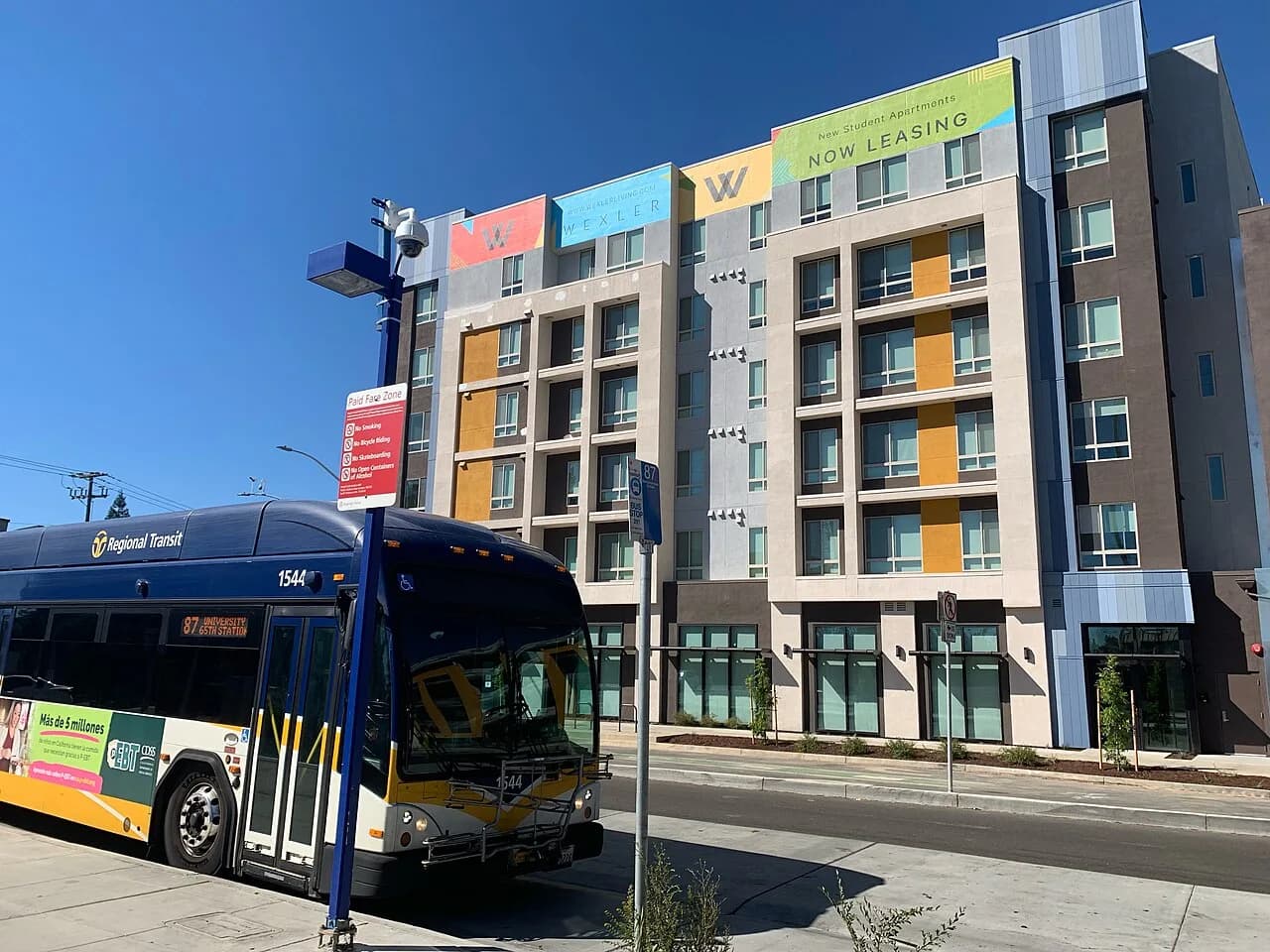

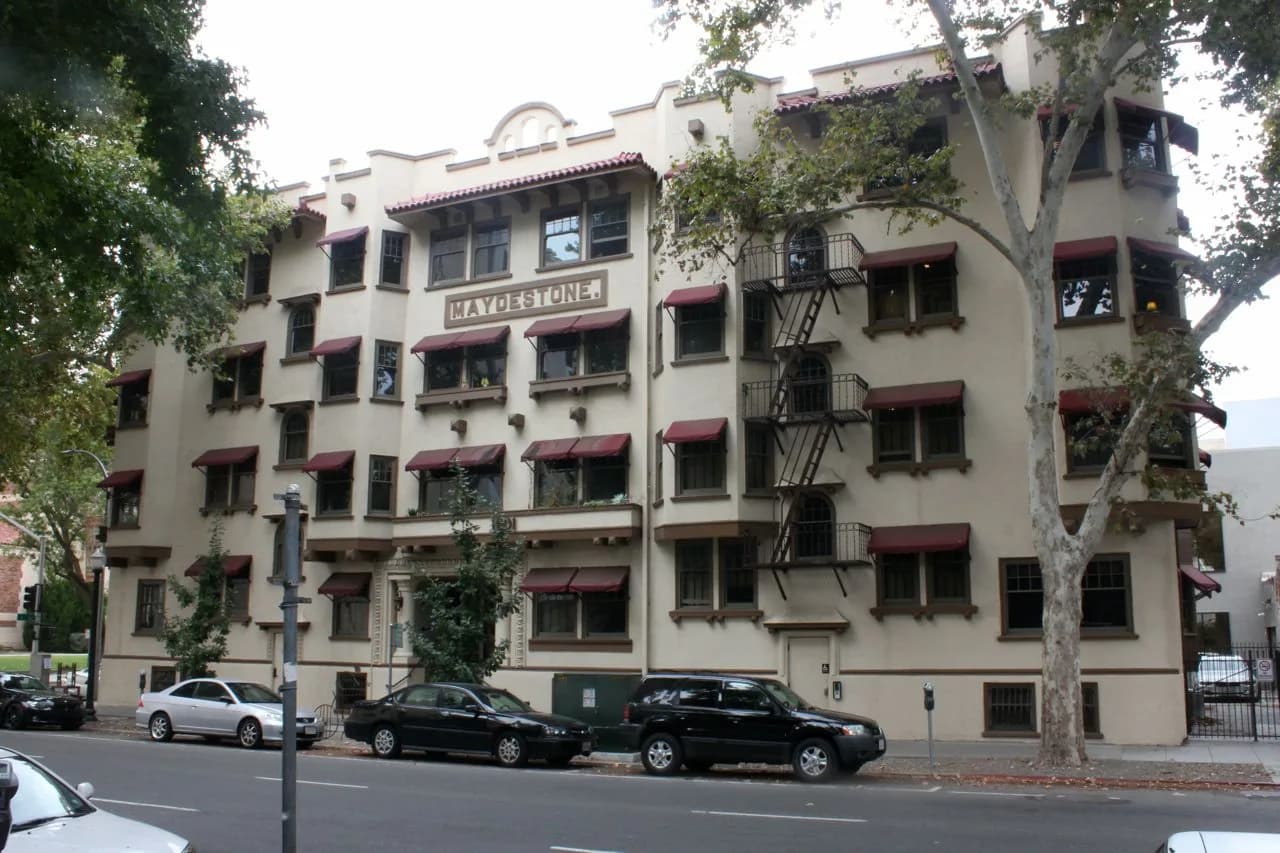
The lead photograph shows an older central-city apartment form; the in-body photograph shows newer student-oriented apartments by University/65th Street station. Neither image determines that building’s legal coverage or current economics. The distinction is useful because a central occupied building, a per-bedroom student lease and a suburban household apartment are different operating propositions.
For older central stock, compare lawful leases, layout, utility responsibility, parking and condition. For a University/65th Street-area plan, compare actual lease terms and whole-unit versus per-bed pricing, then budget concentrated turnover and any included service. A new building’s advertised amount is a weak renovation target when its concession, furnishing or lease structure differs.
For a Roseville, Folsom or other suburban acquisition, build the comp set around the actual home type and trip to work. City of Sacramento rules do not automatically describe those jurisdictions. Use Sacramento ZIP rent comparisons, Sacramento County and Placer County research to screen, then verify property-level leases and requirements.
Fund the occupied hold before assigning a return to cosmetic work
Get a buyer-specific property-tax estimate, an insurance quote for the actual building/use, and the seller’s utility and maintenance records. Do not carry forward a long-held owner’s expense sheet unchanged. Price roof, plumbing, electrical and life-safety work separately from finish upgrades.
For occupied work, identify who remains in place, which systems must stay operating, the lawful access schedule and how disruption changes costs. A capital project may preserve existing income without creating a premium. That spending still belongs in the basis and liquidity plan.
For a vacant unit, obtain written current competing offers and a realistic completion/leasing schedule. Separate one-time incentives from recurring concessions. A single free month is a collection shortfall; permanent value capitalization requires an explicit recurring-income assumption. Do not deduct an incentive twice through both reduced rent and the same loss allowance.
This $650,000 Sacramento four-unit does not justify its price at $1,600 in-place rent
Assume four occupied units at $1,600 monthly, 6% vacancy/collection loss, $40,000 operating expenses, $4,800 annual capital reserves and $50,000 initial repairs. A $650,000 price plus 3% closing costs produces a $719,500 total basis. Financing is assumed at 65% of price, 7% interest and 30-year amortization. These assumptions describe a hypothetical property, not an available investment or loan quote.
Acquisition lab · assumed Sacramento property
Editable assumptions, not an available listing or financing quote. Closing costs are fixed at 3% of purchase price; repairs are paid upfront. No appreciation, tax benefits, refinancing proceeds or rent growth are needed to generate the results.
Edit property assumptions
| Measure | Base | Downside |
|---|---|---|
| Scheduled rent | $76,800 | $72,960 |
| After vacancy / collection loss | $72,192 | $66,394 |
| Net operating income (NOI) | $32,192 | $22,394 |
| Annual loan payments | $33,731 | $33,731 |
| Cash after debt + capital reserve | -$6,339 | -$16,137 |
| Debt coverage (NOI ÷ payments) | 0.95× | 0.66× |
NOI excludes financing and capital reserves. Operating expenses must include taxes, insurance, management, routine maintenance and owner-paid utilities. A reserve reduces spendable cash; it does not make a known roof or sewer replacement disappear. Results describe a stabilized year after initial repairs. Fund renovation downtime and carrying costs separately; they are not estimated here.
| Required yield | Base NOI | Downside NOI |
|---|---|---|
| 6.5% | $432,293 | $285,939 |
| 7.5% | $368,181 | $241,341 |
| 8.5% | $319,155 | $207,237 |
A price below a yield ceiling can still fail debt coverage or require more cash than you have. Check the loan terms, unit-level leases and a contractor’s scope before treating a modeled ceiling as an offer.
Base NOI is $32,192, only about 4.5% of total basis before reserves and debt. At the assumed leverage, cash after debt and reserves is negative. Raising the input to an unsupported $1,900 would disguise the acquisition problem. The starting decision is to lower the price, change the fully funded capital/financing plan or pass—not enter income that the leases and legal review cannot support.
The combined downside cuts rent 5%, increases loss three percentage points and raises operating expenses 10%. An uncertain or delayed lawful increase deserves its own timing case. The stabilized model does not fund construction downtime or carrying costs; reserve separate cash for them. Yield ceilings are investment hurdles, not reported Sacramento cap rates.
Buy verified lawful income; revisit the rent gap only when timing and net collections are supportable
Acquire an occupied building at a supported basis
Require a clean lease and payment reconciliation, reviewed regulatory coverage and a priced essential-capital scope. Treat any future gap realization as a timed upside case. The building should carry through a slower lawful-income path.
Hold and repair productive occupied units
Preserve usable housing and existing collections. A renewal can be worth more than a costly attempted repositioning. Proceed with elective work when a documented incremental benefit pays for work, disruption and carrying costs under the actual rules.
Revisit a vacant or newer property on its own evidence
A supported legal vacancy or verified exemption can change the opportunity, but it does not guarantee market acceptance. Require current executed comparable leases, effective incentives and funded repairs. Pass when the price needs both immediate rent reset and uninterrupted occupancy.
The signals to watch are repeatable effective rents at the actual competitors, executed lawful leases at the subject and a capital/expense budget that survives inspection. For renters, compare the full recurring lease cost and verify the coverage relevant to the address. Extend a buyer’s monthly and debt schedule in the multifamily calculator.
Sources and methodology
Evidence behind this report
- Kidder Mathews Q3 2026 Sacramento apartment research, attributed to CoStar: 6.1% vacancy, $1,807 asking rent, 0.8% annual rent growth, 1,023 quarterly net absorption and 248 quarterly deliveries. Apartment survey population, not all-home ZORI; no transfer of its vacancy rate to an individual house.
- City of Sacramento Tenant Protection Program: 8.6% city-program annual adjustment maximum effective July 1, 2026, annual registration and tenant protections. Actual coverage and controlling state/local rules require unit-specific review; a maximum is not guaranteed achievable rent.
- California Attorney General landlord/tenant guidance: state rent-increase limits, exemptions, notice and just-cause protections; local rules can also apply. Checked October 20, 2026.
- Sacramento Rental Info Hub: Tenant Protection Program and Rental Housing Inspection Program are separate operating checks
- Zillow all-home, all-bedroom, smoothed, seasonally adjusted metro ZORI CSV; observation 2026-09-30; retrieved 2026-10-21T03:09:00.655Z UTC
- Zillow repeat-rent methodology
- Census July 2023 metro delineations
- Zillow county-to-metro crosswalk, retrieved 2026-10-19
Geography and comparable populations
Official July 2023 county membership matches Zillow’s undated county crosswalk. The index retains the provider geography and naming, rather than a reconstructed county average. Official CBSA: 40900; separate Zillow RegionID: 395045. County and city figures are useful local checks but cannot reproduce this metro index.
| County | State | Zillow crosswalk |
|---|---|---|
| El Dorado County | CA | Included |
| Placer County | CA | Included |
| Sacramento County | CA | Included |
| Yolo County | CA | Included |
What the rent index measures
ZORI follows repeat asking-rent changes, weights toward the rental stock and smooths observations. It does not measure every signed lease, concessions, a two-bedroom quote, property income or a voucher payment standard. Broker apartment surveys have their own boundaries and property populations. Their vacancy and effective-rent readings are labeled by period and are never averaged into ZORI.
The headline and historical chart use one validated version. The file contains 740 metro rows; 740 have a latest-month observation. These are market counts, not rental-unit sample sizes; Zillow does not supply underlying unit sample counts here. Missing observations remain missing and prior months may be revised.
Refresh and editorial review
Provider Last-Modified: Fri, 16 Oct 2026 01:56:12 GMT. This page serves the committed last-good snapshot. The shared weekly refresh publishes validated versions atomically and retains the previous version on failure. Changed interpretation is flagged for review; imports do not advance the editorial review date. Local broker studies and photographs retain their own dates.
SHA-256: cf1ac2ab12236da3e05a81d06542e6fb95581704c6e9f375424e73b72ccb444b
Investment judgments are RentalCalcs’ analysis of the stated evidence. Purchase examples are explicitly assumed underwriting cases, not listings, appraisals, financing quotes or observed market cap rates. Report a correction.