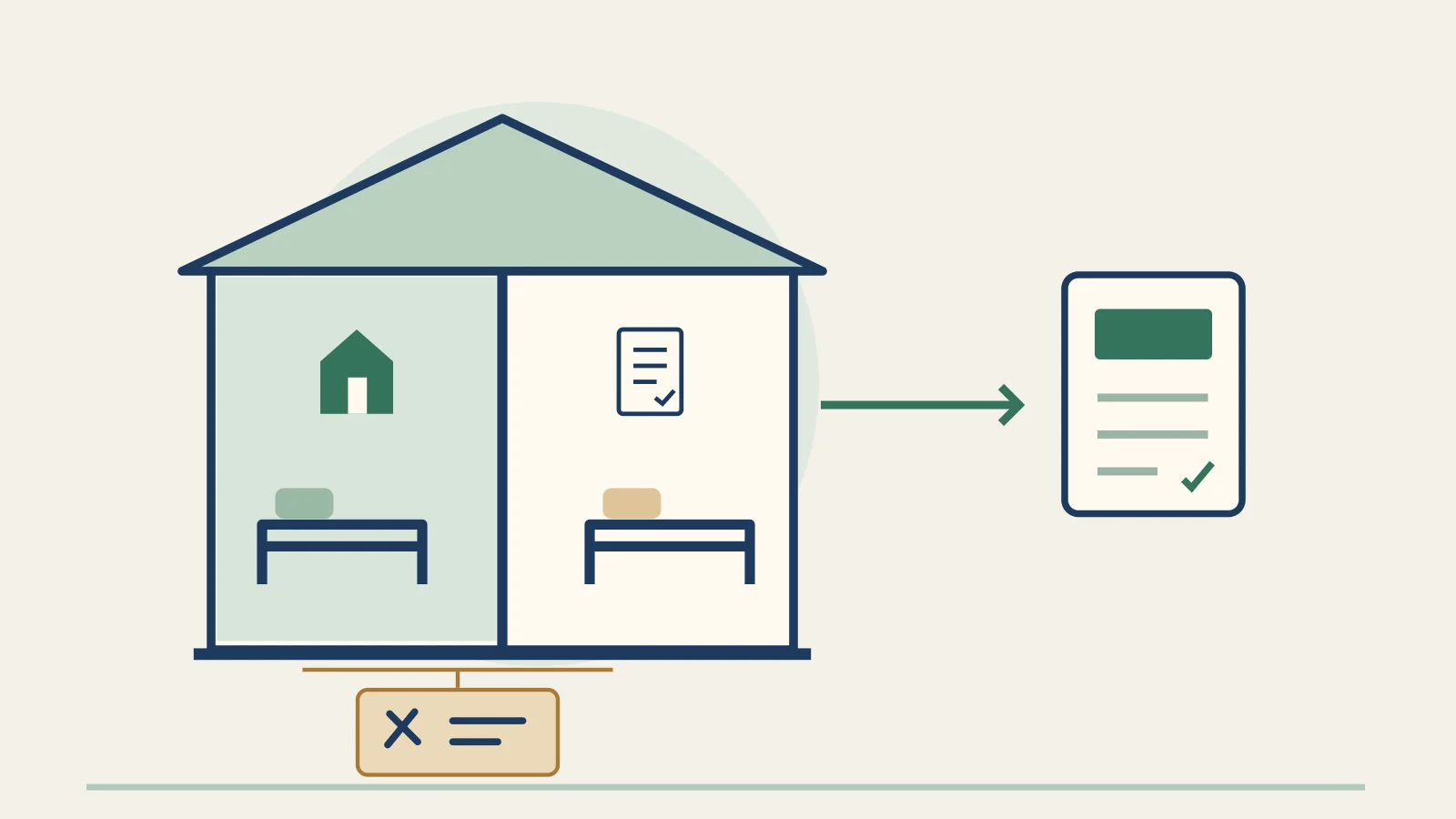
House hacking comes down to three numbers: cash needed to complete the purchase, cash retained afterward, and monthly housing cost after tenant rent and operating allowances. A low down payment can reduce the first number without making the other two manageable.
For the hypothetical $300,000 duplex below, one tenant pays $1,400 a month and the owner's housing cost is about $1,420 after the modeled payment and operating allowances. That example includes a financed upfront mortgage-insurance premium in the loan balance. It does not assume that owner-occupied financing automatically means living for free.
Use the house hack calculator to compare a property with your own loan and expense inputs. Its qualification estimate is a planning screen, not a lender decision. The broader house hacking guide covers the strategy; this article concentrates on the money required and the assumptions that can change the result.
What house hacking actually is
House hacking means occupying part of a property while renting another part to offset housing costs. A duplex owner might rent the second apartment. A single-family owner might rent bedrooms, while a property with a lawful accessory dwelling unit might provide separate living spaces.
These configurations are not interchangeable for financing, zoning or day-to-day management. Confirm that the proposed rental space is lawful and that the lender recognizes the property configuration. Income from an informal room arrangement should not be treated as if it were automatically equivalent to rent from a separately recognized apartment.
Compare the arrangement with the housing you would otherwise pay for. A property leaving you with a $1,400 monthly housing burden can still meet a household objective if a suitable rental alternative costs more. It can also be a poor choice if the required cash, repair exposure and landlord responsibilities exceed what you can comfortably manage.
The owner-occupant financing advantage
On the same $300,000 property used throughout this guide, a 25% down payment is $75,000, a 5% down payment is $15,000 and a 3.5% down payment is $10,500. The arithmetic is straightforward; eligibility for a particular program is not guaranteed by the comparison.
HUD's FHA handbook sets a minimum required investment of at least 3.5% of adjusted value for the applicable program. Our example assumes eligibility and an appraisal that supports the purchase price. Other owner-occupied programs have their own property, borrower and loan-limit conditions. Review the 5% conventional guide or the VA house-hacking guide as relevant, then obtain an actual lender assessment.
Owner-occupied financing requires a genuine plan to use the home as required by the mortgage documents. Do not build a purchase sequence around a promised exception or assume that waiting a year guarantees eligibility for another owner-occupied loan.
Mortgage insurance, financed fees, interest rate and closing expenses can change the result materially. The CFPB Loan Estimate explainer helps identify those items in a lender quote. Compare complete estimates rather than down-payment percentages alone.
The four house hack property types
Duplex
A duplex has one rental unit while you occupy the other. That makes the starting revenue easy to describe, but losing that one tenant can remove all external rent temporarily. Verify utility arrangements, existing lease terms and the condition of both units, including the space you will occupy.
For an occupied building, start with analyzing a duplex with one unit already rented. Use the actual lease during its remaining term. A higher market-rent estimate belongs in a separate future scenario with timing and preparation costs, not in next month's expected receipts.
Triplex and fourplex
More rental units can spread tenant-specific vacancy exposure, but they also add appliances, turnover events and management work. Price the building's condition and operating costs rather than assuming an extra unit always improves the purchase.
FHA's three- and four-unit self-sufficiency test uses appraiser-estimated rent from all units, including the owner-occupied unit, less the greater of the appraiser's vacancy-and-maintenance estimate or 25% of rent. Consequently, describing the test as always exactly 75% of rent can overstate qualifying income. See the current HUD handbook and have the lender calculate the requirement for the property.
For example, $4,800 of total market rent leaves $3,600 with a 25% allowance, but $3,360 with an appraiser-supported 30% allowance. A hypothetical $3,500 payment falls below the first figure and above the second. This is a self-sufficiency illustration, not an overall loan approval. Compare configurations in the duplex-versus-triplex analysis.
Single-family with rented bedrooms
Room rentals can produce income while using shared kitchens and living areas. Budget utilities, furnishing if applicable, cleaning and the possibility that several rooms turn over together. More gross rent does not necessarily mean more usable cash or an arrangement that suits your daily life.
Ask the lender how, if at all, the proposed income can be considered. Keep property qualification separate from your own forecast. A roommate's planned payment is not automatically approved mortgage-qualifying income.
Accessory dwelling unit
An existing ADU may provide more separation, but verify its legal status, allowed use and financing treatment. A construction plan introduces its own budget, completion risk and period without rent. Do not use completed-unit income during months when the space cannot be occupied.
The existing-ADU return example provides a starting framework. Confirm address-specific rules and compare the actual utility and maintenance arrangements before selecting this configuration over a duplex.
The actual math on a representative duplex
How it works · illustrated
The owner occupies one home and a tenant rents the other. The building’s loan and expenses cover both spaces; only the tenant’s payment is rental income.
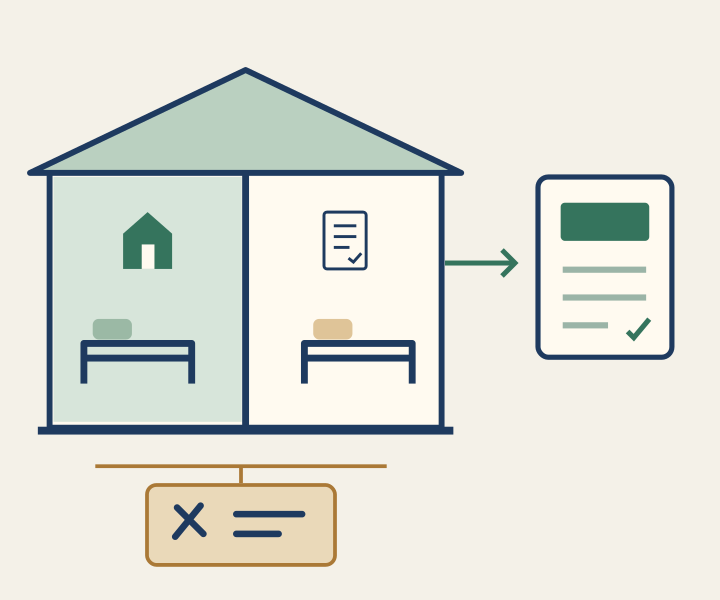
- Rent from the other unit
- $1,400
Scheduled monthly tenant rent. Do not add an imaginary rent payment from yourself.
- Whole-building housing payment
- $2,610
Rounded principal, interest, taxes, property insurance and a mortgage-insurance budget placeholder.
- Owner cost after allowances
- $1,420
$2,610 payment - $1,400 rent + $70 vacancy + $140 building maintenance/replacement allocation.
Hypothetical monthly cash budget, before income tax. Self-managed, no HOA and no separate owner-paid rental utilities. It is not a return on investment or a complete estimate of personal living costs.
Original RentalCalcs illustration · Reviewed October 14, 2026. Conceptual artwork, not a monetary scale. Loan fees and payment components should be reconciled to the lender’s Loan Estimate.
Assume a $300,000 purchase, 3.5% down, a 30-year loan and an illustrative 7% interest rate. The base loan is $289,500. A 1.75% upfront premium is $5,066.25. Under the HUD handbook's whole-dollar rounding rule, financing the premium produces a $294,566 mortgage after rounding down, with the remaining $0.25 paid in cash. Principal and interest are approximately $1,959.75 monthly.
For a simple whole-dollar budget, round that payment to $1,960. Use $300 of monthly property tax, $150 of property insurance and a deliberately separate $200 monthly mortgage-insurance placeholder. Replace that placeholder with the lender's actual premium; it is not a quote of the applicable FHA annual rate. HUD's mortgage-insurance information links the governing premium material.
Preview: 3 of 10 rows
| Monthly planning item | Amount |
|---|---|
| Principal and interest including financed upfront premium | $1,960 |
| Property tax assumption | $300 |
| Property insurance assumption | $150 |
| Mortgage-insurance budget placeholder | $200 |
| Total rounded housing payment | $2,610 |
| Rent from the other unit | -$1,400 |
| Owner housing cost before operating allowances | $1,210 |
| Vacancy allowance, 5% of tenant rent | $70 |
| Maintenance/replacement allocation, 10% of tenant rent | $140 |
| Owner housing cost after these allowances | $1,420 |
The example assumes self-management and no separate association dues or owner-paid rental utilities. Add those costs if they apply. The $140 maintenance/replacement allocation is the whole-building planning amount in this illustration, not an estimate validated by inspection. Inspect the roof, systems and appliances and revise it for their condition. A percentage cannot make an imminent $8,000 replacement disappear.
If comparable alternative housing costs $1,500 monthly, this example leaves only an $80 monthly saving after the stated allowances. Keep equivalent personal utilities and services on the same basis in both options. That comparison excludes transaction costs, opportunity cost and future sale outcomes. The buy-versus-rent calculator can help explore a longer holding period with those inputs.
In an empty-rental month, tenant receipts fall to zero while the $2,610 housing payment remains. A dated vacancy calendar should replace the percentage allowance for that same period to avoid double counting. Test whether wages and retained savings can support the full payment plus preparation costs before relying on the average $1,420 result.
What changes the monthly decision
The worked decision · Monthly dollars
The same $300,000 duplex and $2,610 housing payment. These bars show cash required from the owner under three explicit scenarios, including the stated reserve contribution.
Base planning month$1,420
5% vacancy allowance; no separate turnover event.
$80 less than the assumed $1,500 comparable rental for this month.
Rent 10% lower$1,553
Keep the building reserve at $140; repairs do not become cheaper because rent falls.
$53 more than the assumed $1,500 comparable rental for this month.
One empty month$3,350
Includes a one-time $600 turnover cost. Actual vacancy replaces the percentage allowance.
$1,850 more than the assumed $1,500 comparable rental for this month.
Common scale: $0–$3,500. The dashed marker is the $1,500 rental alternative. The empty month is an event scenario, not a new annual average; it includes $600 of turnover work in addition to the ongoing $140 reserve contribution.
Original RentalCalcs calculations · Reviewed October 14, 2026. Illustrative monthly USD; the rate, rents and costs are assumptions, not market quotes. All cases exclude income taxes, transaction costs, appreciation and principal-paydown benefits. Keep equivalent personal utility costs outside both sides or add them to both. The supporting arithmetic follows.
Open the house-hack decision worksheet| Monthly scenario | Tenant receipts | Vacancy allowance | Building allocation | One-time turnover | Owner cash required |
|---|---|---|---|---|---|
| Base planning month | $1,400 | $70 | $140 | $0 | $1,420 |
| Rent 10% lower | $1,260 | $63 | $140 | $0 | $1,553 |
| One empty month | $0 | $0 | $140 | $600 | $3,350 |
Scroll the table sideways for more columns.
Each row starts with the same $2,610 payment. In the lower-rent case, $2,610 - $1,260 + $63 + $140 = $1,553. The building allocation stays fixed because a weaker rent does not make the roof cheaper. In the empty month, $2,610 + $140 + $600 = $3,350. Do not add the $70 vacancy allowance again when actual lost rent is already modeled.
Relative to a normal $1,420 planning month, the empty month needs $1,930 more cash. That is a timing requirement, not a claim that this event occurs every month. Put the expected lease dates and turnover invoices on a calendar, then decide how much wages and retained cash must cover.
The tax angle most first-timers miss
Keep the rental and personal portions of the property distinguishable in your records. IRS Publication 527 discusses allocating shared expenses, depreciating rental property and converting personal property to rental use. An even duplex may support an even allocation for some shared costs, but use a reasonable method suited to the facts.
An ordinary qualifying repair and a capital improvement do not necessarily have the same treatment. A roof replacement should not simply be listed as an immediately deductible repair because the building contains a rental unit. The rental share of an improvement may need capitalization and depreciation.
For illustration, allocating $120,000 of eligible building basis to the rental side produces about $4,364 annually when divided by 27.5. That is a simplified full-year straight-line illustration, excluding land and ignoring the first-year timing convention. It is not the amount every duplex owner can deduct or immediately use to reduce tax.
The depreciation calculator and rental deduction guide help organize questions and records. Have the actual allocation, placed-in-service date and deduction limitations reviewed for your circumstances. Do not subtract a hoped-for tax benefit from the cash needed to make next month's payment.
If you later rent the formerly occupied unit, document its conversion date and basis separately. Selling a mixed-use property also raises facts beyond this monthly operating example. Preserve records from the initial purchase rather than attempting to reconstruct personal and rental use at sale time.
How much money do you need to house hack a 2-to-4-unit property?
Separate the closing calculation from the amount needed to own the property responsibly afterward. The following $300,000 purchase examples assume closing expenses of 2% to 3%, no credits and no additional cash-paid program fee. They are comparisons, not individualized Loan Estimates.
| Illustrative financing structure | Down payment | Assumed closing expenses | Subtotal before reserves and repairs |
|---|---|---|---|
| FHA with 3.5% down | $10,500 | $6,000 to $9,000 | $16,500 to $19,500 |
| Eligible conventional loan with 5% down | $15,000 | $6,000 to $9,000 | $21,000 to $24,000 |
| Eligible VA loan with 0% down | $0 | $6,000 to $9,000 | $6,000 to $9,000 |
| Investor example with 25% down | $75,000 | $6,000 to $9,000 | $81,000 to $84,000 |
Scroll the table sideways for more columns.
Program fees, prepaid items, financed premiums, credits and earnest money must be reconciled to the actual closing statement. Financing a fee can reduce cash due while increasing the balance and payment. It does not make the fee free. Down-payment and eligibility requirements vary by the loan and property.
Now add an illustrative $15,000 retained reserve and $5,000 preparation budget. The FHA example becomes a $36,500 to $39,500 savings requirement before unrelated moving and personal costs. A buyer with $19,500 might cover the assumed closing subtotal and still have none of this $20,000 operating cushion.
Use a cash schedule listing when inspections, deposits, preparation and the first loan payment must be paid. Count each dollar of savings once. Tenant security deposits do not replace the owner's reserve, and funds spent before closing cannot also be shown as cash retained afterward.
How much should you be making before house hacking?
There is no universal salary that makes house hacking affordable. Loan qualification depends on the lender's permitted income, debts and program rules. Household affordability also includes living expenses and repairs that may not appear in a debt-to-income calculation.
For a transparent illustration only, assume a lender accepts $1,050 monthly of rental income, equal to 75% of the example's $1,400 rent, and uses a 43% total-debt ratio. Those are selected assumptions, not a promise that a lender will use that method or limit. Use the rounded $2,610 housing payment from the worked example.
| Other monthly debt | Total qualifying income needed at 43% | Less assumed rental credit | Required non-rental income |
|---|---|---|---|
| $0 | About $6,070 | $1,050 | About $5,020 monthly |
| $500 | About $7,233 | $1,050 | About $6,183 monthly |
Scroll the table sideways for more columns.
The calculation is total monthly debt divided by 0.43, less the assumed rental credit. Without the credit, the first scenario would require approximately $6,070 of non-rental monthly income under the same hypothetical ratio. A different allowed rental-income method, premium or rate changes the result.
Ask the lender which documentation and rental-income rules apply to your application date and transaction. Then run your own monthly budget including childcare, transportation, savings and the full empty-unit payment. Qualification and a sustainable household budget both need to work.
How many times can you house hack?
Treat every next purchase as a fresh occupancy, financing and liquidity decision. Living in the first home for a year does not automatically authorize another low-down-payment loan. Existing mortgages, program restrictions, rental documentation and required reserves can change eligibility.
The property's move-out case also deserves a new budget. Add supported rent for the unit you leave, but also its preparation costs, management charges and possible vacancy. Keep the next home's down payment separate from the first building's emergency fund.
The same duplex after you move out
At $1,400 rent for each unit, this illustrative fully rented building loses about $303 a month after management and the building allocation. A live-in housing saving is not the same result as positive rental cash flow.
Preview: 3 of 7 rows
| Monthly move-out budget | Amount |
|---|---|
| Scheduled rent, two units at $1,400 | $2,800 |
| Vacancy allowance, 5% | -$140 |
| Rent after vacancy | $2,660 |
| Housing payment held constant for comparison | -$2,610 |
| Whole-building maintenance/replacement allocation | -$140 |
| Management, 8% of rent after vacancy | -$213 |
| Cash after these costs, before income tax | -$303 |
Management uses an invented 8% fee, giving $212.80 before rounding. Without that fee, the same budget is still negative $90. The original $140 building allocation is held constant to isolate this comparison; do not count it once per unit by accident, or assume it is adequate without inspection.
Also allow a separate hypothetical $2,500 to prepare the former owner unit, plus any initial vacancy. That opening cost is not included in the ongoing monthly table. Confirm whether moving out changes the loan obligations, property-tax treatment, insurance or utilities; update the budget with actual terms. The cost of your next home is outside this property's rental cash flow.
Use the single-family calculator for a combined rental scenario where its inputs fit, alongside the house-hack model's exit analysis. A building that reduces your live-in housing expense may still produce thin cash flow once fully rented. Compare that result with the capital and risk you would retain there.
House hacking calculator
The house hack calculator helps compare purchase price, financing, tenant rent and operating allowances. Its outputs are only as reliable as the inputs and the fit between its modeled assumptions and your actual transaction.
Start with three versions: the supported base case, a lower-rent or higher-expense case, and the move-out case with all units rented. Keep a separate cash calendar for the months before tenants pay. The calculator's qualifying estimate helps prepare lender questions; it does not incorporate every rule for every borrower or replace approval.
Reconcile the tool's subtotal with your complete budget
The tool's Housing Cost panel includes the loan payment, taxes, insurance, HOA, your utility share and the owner-occupied share of maintenance and capital reserves. It does not include every rental-side cost in that displayed subtotal. Open See included costs and keep the rental share of reserves, management, turnover and other owner-paid utilities visible in your complete budget.
For a reconciliation using this article's rounded $2,610 payment, assume two equally sized units with $1,400 rent or rental value each. Set the combined repair and capital-reserve assumption to 5% of the $2,800 total rental value: $140 for the building.
The owner's half is $70. After $1,330 tenant rent net of vacancy, the displayed housing-cost subtotal is $1,350. Adding the other $70 of building reserves gives this article's $1,420 budget.
The $70 is a missing budget line, not a second vacancy allowance.
Actual calculator outputs also depend on its mortgage-insurance rate and unrounded payment. Our $200 monthly premium is a planning placeholder; use your lender's amount and reconcile the financed balance before expecting an exact match. This worksheet does not imply that a monthly subtotal or qualification estimate establishes loan approval.
If rent is uncertain, begin with the rent estimate tool, then assemble matched comparable units. If the loan quote changes, update the actual financed balance as well as the rate. This avoids the common error of calculating payments on the base loan while leaving a financed premium out of the budget.
Where to start
Use the house-hack decision worksheet to record the base month, empty month, cash left after opening and move-out case. Fill it locally and print or save it; nothing is submitted or automatically saved.
Choose a property configuration you are willing to live in and manage, obtain a lender estimate and verify the unit rents. Build cash-to-close and post-closing reserve amounts as separate lines. Replace broad percentages with inspection findings, insurance quotes and property-specific tax assumptions where available.
The example in this article works out to roughly $1,420 monthly after its stated allowances, with additional savings required before purchase. Your number may be higher or lower. Save the analysis and revise it as evidence arrives so the offer follows a complete household and property budget.
Get new articles and market updates
Investing guides and market data, straight to your inbox. Unsubscribe anytime.
