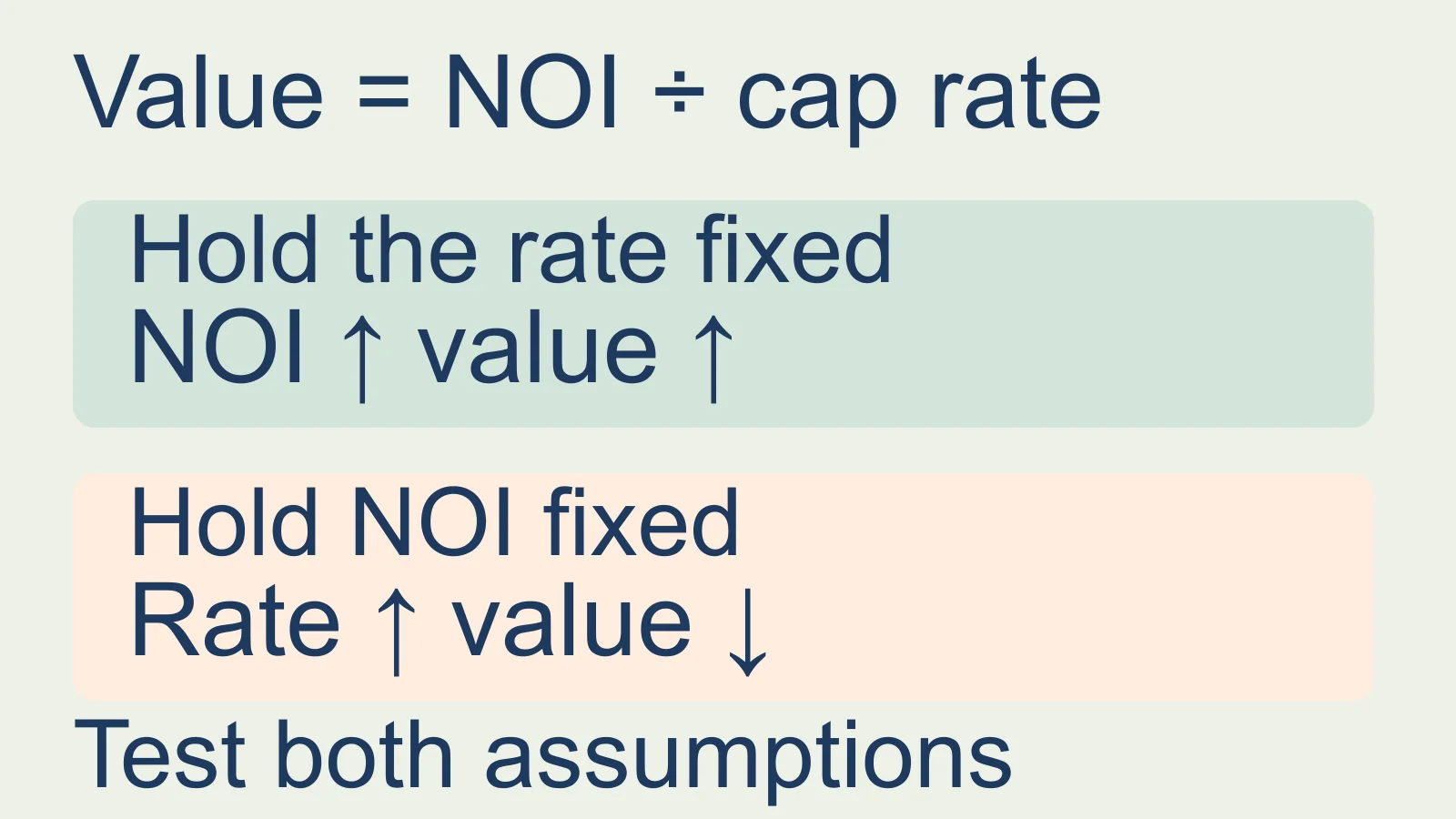
HAP income does not establish a universal Section 8 cap rate, premium or discount. A buyer needs supported rent, a consistent expense definition and evidence for the capitalization rate. In the hypothetical 12-unit comparison below, reducing rent from $1,275 to $1,100 lowers indicated value by about $339,000 at the same 6.5% cap rate. That is sensitivity, not a forecast of voucher rents falling.
Separate three questions: what income is contractually due today, what income is supportable through the holding period, and how an appraiser or lender evaluates the specific property. This guide covers tenant-based Housing Choice Voucher rent. Project-based contracts, affordability restrictions and other subsidized programs require their own contract and valuation analysis.
The decision
Separate the rent evidence from the chosen cap rate
Reconcile current contract rent with actual payment records.
Support the future rent with comparable units and obligations.
Test the price, financing and owner cash as separate outputs.
Does income matter when a duplex is appraised?
Yes. It is incorrect to say income starts mattering only at five units. Fannie Mae's cost and income approach guidance requires an income approach for two- to four-unit properties and rejects appraisals relying solely on that approach. The report must support its rental and sales comparisons and gross rent multiplier.
That is different from taking an owner's NOI, dividing by a chosen cap rate and calling the answer an appraisal. A small-property buyer should reconcile the comparable sales, supported market rent and property condition. A commercial investor may use direct capitalization as one valuation tool, with a rate derived from relevant evidence rather than the tenant's assistance status.
The cap-rate guide explains the metric. The NOI guide supplies the operating definition used here. Neither substitutes for a property-specific appraisal or a lender's written terms.
Which rent belongs in the valuation?
Start with the approved rent roll and collection records, then develop a supported renewal or turnover scenario. A gap between contract rent and a broad market index is not evidence that the unit is over-rented. Match comparable units on condition, location, size, services and utilities before making that judgment.
For ordinary tenant-based HCV, the PHA's rent-reasonableness determination compares the owner rent with comparable unassisted units. 24 CFR 982.507 also allows redetermination during tenancy; the rent is not insulated from review until turnover. A high payment standard alone cannot justify above-comparable rent.
Use the payment-standard guide to distinguish the assistance calculation from owner rent. The FMR guide explains why HUD references and an all-size market index cannot establish a matched-unit premium.
Keep two evidence files: the current lease and payment record, and the comparable rents and obligations supporting the future scenario. The sensitivity matrix below keeps those income assumptions separate from the chosen cap rate.
Temporary income can have value without being permanent
Suppose documented lease income is higher than the supportable future rent. Do not automatically capitalize the difference forever, but do not declare its value zero either. The amount, remaining term, collectibility, expenses and discount rate determine whether the temporary cash flow has meaningful present value.
A discounted cash-flow model can show the current receipts and a different terminal income separately. This article's comparison instead isolates two annual rent assumptions at the same cap rate. It deliberately does not estimate an appraisal, a five-year total return, a sale tax bill or the present value of a particular HAP contract.
How much does a rent assumption change indicated value?
The hypothetical building has 12 units. The $1,275 case illustrates documented current rent; continuing it indefinitely still requires support. The $1,100 case is a conditional future-rent scenario, not an approved reduction or a forecast. Both use the same 5% vacancy/collection allowance, management at 8% of collected rent and $54,000 of other annual operating expenses. Equal loss assumptions avoid attributing an unsupported tenure advantage to voucher tenants.
| Annual line | $1,275 monthly rent per unit | $1,100 monthly rent per unit |
|---|---|---|
| Gross scheduled rent | $183,600 | $158,400 |
| Vacancy and collection loss, 5% | −$9,180 | −$7,920 |
| Effective income | $174,420 | $150,480 |
View all 7 rowsCollapse 7-row table
| Annual line | $1,275 monthly rent per unit | $1,100 monthly rent per unit |
|---|---|---|
| Gross scheduled rent | $183,600 | $158,400 |
| Vacancy and collection loss, 5% | −$9,180 | −$7,920 |
| Effective income | $174,420 | $150,480 |
| Management, 8% of effective income | −$13,954 | −$12,038 |
| Other operating expenses | −$54,000 | −$54,000 |
| NOI before replacement reserves | $106,466 | $84,442 |
| Indicated value at 6.5% | $1,637,945 | $1,299,102 |
If columns extend beyond the screen, scroll inside the table. Focus the table to scroll with arrow keys.
All figures are hypothetical, in annual dollars except monthly per-unit rent. NOI uses full-precision management charges: $106,466.40 and $84,441.60. Direct-capitalization value equals NOI divided by 0.065. The approximately $339,000 difference is caused by the rent assumption, not a measured discount attached to Section 8.
Read across to change only the cap rate; read down to change only the rent and resulting NOI. Each cell is indicated property value, before financing or sale costs.
| Income assumption | 6.5% cap | 7.0% cap | 7.5% cap |
|---|---|---|---|
| Current rent illustration $1,275 / unit / month NOI $106,466.40 | $1,637,945 | $1,520,949 | $1,419,552 |
| Conditional future scenario $1,100 / unit / month NOI $84,441.60 | $1,299,102 | $1,206,309 | $1,125,888 |
Scroll inside the matrix on narrow screens; focus it to use the arrow keys. Values are rounded to whole dollars.
- Rent effect · hold 6.5%
- $338,843 lower value when rent changes to $1,100.
- Rate effect · hold lower NOI
- $173,214 lower value when the cap rate rises from 6.5% to 7.5%.
- Both changes together
- $512,057 below the current-rent / 6.5% indication.
Evidence before price: the current row assumes rent is documented today; continuing that NOI indefinitely still needs support. The $1,100 row is conditional on renewal/turnover rent evidence, not an approved change or forecast. Neither row is an actual property valuation.
Both cases: 12 units, 5% vacancy/collection allowance, 8% management on effective income, $54,000 other expenses; replacement reserves excluded from NOI. All cap rates are illustrative, not observed market rates. Debt, DSCR and cash after reserves belong in the financing section below. Direct capitalization alone is not a complete 2–4-unit appraisal: Fannie Mae approach guidance. Independently checked October 17, 2026.
The expense definition must match the comparable cap-rate evidence. This example keeps replacement reserves below NOI. If a source's capitalization rate uses income after a reserve deduction, restate the income or choose consistent evidence before comparing it. A numerically precise ratio can still be conceptually wrong.
Stress the cap rate as well as the rent
At the lower $84,441.60 NOI, a 6.5% cap implies about $1.299 million, 7.0% implies $1.206 million and 7.5% implies $1.126 million. Those are scenario rates, not current Cleveland or national benchmarks. They show that rent performance and the market's required return can affect an exit independently.
Support the rate with comparable transactions and their income definitions, condition, lease structure and date. A claimed voucher premium needs that evidence just as much as a claimed voucher discount. The market-versus-voucher cash comparison addresses operating differences before a valuation rate is applied.
What does the lender's calculation change?
A loan can fit one income assumption and become tight under another. Lenders may use a different rent, vacancy allowance, reserve or debt-coverage definition from the buyer. Ask for the written worksheet and reconcile the lines; do not assume a quoted minimum DSCR applies to every product or that every residential DSCR loan uses commercial NOI.
Assume a $1,000,000 fully amortizing loan at 7.25% over 30 years. Annual principal and interest are $81,861. This is an illustration, not a lender quote. The buyer separately allocates $12,000 a year to replacement reserves.
| Result | Higher-rent case | Lower-rent case |
|---|---|---|
| NOI before replacement reserves | $106,466 | $84,442 |
| NOI divided by annual debt service | 1.30 | 1.03 |
| Cash after $12,000 reserve and debt | $12,605 | −$9,420 |
If columns extend beyond the screen, scroll inside the table. Focus the table to scroll with arrow keys.
The lower-rent case still covers principal and interest before the reserve, but it does not cover both. A DSCR above 1.00 is therefore not proof of positive owner cash. At an assumed lender requirement of 1.25, the lower NOI supports only about $825,000 of this same-rate debt, before any loan-to-value limit or fees. The lender must confirm its own definition and terms.
For conventional financing, Fannie Mae's general rental-income guidance requires documentation and income likely to continue; it is not a blanket HAP valuation rule. For a separate residential DSCR product, use the DSCR explanation as preparation for the lender conversation, not a universal approval threshold.
What should a buyer verify in the HAP file?
A complete file gives a buyer evidence to evaluate the rent and ongoing obligations. It does not establish a special cap rate by itself. Obtain records through authorized channels and keep household personal information out of marketing materials and model exports.
- Reconcile the lease, HAP contract, payment notices and actual receipts. Identify tenant rent, agency rent, credits, arrears and any amounts owed to the PHA separately.
- Review inspection findings, repair completion and current withholding or abatement notices. A recent deposit does not prove all compliance issues are resolved.
- Confirm the ownership-transfer process. The HUD HAP contract, Part B section 14 requires prior written PHA consent to assignment.
- Review renewal terms, rent-increase procedures, utility responsibilities and applicable local restrictions before projecting changes.
- Check whether a proposed buyer's occupancy or financing plan is compatible with existing leases and legal obligations. Do not assume the property can be delivered vacant.
The occupied-property purchase guide expands that diligence. The loss-underwriting guide separates permanent income loss from cash timing.
Which evidence should change the offer?
A lower supported rent, unresolved repair obligation or tighter financing limit can justify revising an offer. A label on the rent roll cannot do that work on its own. Show the seller the specific assumption, the supporting record and its effect on cash or indicated value.
In this example, accepting $1,275 as permanent instead of testing $1,100 changes the 6.5% indication by roughly $339,000. That is large enough to demand comparable-rent evidence before treating the higher case as the base case. It does not prove that either illustrative rent is achievable for an actual property.
Test income, financing and the exit separately
Use the Section 8 investment analyzer for the rent and operating comparison. The multifamily calculator handles the building-level budget, while the single-family calculator supports smaller rental acquisitions. Reconcile each tool's reserve convention before comparing its NOI or DSCR with the figures here.
Keep current receipts, sustainable future income and sale proceeds as separate outputs. An indicated property value is not cash available to reinvest: selling costs, remaining debt and applicable tax still have to be deducted.
Keep the assumptions with the evidence
Open the free income, cap-rate and financing worksheet. It includes the worked inputs, source links and blank spaces for your own records. Print or download the CSV; no account is required and this worksheet does not save your data.
Open printable worksheetDownload example CSVGet new articles and market updates
Investing guides and market data, straight to your inbox. Unsubscribe anytime.