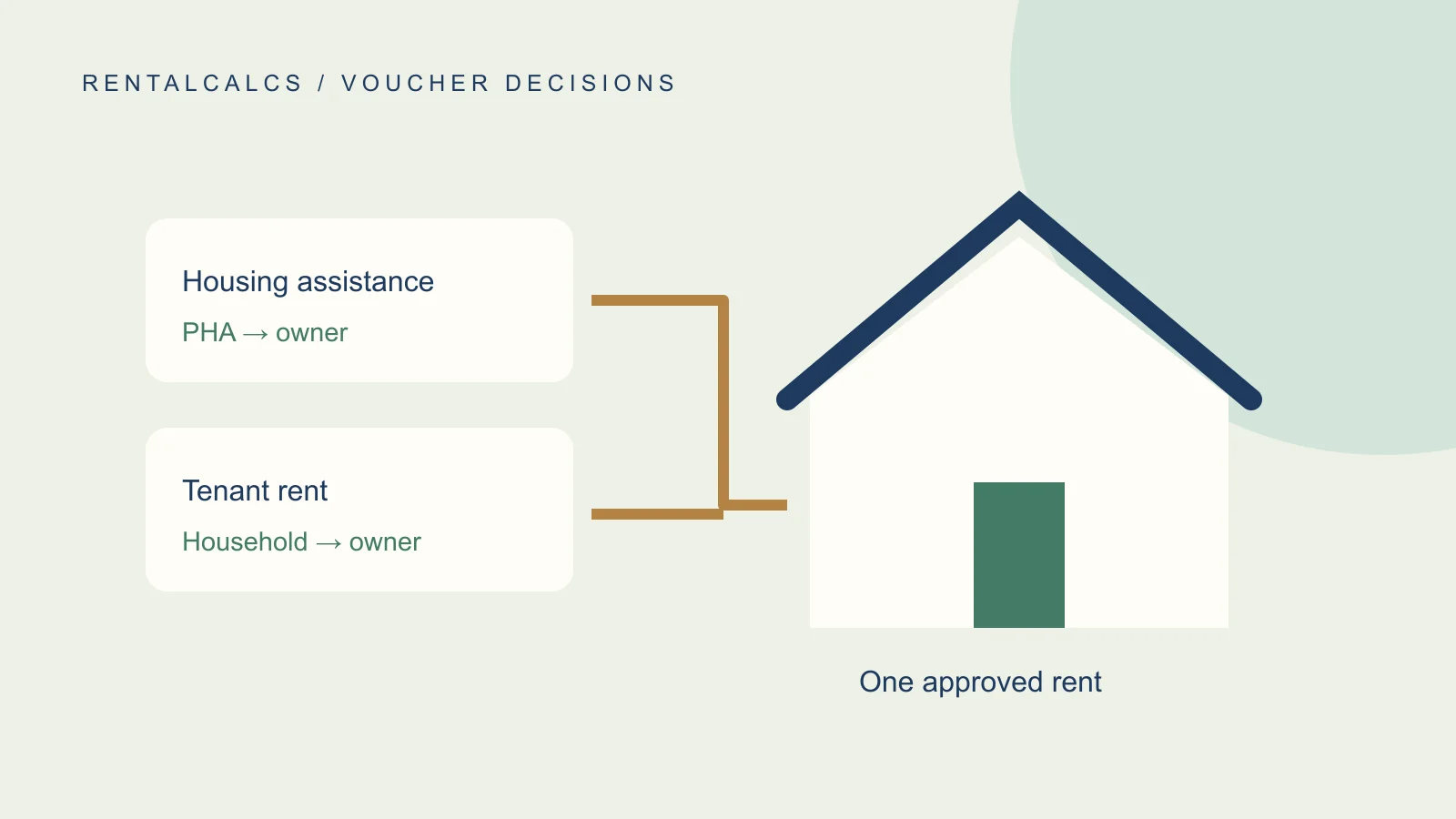
Section 8 can support a rental business when the approved rent covers the property's costs and the owner can manage the program's requirements. It does not turn a weak purchase into a sound investment. A voucher changes who pays the rent; it does not guarantee the entire rent, uninterrupted occupancy or a property's condition.
This guide covers ordinary tenant-based Housing Choice Vouchers in the United States. Project-based assistance, special voucher programs and Moving to Work agency policies can differ. The examples are hypothetical, not a local rent quote or a household eligibility determination.
How the voucher program works
There are two agreements: the tenant's lease with the owner, and the housing assistance payments (HAP) contract between the owner and the public housing agency (PHA). HUD provides the federal framework; the administering PHA handles the local file. Identify that agency for the specific tenancy, especially when a voucher has moved between jurisdictions.
Keep five figures separate:
Preview: 2 of 5 rows
| Figure | What it tells an owner |
|---|---|
| HUD Fair Market Rent or Small Area FMR | A reference used in the subsidy system, not an offer for your property |
| Applicable payment standard | An input to the household's assistance calculation, not the approved contract rent |
| Utility allowance | The PHA's allowance for applicable tenant-paid utilities, not the actual bill |
| Approved rent to owner | The total rent due to the owner under the approved lease |
| HAP and tenant rent | The two portions that together pay the approved rent to owner |
The PHA determines whether the proposed rent is reasonable against comparable unassisted units, considering the property and included services. A high payment standard is not evidence that a lower-quality property deserves a higher rent. See 24 CFR 982.507.
The FMR and approved-rent guide explains the reference-data side in more detail. Start underwriting with supportable contract rent, then verify the household-specific approval.
The process, step by step
Identify the PHA and its packet → submit the proposed tenancy → resolve rent and inspection requirements → execute the approved documents → reconcile payments. Some steps run together; this is a document sequence, not a promised number of days.
Ask for the current request for tenancy approval, owner onboarding instructions, utility schedule and inspection procedure. Agree who will supply each utility and appliance before submitting the proposed lease. Prepare the unit and a repair contact before the inspection is scheduled.
The PHA must approve the tenancy and execute the HAP contract before paying assistance. Limited initial-inspection alternatives exist; do not assume your unit qualifies. Obtain written confirmation of the approved start date and any outstanding conditions before relying on that income. HUD's June 2025 housing search and leasing guide describes the federal process and local options.
A lease-up budget should show actual dates for readiness, submission, inspection, corrections, contract execution and first remittance. An empty month costs rent whether the delay comes from construction, applicant search or paperwork. An occupied month with an amount still owed but unpaid creates a different cash problem.
A worked example: the rent split
Assume an applicable payment standard of $1,500, approved rent to owner of $1,350, a $150 tenant-paid utility allowance and a PHA-determined total tenant payment (TTP) of $420. Gross rent is $1,350 + $150 = $1,500.
For this simplified case, total assistance is the lower of the payment standard and gross rent, minus TTP: $1,500 − $420 = $1,080. The owner receives $1,080 from the PHA and $270 from the tenant. The $150 utility allowance is not additional owner revenue. The family pays its actual utility bills, which may differ from the allowance.
This follows 24 CFR 982.505. The applicable standard can depend on both the voucher size and rented unit size; use the amount confirmed for the household, not simply the largest bedroom figure on a schedule.
TTP is an input here. It is not always 30% of adjusted income: other statutory calculations and minimum-rent rules can control. If assistance exceeds rent to owner, the excess can be a utility reimbursement rather than rent paid to the owner. HUD explains these distinctions in its rent and HAP calculation chapter.
Test the decision
Where does the housing payment go?
Hypothetical example, reviewed October 9, 2026. Simplified unprorated HCV illustration using a PHA-supplied TTP and applicable standard. This does not calculate eligibility, the initial 40% affordability test or local exceptions. Do not enter private household information.
Monthly HAP paid to the owner
$1,080
The approved rent to owner is paid by the owner HAP plus tenant rent.
HAP to owner$1,080
Tenant rent to owner$270
Utility reimbursement$0
Original RentalCalcs calculation. Bars show dollar magnitude; red and a minus sign mean negative cash. Values are rounded for display.
- Gross rent, including allowance
- $1,500
- Total assistance
- $1,080
- HAP to owner
- $1,080
- Tenant rent to owner
- $270
- Utility reimbursement
- $0
- Family share, using allowance
- $420
If total assistance exceeds rent to owner, the remaining assistance is shown as a utility reimbursement. The allowance is not the actual utility bill. Local exceptions, prorated assistance and income calculations are outside this illustration.
Download the rent evidence worksheet (CSV)Free to use without an account. This illustration does not save a deal.
Now raise the proposed contract rent to $1,450, leaving the other inputs fixed. Gross rent becomes $1,600, assistance stays $1,080 and tenant rent rises to $370. The family's rent plus allowance becomes $520. At a hypothetical $1,400 adjusted monthly income, that is about 37%. If rent instead rose to $1,550, the share would be $620, about 44%.
At initial assisted occupancy, when gross rent exceeds the applicable payment standard, the family share cannot exceed 40% of adjusted monthly income. The second increase would fail that test on these assumptions; the first still requires rent reasonableness and every other approval. The interactive illustration does not decide either. See 24 CFR 982.305.
Section 8 versus a market tenant
Compare the same unit, condition, utilities and financing. Hold vacancy, repairs and turnover equal unless local records support a different assumption. Voucher status alone is not a repair budget or a tenancy-length forecast.
For example, an extra $50 of approved monthly rent produces $600 scheduled annual rent. At 5% vacancy/collection loss and 10% management on collections, only $513 remains before any extra administrative cost. A quoted $300 annual coordination fee leaves $213. One additional empty month can erase that margin.
The full voucher-versus-market cash-flow comparison carries those assumptions through taxes, insurance, reserves and debt. It also separates the first lease-up year from a stabilized year.
Pros
A documented payment arrangement. A portion of the rent is paid through the PHA under the HAP contract. That gives the owner a separate remittance trail to reconcile with the household's payments. The split can change; maintain the latest notice in the lease file.
Access to households using rental assistance. Accepting vouchers can make a unit available to applicants who could not otherwise meet its full housing cost. Whether participation is optional depends on applicable law. Use lawful, consistent screening and check local source-of-income protections; a voucher is not evidence of how someone will maintain a home. HUD's fair housing guide describes the federal framework.
A clear reason to document condition and repairs. Inspection notices provide a work list and deadlines. A prepared owner can integrate that work into the same preventive maintenance system used for every unit. Program compliance still does not replace a buyer's building inspection or a long-term capital plan.
Cons
Approval and collection are separate tasks. A published schedule, submitted packet or passed inspection alone does not establish that all payments are ready to flow. Track the actual contract and remittance status.
The PHA share is conditional. Required payments can be delayed, and noncompliance can lead to withholding, abatement or termination. A tenant is not responsible for the PHA's share. Do not solve an agency-payment problem by billing that amount to the household. 24 CFR 982.451 governs the payment relationship.
Inspection rules need a dated local check. As reviewed October 9, 2026, HUD has extended mandatory NSPIRE compliance for HCV, PBV and Moderate Rehabilitation programs through January 31, 2027, with the new compliance date February 1, 2027. Some agencies may transition earlier. The October 2026 affirmative-scoring date for Public Housing and Multifamily Housing is a different program deadline. Confirm your PHA's current standard and correction procedure using HUD's official notices.
Where Section 8 pencils
A useful candidate has supportable rent, a sound building, cash for initial delays and an owner or manager equipped to complete the local process. Start with evidence you can collect: comparable leases, tax and insurance estimates, a condition report, a written management proposal and the PHA packet.
Do not treat a ratio between HUD references and an all-size market index as a matched-property rent premium. Nor does a neighborhood label establish a household's payment behavior. The deal should survive a lower approved rent and a slower start before relying on either optimistic assumption.
For an occupied purchase, use the separate in-place voucher due-diligence guide. Its transfer and payment checks matter more than a new-lease timeline.
Common mistakes
- Counting a utility allowance as rent the owner receives.
- Treating the payment standard as a guaranteed offer or a universal rent ceiling.
- Budgeting the PHA payment twice: once as rent and again as a subsidy bonus.
- Applying lower vacancy or higher repairs solely because of voucher status.
- Using cash reserved for a roof as the same cash that will bridge delayed receipts.
Separate operating expenses from capital reserves and evaluate the complete cash-on-cash denominator. A low purchase price does not remove those obligations.
Bottom line
Before committing, resolve three questions: what rent can this unit support, what must happen before assistance is payable, and how much cash can bridge a difficult start? If the investment only works at the top schedule amount with no interruptions, the underwriting is unfinished.
Use the Section 8 investment analyzer to compare property cash-flow assumptions, then confirm the applicable standard, utility treatment and approved rent with the PHA. The illustration above is free without an account. The broader deal tools have their own analysis, export and saving limits.
Get new articles and market updates
Investing guides and market data, straight to your inbox. Unsubscribe anytime.
