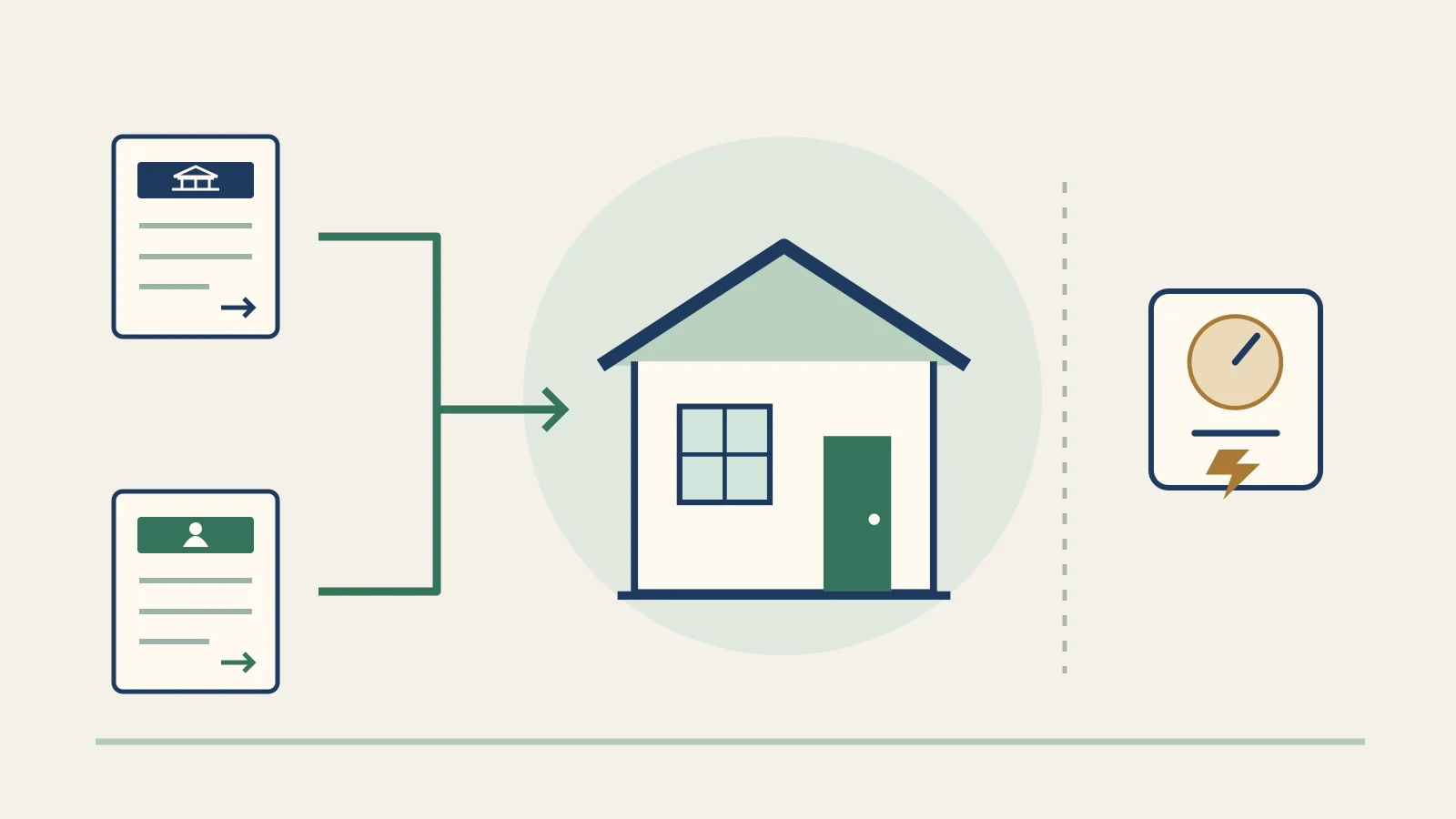
Find the number for your property
From HUD reference to a rent assumption
Use the exact address, bedroom count and administering agency. Keep each source and its effective date with your property analysis.
1. Find the HUD reference
Check whether the result is ZIP-level SAFMR or an area FMR, and read the data year.
Look up FMR by ZIP2. Confirm the local schedule
Get the agency’s adopted payment standard and utility allowance for the unit and voucher size.
Find the housing authority3. Test the property budget
Use total owner rent as revenue. Keep tenant-paid utilities outside owner receipts and allow for vacancy and expenses.
Compare rental cash flow
Before relying on a quoted rent: five checks
- Match the property’s ZIP or HUD rent area; a nearby ZIP can have a different reference.
- Record the HUD fiscal year and any revision date. Federal fiscal years begin October 1; a calendar-year label alone is not enough.
- Check the local schedule’s effective date separately. A new federal FMR does not automatically become the agency’s adopted payment standard.
- Record who pays each utility and obtain the applicable allowance. Gross rent includes that allowance; owner receipts do not automatically include it.
- Confirm rent reasonableness and the household’s applicable affordability test with the authority. A lookup result is not rent approval.
Lookup guidance reviewed October 14, 2026. Sources: HUD’s FMR releases and revisions and HUD’s payment-standard guide. This checklist does not change the data year shown in the live tables below.
Section 8 assistance starts with the lower of gross rent or the applicable payment standard, minus the household contribution. The owner may also receive a tenant payment. A HUD rent figure alone does not establish approved contract rent.
Gross rent combines owner contract rent with the allowance for tenant-paid utilities. Assistance cannot fall below zero. The authority also checks rent reasonableness and, where applicable, the family's initial affordability limit. This guide walks through those calculations with hypothetical monthly figures for a standard tenant-based Housing Choice Voucher, without assistance proration.
Start with the Section 8 analyzer to organize a property's assumptions. Use the administering public housing agency's determination to confirm what applies to the actual unit and family before treating an amount as expected revenue.
What Fair Market Rent Actually Means
HUD's Fair Market Rent is an area-level gross-rent benchmark differentiated by bedroom count. Small Area Fair Market Rent supplies ZIP-level references in covered areas. Neither is a property appraisal or a guarantee that an owner can collect the listed amount.
The source is HUD's Fair Market Rent dataset. Its tables distinguish fiscal year, geography and bedroom count. Check all three. HUD can also revise values, so keep the schedule date rather than relying on an old screenshot without context.
For the owner, the practical task is to assemble a chain of evidence: correct reference area, applicable authority payment schedule, unit-specific utility allowance, proposed rent and approval. A higher reference in a neighboring ZIP is not evidence that your own property qualifies for the same assistance calculation.
How to Find Your Area's Fair Market Rent
Use the rent estimate tool or the city rent-estimate directory to locate relevant reference data. Enter the actual property address or ZIP and the legal bedroom count. Check whether the result is a ZIP Small Area FMR or a county or metropolitan reference.
The live table below compares loaded HUD references for several areas. Its fiscal year is part of the result, not an incidental footnote. The displayed amounts can change as data is refreshed; they remain federal benchmarks rather than adopted local payment standards.
Preview: 2 of 5 rows
| Metro | 2 BR FMR | 3 BR FMR |
|---|---|---|
| Memphis, TN | $1,301 | $1,717 |
| Indianapolis, IN | $1,536 | $1,991 |
| Phoenix, AZ | $1,734 | $2,287 |
| Atlanta, GA | $1,762 | $2,099 |
| Denver, CO | $2,169 | $2,846 |
HUD Fair Market Rents for fiscal year 2027, gross rent including utilities. Source: HUD Fair Market Rents. Values reflect the dataset currently loaded on RentalCalcs; check HUD for subsequent revisions.
Retain the source and lookup date in the property's file. If a housing-authority representative supplies a different number, first reconcile geography, bedroom size and effective date. Those differences are more useful to resolve than choosing whichever figure creates the strongest projected return.
FMR vs. Payment Standards: The Part Most Landlords Miss
Keep these six terms separate when you use a fair market rent calculator or speak with the housing authority. The owner needs a supported contract rent and a payment split; a HUD lookup supplies only the starting reference.
Preview: 3 of 6 rows
| Term | Meaning in the calculation |
|---|---|
| Fair Market Rent (FMR) | HUD's area and bedroom reference for gross rent; not an approval for this unit. |
| Payment standard | The authority's applicable input to the family's subsidy calculation. |
| Owner contract rent | Total rent payable to the owner from authority and tenant payments. |
| Utility allowance | Administrative allowance for tenant-paid utilities, added to owner rent to calculate gross rent. |
| Total tenant payment (TTP) | The household contribution determined under program rules; not always the tenant's payment to the owner. |
| Family share | Gross rent less total assistance; may exceed TTP when gross rent exceeds the payment standard. |
A payment standard is the authority's input to the subsidy calculation. FMR is a reference used in establishing standards. The applicable family standard can depend on both voucher size and actual unit size, so the largest bedroom amount shown in a lookup is not automatically the amount available to the household.
The federal assistance-calculation rule specifies the lower-of-payment-standard-or-gross-rent calculation and the unit-size comparison. For this article's examples, assume the authority has already determined an applicable payment standard of $1,800 and total tenant payment of $600. Those values are invented inputs; $600 is not a universal contribution for voucher households.
Do not substitute 30% of gross wages for total tenant payment. The federal TTP rule compares several measures, including adjusted income, monthly income, certain welfare payments and the applicable minimum rent. Use the authority's determined TTP, rather than trying to establish household eligibility from a landlord worksheet.
Request the authority's applicable payment schedule and utility-allowance calculation before setting an underwriting assumption. The landlord payment-standard walkthrough provides additional background, including dated examples that should not be mistaken for newly adopted rates.
How Section 8 Rent Gets Split
How it works · illustrated
For the hypothetical $1,750 rent, follow who pays the owner and what stays outside the owner’s receipts. All amounts are monthly.
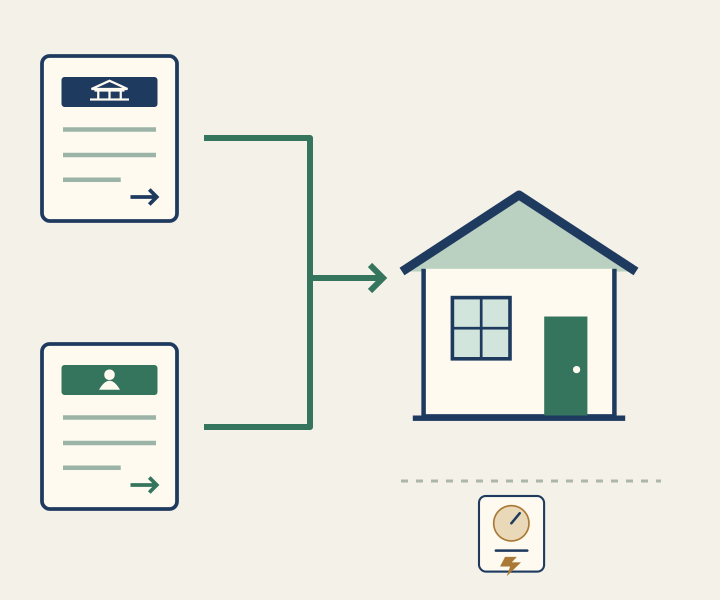
- Authority pays the owner
- $1,200
$1,800 applicable payment standard less $600 total tenant payment.
- Tenant pays the owner
- $550
$1,750 owner rent less the $1,200 assistance payment.
- Tenant utility allowance
- $150
Used to calculate the household’s $700 gross share; it is not additional rent paid to the owner.
The $700 family share is 35% of assumed $2,000 adjusted monthly income. This fits the illustrated initial affordability test but does not establish rent reasonableness or tenancy approval. Actual utility bills can differ from the allowance.
Original RentalCalcs illustration · Reviewed October 14, 2026. Conceptual artwork, not a monetary scale. Based on the federal voucher calculation; these are invented inputs, not a local schedule.
Assume tenant-paid utilities carry a $150 allowance. If proposed contract rent is $1,650, gross rent is $1,800. With the illustrative $1,800 payment standard and $600 total tenant payment, assistance is $1,200. In this example that assistance goes to the owner, and the tenant pays the remaining $450 of owner rent. The family's $600 gross share consists of $450 to the owner plus the $150 allowance.
The utility allowance is an administrative estimate used in the calculation. It is not necessarily the tenant's exact monthly utility bill. Likewise, the housing-assistance payment is only one part of the owner's rent receipts; it should not be recorded as the entire rent if a tenant portion is also due.
When assistance is greater than owner rent
A separate low-rent example makes this exception clearer. Assume $600 owner rent, a $200 utility allowance, a $900 payment standard and $100 TTP. Gross rent is $800, so total assistance is $700: the lower of $900 or $800, less $100.
Under the owner-payment and utility-reimbursement rule, only $600 goes to the owner. The remaining $100 is a utility reimbursement payable to the family or utility supplier under the authority's process. Tenant rent to the owner is $0, not negative $100.
The family's calculated gross share is $100: $800 gross rent less $700 assistance. On the allowance basis, that is a $200 utility cost less the $100 reimbursement. The actual bill may differ. This is why a worksheet needs separate lines for total assistance, assistance paid to the owner and utility reimbursement.
What Happens If You Price Above the Payment Standard
Owner rent can sometimes exceed the amount obtained by subtracting utilities from the payment standard. The family bears an additional share while assistance stops increasing, subject to applicable approval rules. Calling payment standard minus utilities a universal legal rent ceiling is therefore incorrect.
At initial occupancy, when gross rent exceeds the payment standard, the federal affordability rule generally limits the family's share to 40% of adjusted monthly income. Use the authority's adjusted income and family-share calculation, not gross wages guessed from a rental application.
In our hypothetical case, adjusted monthly income is $2,000. A $700 family share is 35%; an $850 share is 42.5%. The first fits the illustrated affordability test, while the second fails it. Neither result alone establishes approval because rent reasonableness and the remaining tenancy requirements still matter.
Rent Reasonableness: The Second Approval Hurdle
An amount that fits the subsidy and family affordability calculations can still exceed reasonable rent for the unit. The rent-reasonableness rule calls for comparison with comparable unassisted units and consideration of property features, services and utilities. The owner's comparable unassisted units also matter.
Prepare evidence that matches the subject property: bedroom count, location, condition, amenities and included utilities. A renovated detached home with a garage is not directly interchangeable with an older apartment simply because both have two bedrooms. Explain material differences rather than assembling only the highest advertised rents you can find.
Keep owner rent and utility responsibility together in the comparison. If one listing includes heat and another makes the tenant responsible, their face rents do not represent the same housing package. This is also why a countywide rent index cannot prove that a particular requested contract rent is reasonable.
Small Area Fair Market Rents: A Newer Wrinkle
ZIP-level references can differ substantially inside the same broad metropolitan market. The Small Area FMR guide explains how that changes the research process. Confirm that the applicable authority uses the reference and schedule you have located; a ZIP lookup cannot resolve every portability or household-specific question.
Use the Section 8 rent-comparison pages for screening, with attention to their data basis. A difference between a bedroom-specific HUD reference and an all-size market-rent index is not a matched voucher premium. It identifies a question worth investigating, not a promised income advantage.
Fiscal-year rollover also needs care. A newly loaded HUD year and an authority's effective payment-standard date can differ. Record both dates so your file does not silently treat a federal update as a completed local rent approval.
A Complete Rent Calculation Example
Hold the hypothetical payment standard at $1,800, utility allowance at $150, total tenant payment at $600 and adjusted monthly income at $2,000. Change only requested owner contract rent:
The worked decision · Monthly dollars
Hold the payment standard at $1,800, utility allowance at $150 and total tenant payment at $600. Each bar shows gross rent: the two owner payments plus the utility allowance.
Left to right: authority to owner, tenant to owner, then utility allowance. Exact amounts below make color optional.
Owner rent $1,500$1,650 gross
$1,050 authority + $450 tenant = $1,500 to owner. Add $150 utility allowance for gross rent.
Family share: $600 (30%). Still requires rent reasonableness and tenancy approval.
Owner rent $1,650$1,800 gross
$1,200 authority + $450 tenant = $1,650 to owner. Add $150 utility allowance for gross rent.
Family share: $600 (30%). Still requires rent reasonableness and tenancy approval.
Owner rent $1,750$1,900 gross
$1,200 authority + $550 tenant = $1,750 to owner. Add $150 utility allowance for gross rent.
Family share: $700 (35%). Still requires rent reasonableness and tenancy approval.
Owner rent $1,900$2,050 gross
$1,200 authority + $700 tenant = $1,900 to owner. Add $150 utility allowance for gross rent.
Family share: $850 (42.5%). Fails the illustrated initial affordability limit.
Every bar uses the same $0–$2,050 scale. Unfilled space is unused scale, not a payment. Family-share percentages use $2,000 adjusted monthly income. The utility allowance is an estimate of household costs, not an owner receipt or necessarily the actual bill.
Original RentalCalcs calculations · Reviewed October 14, 2026. Hypothetical standard tenant-based voucher example, without assistance proration. Sources: 24 CFR 982.505 and the initial affordability rule. The exact supporting table follows.
Open the rent-split evidence worksheet| Requested owner rent | Gross rent with utilities | Assistance | Tenant rent to owner | Family gross share |
|---|---|---|---|---|
| $1,500 | $1,650 | $1,050 | $450 | $600 |
| $1,650 | $1,800 | $1,200 | $450 | $600 |
| $1,750 | $1,900 | $1,200 | $550 | $700 |
| $1,900 | $2,050 | $1,200 | $700 | $850 |
Scroll the table sideways for more columns.
At $1,500 owner rent, assistance is $1,650 minus $600, or $1,050. Increasing owner rent to $1,650 increases assistance by $150 because gross rent has not yet exceeded the payment standard. Above that point, assistance stays at $1,200 and the family absorbs the additional amount.
The $1,750 row produces a $700 family gross share, or 35% of the assumed adjusted income. The $1,900 row produces 42.5% and fails the illustrated initial affordability limit. The first three rows still need the authority's rent-reasonableness and tenancy approval; they are not approved quotes.
For underwriting, enter the total approved owner rent as property revenue and keep the assistance and tenant portions visible as separate collection sources. Do not add the $150 utility allowance to owner revenue when the tenant is responsible for those utilities. It is already included only for the gross-rent calculation.
Common Mistakes When Calculating Section 8 Rent
The most consequential mistakes are mixing definitions: treating FMR as contract rent, treating the payment standard as the assistance payment, or counting the tenant utility allowance as money paid to the owner. The worked table provides a way to catch each error because owner receipts and family costs reconcile separately.
Another mistake is treating the rent determination as the entire investment analysis. An approved rent still needs operating costs, debt service, repair reserves and realistic timing. The Section 8 underwriting guide covers those property-level assumptions. Confirm the current inspection and tenancy-start process with the authority rather than assuming every approved application produces a payment immediately.
Finally, do not apply a single family's calculated split to all future tenants. Household circumstances, utility allowances and applicable payment standards can change. Keep the approved documents with the tenancy and update the analysis when the actual inputs change.
When Section 8 Makes Financial Sense
Evaluate the property's complete expected cash flow. Compare supported owner rent, utility responsibility, preparation costs, leasing timeline and ongoing management requirements. A larger assistance benchmark does not automatically compensate for an expensive roof, insurance increase or prolonged vacancy.
Use the voucher-versus-market comparison to keep scenario assumptions explicit. Do not infer tenant reliability from whether assistance is involved. Evaluate the tenancy through the applicable lawful screening and program process, and budget for the actual obligations attached to the property.
The single-family calculator can test the approved owner-rent scenario alongside a supported market-rent scenario. Save both with their source dates so changes to rent, taxes or financing can be traced to the input that changed.
Average Section 8 Voucher Amount in 2026
There is no single national voucher amount that establishes what an owner can receive. Geography, bedroom size, the authority's schedule and household circumstances affect the calculation. The live references below answer the narrower question of what HUD benchmark is currently loaded for each listed metro.
Preview: 2 of 15 rows
| Metro | 1 BR FMR | 2 BR FMR | 3 BR FMR |
|---|---|---|---|
| New York, NY | $2,729 | $2,971 | $3,760 |
| Los Angeles, CA | $2,402 | $2,964 | $3,760 |
| San Francisco, CA | $3,003 | $3,697 | $4,832 |
| Boston, MA | $2,518 | $3,008 | $3,584 |
| Seattle-Bellevue, WA | $2,180 | $2,549 | $3,324 |
| Miami, FL | $2,121 | $2,564 | $3,277 |
| Dallas, TX | $1,536 | $1,807 | $2,275 |
| Chicago, IL | $1,780 | $2,011 | $2,586 |
| Philadelphia, PA | $1,558 | $1,860 | $2,216 |
| Houston, TX | $1,261 | $1,497 | $2,017 |
| Charlotte, NC | $1,640 | $1,785 | $2,179 |
| Columbus, OH | $1,346 | $1,602 | $1,909 |
| Kansas City, MO-KS | $1,366 | $1,546 | $2,020 |
| Detroit, MI | $1,167 | $1,459 | $1,777 |
| Cleveland, OH | $1,050 | $1,274 | $1,628 |
Scroll the table sideways for more columns.
HUD Fair Market Rents for fiscal year 2027, gross rent including utilities. Source: HUD Fair Market Rents. Values reflect the dataset currently loaded on RentalCalcs; check HUD for subsequent revisions.
Read the displayed fiscal year. This section retains its original 2026 search question, but the live table may show a later loaded year. Neither averaging these metros nor multiplying their references by a generic percentage produces a household's housing-assistance payment.
How Much Will HUD Pay for a 3 Bedroom House?
Start with the property's three-bedroom reference, then confirm the household's applicable payment standard with the authority. The actual assistance may reflect a smaller voucher size, the unit's gross rent and the family's required contribution. The owner can also receive a tenant portion, so assistance alone is not the same as total owner rent.
For example, suppose the applicable two-bedroom standard is $1,800 and the three-bedroom standard is $2,100. A family whose voucher size is two bedrooms rents a three-bedroom unit. In the ordinary unit-size comparison, the lower $1,800 standard applies. At $1,750 owner rent, $150 utilities and $600 TTP, assistance is still $1,200, not $1,500. These are invented schedule amounts; the authority must determine the family's applicable standard.
Use the same calculation sequence as the worked table with the confirmed three-bedroom inputs. Keep bedroom eligibility and utility responsibility visible. If an advertised three-bedroom layout has an uncertain legal or inspection status, resolve that before building a purchase decision around the higher bedroom figure.
For a local example with program-specific rules, the San Diego rent report connects SDHC's ZIP standard, the household determination and a separate owner budget. Its utility guidance explains why a general federal example cannot replace the agency's written calculation.
Running Your Section 8 Numbers
Use the rent-split evidence worksheet to record the sources and reconcile each payment. It can be filled locally and printed; it does not submit information or calculate eligibility. Record confirmed figures without household names, Social Security numbers or income documents.
Gather the address, bedroom count, proposed owner rent, utility responsibilities, current authority schedule and its effective date. Ask the authority to confirm the family-specific contribution, affordability and rent-reasonableness results. Then place approved owner rent into a complete property budget.
The Section 8 analyzer helps organize that workflow and compare investment assumptions. Save the analysis with the supporting determination and a reserve plan. The useful output is a rent calculation you can reconcile to the tenancy documents and a property budget that can withstand a delay, not a single attractive HUD number.
Get new articles and market updates
Investing guides and market data, straight to your inbox. Unsubscribe anytime.
